
SunGold
Why a 48 Volt Lithium Battery Is the Best Choice for Solar Systems
Why a 48 Volt Lithium Battery Is the Best Choice for Solar Systems
The 48 volt lithium battery has become the standard energy storage architecture for residential and small commercial solar systems, and the reasons are both technical and practical. At 48V nominal, the system operates at lower current than equivalent 12V or 24V installations for the same power output — reducing cable sizing, minimising resistive losses, and improving overall round-trip efficiency. Paired with LiFePO4 (Lithium Iron Phosphate) cell chemistry, the result is a battery bank that delivers more usable energy per cycle, lasts longer, and requires less maintenance than any lead-acid alternative at equivalent nominal capacity.
Table of Contents
- Why 48V Is the Right Voltage for a Solar Battery System
- LiFePO4 Chemistry — What Makes It the Right Choice
- 48 Volt Lithium Battery for Solar — Usable Capacity vs Lead-Acid
- Server Rack Batteries — Why the Format Matters
- 48V Lithium Ion Battery 100Ah and 200Ah — Sizing the Bank
- Long-Term Value — ROI Across the Battery’s Service Life
- Integration With Modern Solar Inverters
- Frequently Asked Questions
Why 48V Is the Right Voltage for a Solar Battery System
The physics of DC electrical systems makes voltage selection directly consequential for system efficiency and component sizing. Power equals voltage multiplied by current — for the same power output, doubling the voltage halves the current. Lower current means smaller cable cross-sections, lower resistive losses in the wiring, and reduced stress on the battery terminals and connection hardware.
A 10kW load at 12V draws 833A continuously — a current that requires extremely heavy copper cabling and places severe stress on terminal connections. The same 10kW load at 48V draws 208A — manageable with standard 2/0 AWG or 4/0 AWG copper cabling in most residential installations. At 48V, the system operates within the range where quality MPPT charge controllers, inverters, and battery management systems are readily available and competitively priced.
The transition from 12V and 24V systems to 48V as the residential off-grid standard reflects this physics — larger battery banks and higher inverter outputs simply require the lower current that 48V provides to remain safe and practical.
LiFePO4 Chemistry — What Makes It the Right Choice
LiFePO4 (Lithium Iron Phosphate) is the lithium-ion chemistry that best suits stationary solar energy storage applications. It is not the highest energy density lithium chemistry available — NMC and NCA cells pack more energy per kilogram — but energy density is not the binding constraint in a stationary installation where weight and volume are not the primary limits.
What LiFePO4 offers that other lithium chemistries and lead-acid alternatives cannot match at this application:
- Thermal stability. The iron-phosphate bond in LiFePO4 cells requires substantially more energy to break than the oxide bonds in NMC and NCA cells. This makes thermal runaway — the uncontrolled self-heating that causes lithium battery fires — significantly harder to initiate in LiFePO4 cells under charging, discharging, and fault conditions.
- Cycle life. LiFePO4 cells routinely deliver 4,000–7,000 cycles at 80% depth of discharge. At one full cycle per day, the battery reaches end-of-rated-life after 11–19 years — covering the full service life of the solar system it is paired with.
- Flat discharge curve. A LiFePO4 cell maintains nearly constant output voltage from 100% to approximately 20% state of charge, then drops sharply. This flat curve means the inverter and all connected loads receive consistent voltage throughout the discharge cycle, rather than the progressive voltage sag that lead-acid cells produce.
- Maintenance-free operation. No water refills, no equalisation charges, no terminal corrosion from electrolyte vapour — a LiFePO4 battery bank requires no routine maintenance beyond monitoring state of charge and cycle count.
48 Volt Lithium Battery for Solar — Usable Capacity vs Lead-Acid
The comparison between a 48 volt lithium battery and a lead-acid bank at equivalent nominal capacity is frequently misunderstood, because nominal capacity does not equal usable capacity in either chemistry.
A 48V 100Ah LiFePO4 battery holds 5.12kWh of energy at nominal voltage. At 80% depth of discharge — the standard daily cycling limit for maximising cycle life — 4.1kWh is accessible per cycle. Lead-acid batteries at comparable 48V 100Ah nominal capacity should only be discharged to 50% depth of discharge for adequate cycle life — delivering 2.56kWh of usable energy per cycle.
The LiFePO4 battery delivers 60% more usable energy from the same nominal capacity — meaning a homeowner needs 60% fewer lithium battery units to achieve the same daily energy budget as lead-acid. This directly offsets the higher per-kWh cost of lithium compared to lead-acid when evaluated on a cost-per-usable-kWh basis rather than cost-per-nominal-kWh.
Over a 15-year system life, the equation tilts further toward LiFePO4: one set of lithium batteries covers the full period. A lead-acid bank cycling daily at 50% DOD typically requires replacement every 3–5 years — three to five replacement sets over 15 years, at costs that accumulate well beyond the initial lithium investment.
Server Rack Batteries — Why the Format Matters
Server rack batteries — 3U rack-mounted 48V 100Ah LiFePO4 units — have become the dominant format for residential and small commercial 48V solar storage because the form factor solves several installation and management challenges simultaneously.
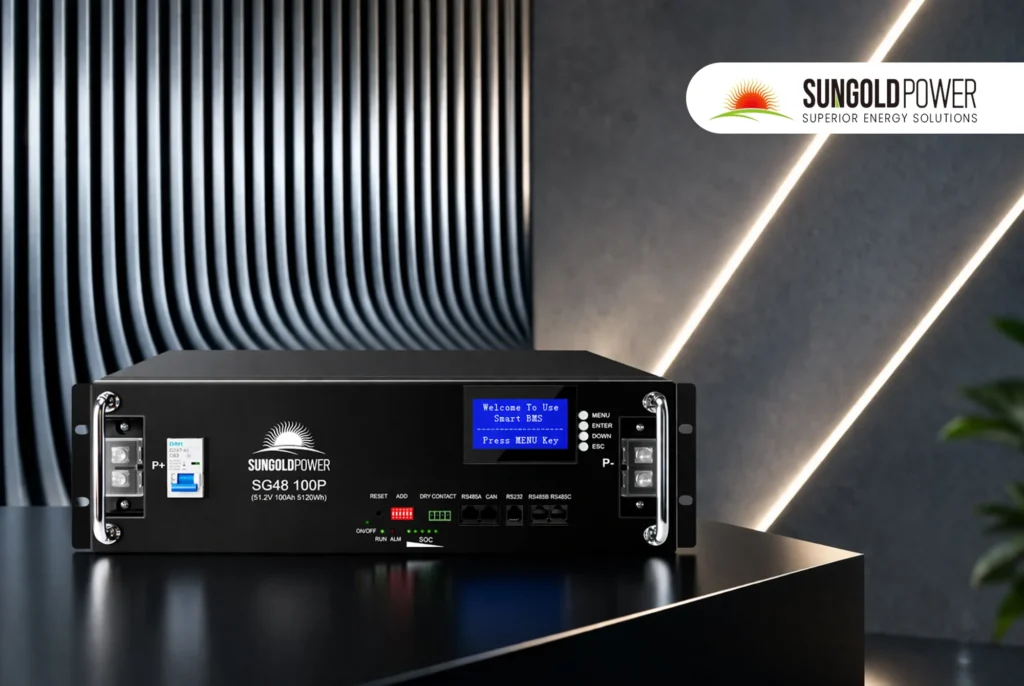
Each server rack unit is a self-contained module with its own BMS, its own LCD display, and its own communication ports (CAN Bus, RS485, RS232). Up to 32 units can be connected in parallel, scaling total capacity from 5.12kWh to 163.84kWh without changing the system architecture. The modular design means the battery bank can grow with the property’s energy requirements without replacing existing units.
The rack format also simplifies installation management. All units in a rack installation face the same direction, connect to the same busbar, and can be individually monitored through the BMS communication link. A fault in one unit shows up on that unit’s LCD and BMS communication output — isolating the problem without affecting the remaining units in the bank.
A 48v lithium ion battery in server rack format is also compatible with a wide range of inverters through standard BMS communication protocols — the SunGoldPower SG48100P and SGH48100T server rack units communicate with Growatt, Deye, Sol-Ark, Victron Energy, Schneider, SMA, and most other quality residential hybrid and off-grid inverters via CAN or RS485.
48V Lithium Ion Battery 100Ah and 200Ah — Sizing the Bank
The two most common server rack lithium battery capacities — 100Ah (5.12kWh) and 200Ah (10.24kWh) — address different system scale requirements.
A 100Ah unit at 5.12kWh is the appropriate building block for systems being assembled incrementally or where the initial system is modest in scale — a cabin, an RV installation, or a household starting with 10kWh–15kWh of total storage. Four units provide 20.48kWh, eight units provide 40.96kWh — both reasonable residential off-grid storage scales.
A 200Ah unit at 10.24kWh is appropriate when the battery bank target is 20kWh or more and fewer total units are preferred. Two 200Ah units achieve the same 20.48kWh as four 100Ah units, with fewer parallel connections, simpler busbar wiring, and lower total BMS communication complexity.
For a 48v lithium ion battery 200ah bank of four units — 40.96kWh nominal — the accessible daily energy at 80% DOD is 32.77kWh: enough for two full days of average US household consumption from storage alone, or one day’s consumption with substantial reserve for a larger household.
A 100ah 48v lithium battery bank of four units provides 20.48kWh nominal — 16.38kWh usable — sufficient for overnight coverage of most residential loads plus a partial reserve into the next morning.
Long-Term Value — ROI Across the Battery’s Service Life
The return on investment of a 48 volt lithium battery system over 15 years is driven by three factors: the energy value of what the battery enables the system to produce and use, the cost of what it replaces (grid electricity or generator fuel), and the replacement cost avoided compared to lead-acid alternatives.
For a household eliminating 15kWh per day of grid electricity at $0.15/kWh, the annual electricity saving is approximately $820. Over 15 years, that is $12,300 of avoided electricity cost — typically exceeding the cost of the battery bank in a well-sized residential system. In markets with higher electricity rates, the payback period is shorter.
The avoidance of lead-acid replacement costs adds to this: three replacement sets of lead-acid batteries over 15 years at $2,000–$4,000 per replacement represents $6,000–$12,000 of avoided cost for the household that chose LiFePO4 at the outset.
Integration With Modern Solar Inverters
A 48 volt lithium battery is compatible with any hybrid or off-grid inverter that supports 48V nominal battery input — which covers virtually every residential-scale inverter currently in the market above 3kW output. The BMS communication link is what elevates this from basic compatibility to genuine system integration.
When the battery BMS communicates with the inverter over CAN Bus or RS485, the inverter knows the battery’s actual state of charge, voltage, current limits, and any active alarms — not estimated from terminal voltage, but measured from cell-level BMS data. The inverter adjusts its charging voltage and current dynamically based on this real data, preventing the chronic minor overcharge and undercharge events that accumulate into capacity loss over years of operation.
Browse our full 48V LiFePO4 Batteries, Solar Battery Storage, and Off-Grid Power Systems for complete battery and inverter system options.
Frequently Asked Questions
Q: What is the 48 volt lithium battery price for a residential solar system? The 48 volt lithium battery price for a residential 5.12kWh server rack unit varies with market conditions and certification level. UL 1973 and UL 9540A certified units command a premium over uncertified alternatives, reflecting the independent testing cost and the manufacturing consistency required to pass those standards. For the full bank cost, multiply the per-unit price by the number of units required to meet your autonomy target.
Q: What is a 48V lithium ion battery 200Ah and when is it better than 100Ah? A 48V lithium ion battery 200Ah unit holds 10.24kWh at nominal voltage. It is better than two 100Ah units when minimising the number of parallel connections is a priority — fewer units mean fewer cables, fewer busbar connections, and simpler BMS communication setup. For systems targeting 20kWh or more of total storage, 200Ah units reduce total unit count and installation complexity.
Q: What is the best 48 volt lithium battery for solar? The best 48 volt lithium battery for solar combines LiFePO4 chemistry with UL 1973 and UL 9540A certification, at least 4,000 cycles at 80% depth of discharge, CAN Bus and RS485 BMS communication, and a 10-year warranty. The SunGoldPower SG48100P and SGH48100T meet these criteria with the addition of self-heating capability (SGH48100T) for cold-climate installations.
Q: What is the best 48 volt lithium battery for RV? The best 48 volt lithium battery for RV applications in the server rack format is the SGH48100T — the self-heating function protects against cold-temperature charging rejection during overnight temperature drops that are common in RV use across most of North America from October through April. The 48V architecture also reduces cable sizing requirements compared to 12V or 24V alternatives at equivalent power output.
Q: What does a 48 volt lithium battery charger look like in a solar system? In a solar system, the 48 volt lithium battery charger is the MPPT charge controller or the charging stage of a hybrid inverter — not a standalone charger in most installations. The solar array generates DC power, the MPPT stage tracks the array’s maximum power point, and the charging circuit converts and delivers that power to the battery bank at the voltage and current the BMS specifies. A standalone 48 volt lithium battery charger is used only for maintenance charging from grid AC when no inverter with AC charging capability is present.
Только что опубликовано: мгновенный займ онлайн
доставка пиццы на дом пицца цены
бюро нотариальных переводов https://moyleadgen.ru
Главный сюжет дня: https://6may.org
Узнать больше здесь: разработка инструкций по охране труда нормативный документ
Информативный обзор здесь: https://avto-drug.com
Расширенный обзор: https://autonovosti.kyiv.ua
Открыть полную публикацию: https://allwoman.kyiv.ua
Новое в категории: https://bestsport.com.ua
Читать статью полностью: https://cpcfpu.org.ua
Смотреть свежий выпуск: https://cmc.com.ua
Свежая публикация на странице: https://detiwki.com.ua
Эксклюзивные подробности: https://diasoft.kiev.ua
Все ключевые моменты: https://fines.com.ua
Все лучшее здесь: https://elnik.kiev.ua
Перейти к полному тексту: https://fraza.kyiv.ua
Свежая подборка материалов: https://gau.org.ua
Изучить полную версию: https://gryada.org.ua
Свежие подробности на странице: https://gromrady.org.ua
Самое интересное: https://horoscope-web.com
Самое полезное для вас: https://kakbog.com
Читать текстовую версию: https://infotolium.com
Все факты по ссылке: https://inox.com.ua
Изучить подробности: https://krasotka.kyiv.ua
Узнать подробности прямо сейчас: https://mch.com.ua
Больше на нашем сайте: https://lentanews.kyiv.ua
Полная статья здесь: https://mediateam.com.ua
Смотреть свежий материал: https://magiclady.kyiv.ua
Обновления по теме: https://mts-slil.info
Все детали в одно клик: https://mostmedia.com.ua
Последние обновления: https://myauto.kyiv.ua
Главные факты здесь: https://newsportal.kyiv.ua
Открыть полную публикацию: https://novosti24.com.ua
Ключевые факты внутри: https://nicegirl.kyiv.ua
Читать статью полностью: https://one-lady.com
Переходите по ссылке: https://otnoshenia.net
Подробности на странице: https://proauto.kyiv.ua
Открыть полную публикацию: https://presslook.com.ua
Подробно о событии: https://prp.org.ua
Читать больше на сайте: https://prestige-avto.com.ua
Больше на нашем сайте: https://reuth911.com
Интересные детали внутри: https://ramledlightings.com
Только лучшее здесь: https://rosetti.com.ua
Главные новости: https://sensus.org.ua
Важные детали по ссылке: https://sovetik.in.ua
Все подробности в источнике: https://setbook.com.ua
Изучить подробности: https://srk.kiev.ua
Смотреть свежий материал: https://stroysam.kyiv.ua
Читать все подробности: https://tvk-avto.com.ua
Смотреть подробный отчет: https://valkbolos.com
Полный материал на сайте: https://vasha-opora.com.ua
Изучить полную версию: https://stylewoman.kyiv.ua
Обновления по теме: https://vsegladko.net
Эксклюзивные подробности: https://viewport.com.ua
Juegos de juegos-poki.mx online gratis para ninos y adultos. Juega directamente en tu navegador sin necesidad de descargas ni registro: puzles, carreras, disparos, juegos para dos jugadores, accion, deportes, aventuras y exitos populares. Una amplia seleccion de entretenimiento disponible para tu ordenador, tableta y telefono.
Ingyenes http://www.poki-games.hu/ jatekok erhetok el online, letoltes vagy telepites nelkul. Hatalmas jatekgyujtemeny egyjatekos es barati jatekokhoz: versenyek, akcio, kirakos jatekok, platformerek, sportok, kalandok es tobbjatekos modok. Talald meg a tokeletes jatekot, es kezdj el jatszani most.
Нефтегазопромысловое оборудование и запчасти https://kubanbur.ru. Посетите сайт Компании «КубаньБурМаш». Мы с 2012 года занимаемся изготовлением оборудования для бурения и ремонта нефтегазовых скважин. Узнайте о нас и нашей продукции подробнее.
Лучшие адвокаты https://advotop.ru в одном рейтинге. Изучайте профили специалистов, их специализацию, опыт работы и профессиональные достижения, чтобы выбрать адвоката для представительства в суде, защиты и юридического сопровождения.
Профессиональная помощь https://szouo.ru от Союза Защиты и Обеспечения Уверенных Обязательств. Защита интересов клиентов, сопровождение обязательств, консультации и комплексное решение финансово-правовых задач с учетом особенностей каждой ситуации.
Разработка и продвижение сайтов в Краснодаре https://intopweb.ru. Проведём детальный аудит вашего сайта бесплатно. 13 лет опыта и только реальные проекты с кейсами. Узнайте о нас подробнее. Работаем по всей России.
Посетите сайт Акула Системс https://acula.by и вы найдете SEO продвижение сайтов в Минске, а также бесплатный аудит, план работ и примеры кейсов. Увеличим трафик и продажи без лишних затрат. Узнайте обо всех наших услугах подробнее на сайте.
Все для успешной учёбы https://lovi-znaniya.ru. Тренажёр для самостоятельной подготовки школьников. Посетите сайт и вы найдете задания, тесты, флеш-карточки, AI-помощник и геймификация — всё в одном месте, а также материалы для обучения для 1-11 классов.
Everything about more info: flight schedules, arrivals and departures, online information boards, terminals, check-in, parking, buses, trains, and transportation to Berlin. Up-to-date information for passengers and tourists.
При возникновении проблем с зубами рекомендуется своевременно обратиться стоматологии ижевска цены на услуги к опытному стоматологу, поскольку откладывание визита может привести к ухудшению состояния. Современная стоматология позволяет проводить стоматологическое лечение с применением актуальных технологий. В зависимости от результатов диагностики врач предлагает подходящий метод лечения. Это может быть лечение корневых каналов или проведение других необходимых процедур. Своевременная диагностика также помогает обнаруживать проблемы на начальном этапе.
Современным компаниям важно курсы переподготовки для педагогов поскольку взаимодействие с действующей маркировкой требует от сотрудников знания актуальных правил, порядка регистрации товаров и использования цифровых систем. Ошибки при вводе продукции в оборот, передаче сведений или формировании кодов способны привести к дополнительным расходам и сложностям при работе с контрагентами. Поэтому сотрудникам торговли, производства и другим участникам товарооборота стоит заранее разобраться в требованиях системы маркировки. Специализированный курс помогает систематизировать знания, изучить реальные примеры и понять порядок действий при работе с маркированной продукцией. Особенно полезно такое направление для сотрудников компаний, которые недавно начали работать с системой или увеличивают перечень товарных категорий.
Traveling via http://www.athens-ath-international-airport.com? Check flight arrivals and departures in real time, explore schedules, terminals, and transportation options. Learn more about the metro in 2026 and routes to central Athens.
Everything you need to know about thessaloniki skg airport guide: current flights, arrivals and departures, online schedules, check-in, baggage, transportation, and services. Information on routes to the city center, buses, taxis, and car rentals for tourists.
Planning a flight through Lisbon Airport https://lisbon-lis-international-airport.com/? Here you’ll find information about LIS Humberto Delgado flights, arrival and departure schedules for 2026, terminals, and other important passenger information.
How do I get from here? Which flights arrive at JTR and where can I find departure information? A complete guide to Thira Airport, transportation, transfers, and independent travel around the island.
Arriving in Miami for the first time? source Find out what awaits passengers at MIA Airport after landing, including baggage claim, exiting the terminal, transportation, and transfers. This guide also includes flight schedules and tips for a comfortable departure.
How to get from Airport http://www.mykonos-jmk-international-airport.com to the city and beaches? Compare buses, taxis, private transfers, and car rentals. The JMK 2026 travel guide also includes information on flights, arrivals, departures, and airport features.
Planning a trip to Argentina? more info Learn about Ezeiza Airport (EZE) in advance: where the terminal is located, the arrival process, where to find transportation, and the most convenient way to get to Buenos Aires after landing.
How to get from Barcelona Airport bcn airport guide? Compare the metro, train, Aerobus, bus, taxi, and transfer options. The BCN guide will also help you navigate terminals, flights, arrivals, departures, and travel arrangements.
SEO experts https://www.cactix.com partner with marketing agencies to scale operations, outsource link building, and order premium content.
Расширенный обзор: разработка локальных документов по охране труда
недорогие цветы Омск https://omsk-dostavka-cvetov.ru
Полный материал на сайте: разработка документов по охране труда для организаций
простая ии фотосессия по фото онлайн дает возможность быстро протестировать несколько идей. выберите наиболее удачный результат и используйте его для своих задач.
Если вас обманули, https://checkercom.com поможет понять, как вернуть переведённые мошенникам деньги: куда обращаться, что написать банку, когда возможен чарджбэк и какие доказательства сохранить.
Нужна заточка ножей? купить станок для заточки дисковых ножей профессиональный станок для заточки круглых и дисковых ножей обеспечивает качественную обработку режущего инструмента. Оборудование подходит для регулярной заточки, позволяет точно выдерживать параметры кромки и поддерживать ножи в рабочем состоянии.
Решения для мониторинга транспорта https://gps-t.ru. Закажите у нас мониторинг ГЛОНАСС GPS и вы сможете отследить местоположение транспортного средства, его маршрут, пробег, и многое другое, как для легковых, так и грузовых автомобилей.
Looking to learn about the Forex market? https://forexlanes.com can help. You will gain a structured path into the currency market. The guide explains how the Forex market actually works, what key concepts mean in practice, and how to build the necessary knowledge base before risking real capital.
Azure Forex Engine https://azureforexengine.com is a proprietary algorithmic trading system developed by professional traders and quantitative analysts. It is designed for those who understand that execution quality—not prediction—distinguishes consistent performance from market noise.
Explore the currency market at https://cwsforex.com — visit the site to learn how currencies are valued and traded, and to understand the market participants and the mechanics behind every quote. Read the latest analysis to stay profitable.
Сервис предлагает быстрый https://tarifexchange.pl и безопасный обмен криптовалюты в Варшаве за наличные. Доступна покупка и продажа популярной цифровой валюты (USDT, BTC, ETH) за USD, EUR и PLN. Сделки проводятся по выгодному курсу в физическом офисе компании, что гарантирует абсолютную конфиденциальность, надежность и безопасность операций.
Visit https://easy-stick.com to purchase the Terea, Levia, Virto, and Delia collections, featuring rich flavors, modern design, and a smooth, smokeless experience. Find your favorite flavors, compare product lines, and explore new items.
برای آگاهی از نحوه شروع سرمایهگذاری بدون داشتن درآمد بالا، به وبسایت https://safe-money-iran.com مراجعه کنید؛ این وبسایت راهنمایی کاربردی برای آغاز سرمایهگذاری با بودجه محدود ارائه میدهد. همچنین میتوانید در آنجا تحلیل فناوریهای معاملاتی را بر اساس حجم معاملات مشاهده کنید
برای آشنایی سریع با بازار فارکس در ایران به کمک هوش مصنوعی، به وبسایت https://ai-forex-iran.com مراجعه کنید. از راهکارهای برتر و پتانسیل کسب بازدهی بالا با حداقل سرمایهگذاری بهرهمند شوید؛ همه اینها با تکیه بر قدرت هوش مصنوعی
переподготовка репетитор испанского репетитор испанского для детей Москва
Посоветуйте контору шумку авто по Москве. Вот контора: shumoizolyaciya-avto-moskva-15.ru. Работу принял.
стоимость шумоизоляции авто