
SunGold
Off the Grid Solar Power Kits: Everything You Need to Know Before Buying
Off the Grid Solar Power Kits: Everything You Need to Know Before Buying
Off the grid solar power kits represent a complete departure from grid-dependent electricity — a system that generates, stores, and supplies its own power without any utility connection. For remote properties, rural homesteads, cabins, and homeowners who want genuine energy autonomy, the right off-grid kit eliminates both the grid’s monthly bills and its outage vulnerability. But buying the wrong system — undersized battery bank, inadequate panel array, or incompatible components — produces a frustrating and expensive result. This guide covers everything that determines whether an off-grid solar investment delivers what it promises.
Table of Contents
- What a Solar Panel Off Grid System Provides
- Why Off-Grid Solar Power Kits Make Financial Sense
- Key Components — What Each Part Does
- On-Grid vs Off-Grid — Choosing Based on Priorities
- Off-Grid Solar Panel Kit With Battery and Inverter — Sizing Correctly
- How Many Batteries for Off-Grid Solar
- Common Mistakes That Undermine Off-Grid Systems
- Frequently Asked Questions
What a Solar Panel Off Grid System Provides
A solar panel off grid system converts sunlight into electricity, stores it in a battery bank, and supplies it to household loads continuously — day and night, regardless of what the grid is doing. The system is self-contained: the panels generate, the batteries buffer, and the inverter converts and distributes. No utility connection, no monthly electricity bill, no exposure to grid outages.
This architecture is ideal for:
- Remote properties where grid connection is unavailable or uneconomic. Running a utility line to a property that sits a mile from the nearest pole costs tens of thousands of dollars. An off-grid solar system typically costs less and provides more reliable power.
- Rural farms and homesteads where large well pumps, irrigation systems, and workshop loads need to run independently of an often-unstable rural grid.
- Cabins and vacation properties where seasonal or weekend use makes the utility connection cost hard to justify.
- Homeowners seeking energy independence regardless of grid availability — a deliberate choice to disconnect from external energy infrastructure.
Recent improvements in LiFePO4 lithium battery cycle life — routinely 4,000–7,000 cycles at 80% depth of discharge — and the fall in monocrystalline panel cost per watt have made off-grid solar power systems for homes more accessible and practical than at any previous point.
Why Off-Grid Solar Power Kits Make Financial Sense
The economics of off the grid solar power kits come down to two comparisons: the cost of the system versus the cost of the alternative energy infrastructure, and the ongoing cost of the system versus the ongoing cost of grid electricity.
For remote properties, the comparison is against a utility connection cost. In most rural US areas, utility extension costs $20,000–$50,000 per mile of new line — and that cost buys a grid connection that still exposes the property to outages, rate increases, and monthly bills. An off-grid system at comparable cost provides energy with no ongoing bill and no future rate increase exposure.
For properties with existing grid access, the comparison is against the ongoing electricity bill and the cost of backup generation during outages. A well-sized off grid solar system for camper or residential application typically recovers its cost through eliminated electricity bills within 7–12 years — and continues providing free energy for the remaining 10–15 years of its design life.
The cost variability that matters most when evaluating off-grid solar system kit options: battery capacity is the largest single cost driver. More storage costs more upfront but provides more autonomy, requires less generator backup, and reduces the system’s sensitivity to consecutive low-production days.
Key Components — What Each Part Does
Understanding what each component does makes it easier to evaluate whether a specific kit includes what the installation requires.
Solar panels are the energy source. A 12 × 550W array generates 5,500W of peak DC power, producing approximately 22kWh per day at 4 hours of peak sun. Panel quantity, wattage, and orientation determine total daily generation.
The inverter converts battery DC power to AC for household loads. It is the component whose output rating, waveform quality, and efficiency directly affect whether high-draw loads can run reliably. A split-phase inverter provides both 120V and 240V output — essential for properties with well pumps, HVAC, and electric water heaters. A 120V-only inverter cannot power these loads.
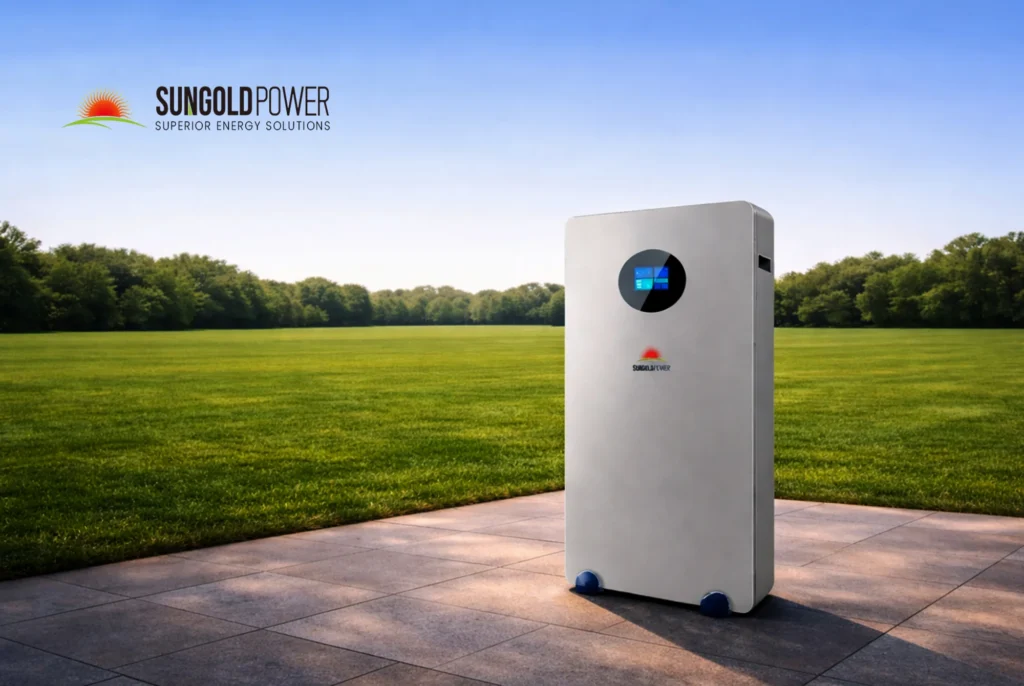
The battery bank stores energy for overnight use and cloudy-day buffering. LiFePO4 is the chemistry of choice — stable, long-cycle, deeply dischargeable, and maintenance-free. The bank capacity determines the system’s autonomy: how many hours it can supply the load without solar input.
The charge controller (integrated into most modern inverters or standalone) manages the energy flow from panels to batteries, optimising solar harvest through MPPT tracking and managing the battery charge profile to protect cell life.
DC protection hardware — breakers, fuses, and disconnects — provides safe system isolation during installation, maintenance, and fault events.
On-Grid vs Off-Grid — Choosing Based on Priorities
The grid off solar system vs grid-connected comparison is not about which is technically superior — it is about which matches the buyer’s actual priorities and circumstances.
An on-grid system with battery storage — a hybrid configuration — maintains the grid connection as a backup while providing battery-backed resilience against outages. It is appropriate when grid power is available and reliable, net-metering credit is available for exported solar, and the buyer wants backup power without fully committing to off-grid sizing requirements.
A pure off-grid system is appropriate when the grid is unavailable, when grid connection cost exceeds the off-grid system cost, or when complete energy independence is the explicit goal regardless of cost or convenience.
The off-grid solar panel kit with battery and inverter format is available in both configurations — confirm which inverter architecture the kit uses before purchasing if grid interconnection is relevant.
Off-Grid Solar Panel Kit With Battery and Inverter — Sizing Correctly
Correct sizing is the difference between a system that performs as expected and one that leaves the owner running a generator more often than anticipated. The sizing process follows a specific sequence:
- Calculate daily energy consumption. List every load, its wattage, and its daily hours of operation. Sum the total. Add 20% for system losses.
- Determine peak simultaneous demand. Identify which loads might run at the same time — HVAC plus refrigerator plus well pump plus lighting plus electronics. Sum these wattages. This is the minimum inverter output rating.
- Size the solar array. Divide the daily consumption target by the peak sun hours for the location. This gives the minimum panel array size in kW.
- Size the battery bank. A 20kW solar kit typically pairs with 20kWh–30kWh of battery storage, providing 1–1.5 days of autonomy at average consumption. In locations with fewer sun hours or higher consumption, more battery storage reduces generator dependency.
- Add a generator input. For extended low-production periods — winter months at northern latitudes, extended storms — most quality off-grid inverters include an automatic generator start input that activates when battery state of charge falls below a configurable threshold.
How Many Batteries for Off-Grid Solar
How many batteries for off-grid solar is the question that most determines system cost and autonomy. The answer depends on three variables: daily consumption, desired autonomy days, and battery depth of discharge.
For a household consuming 20kWh per day wanting 1.5 days of autonomy at 80% DOD:
Required usable energy = 20kWh × 1.5 = 30kWh Required nominal capacity at 80% DOD = 30kWh ÷ 0.80 = 37.5kWh nominal
Using 5.12kWh server rack batteries: 37.5 ÷ 5.12 = 7.3 units — round to 8 units for 40.96kWh nominal capacity.
A 20kW solar kit paired with 8 × 5.12kWh batteries delivers a system that covers typical residential consumption for 1.5 days without solar input — providing meaningful resilience against consecutive overcast days without requiring daily generator operation.
The best off-grid solar system packages with batteries specify the battery bank size relative to the solar array size and the target autonomy period — not just the panel wattage in isolation.
Common Mistakes That Undermine Off-Grid Systems
The most consistent pattern in underperforming off-grid solar installations comes down to five avoidable decisions:
- Undersizing the battery bank. A 10kWh battery bank paired with a 10kW inverter sounds balanced, but it provides only 8kWh of usable storage at 80% DOD — fewer than 8 hours of overnight coverage for a household drawing 1kW continuously. Most residential off-grid systems need 20kWh–40kWh of battery capacity.
- Undersizing the solar array for the battery bank. A large battery bank charged by a small solar array takes multiple consecutive sunny days to reach full charge after a deep depletion event. The array should be sized to fully charge the battery from 20% state of charge in a single average-sun day.
- Using lead-acid batteries to reduce upfront cost. The total cost of ownership of lead-acid over a 15-year system life — including 2–3 replacement sets — typically exceeds the upfront cost of LiFePO4 by a significant margin, while delivering worse performance and requiring regular maintenance.
- Skipping the generator connection. Even a well-sized off-grid system encounters extended low-production periods in some climates and seasons. A connected backup generator with automatic start is inexpensive insurance against the alternative — manually managing critically low battery state of charge.
- Purchasing uncertified components. An uncertified inverter or battery that fails under fault conditions has no independent safety test data demonstrating safe failure behaviour. For a high-energy electrical installation in a residence, certification is not a nicety.
Browse our full Off-Grid Solar Power Kits, Solar Battery Storage, and Off-Grid Solar Systems for complete matched system configurations.
Frequently Asked Questions
Q: What is the buying cost of off the grid solar power kits? Buying off the grid solar cost for a complete residential system typically ranges from $8,000–$25,000 depending on system size. A 10kW inverter with 20kWh LiFePO4 battery and 5kW panel array falls at the lower end. A 20kW system with 40kWh storage and a 20-panel array falls at the upper end. Component quality, certification status, and battery chemistry are the primary cost drivers within each size class.
Q: What is a 20kW solar kit and who needs one? A 20kW solar kit refers to a complete off-grid or hybrid system with approximately 20kW of inverter output capacity. It is appropriate for large residences with multiple HVAC zones, farm operations with significant motor loads, and small commercial buildings with continuous high-draw equipment. A typical 20kW solar kit includes 30–40 solar panels, 30kWh–50kWh of battery storage, and dual inverters in parallel configuration.
Q: How many batteries for off-grid solar does a typical home need? How many batteries for off-grid solar a home needs depends on daily consumption and target autonomy. For a household consuming 20kWh per day targeting 1.5 days of autonomy at 80% depth of discharge, approximately 37.5kWh of nominal battery capacity is required — equivalent to 7–8 units of 5.12kWh server rack LiFePO4 batteries.
Q: What is the best off-grid solar system packages with batteries for a remote property? The best off-grid solar system packages with batteries for a remote property combine correctly sized LiFePO4 battery storage — typically 1–2 days of autonomy — with a split-phase inverter, a solar array sized to fully recharge the battery on an average-sun day, and a generator input for extended low-production periods. Sungoldpower’s complete off-grid kits include all components matched at the factory for compatibility.
Q: What is an off-grid solar panel kit with battery and inverter, and what does it include? An off-grid solar panel kit with battery and inverter is a complete matched system package containing solar panels, a battery bank, an inverter, mounting brackets, wiring cables, and DC protection hardware — all pre-specified to work within each other’s electrical parameters. The advantage over buying components individually is that the kit eliminates compatibility verification and ensures the system operates as a coherent whole from the first day of operation.