
 4× 24V 100Ah LiFePO4 Deep Cycle Lithium Battery — Bluetooth / Self-Heating / IP65
 Subtotal: $2,088.00
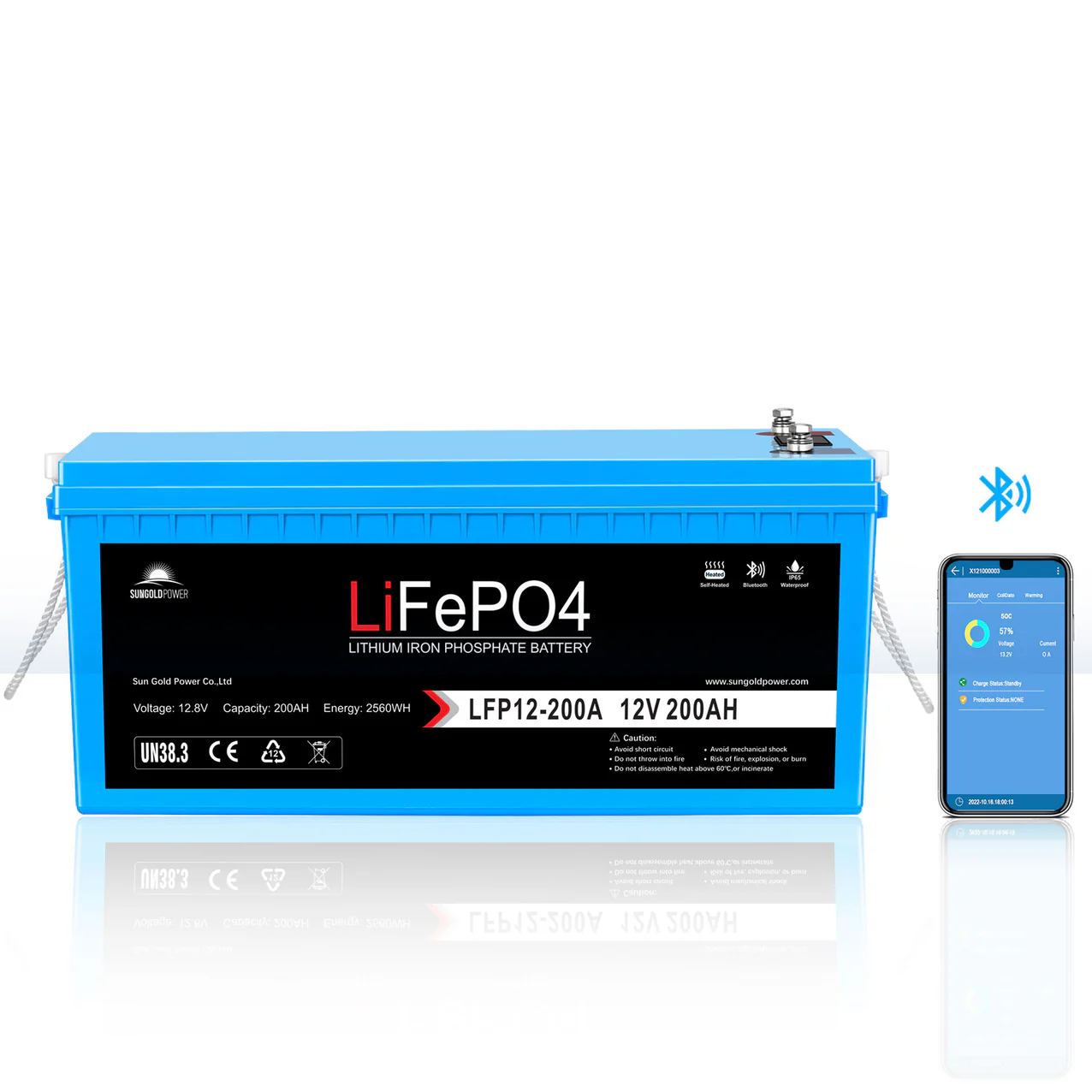
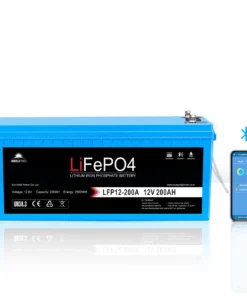
12 Volt Lithium Battery — 100Ah and 200Ah LiFePO4, Bluetooth BMS, Self-Heating, IP65
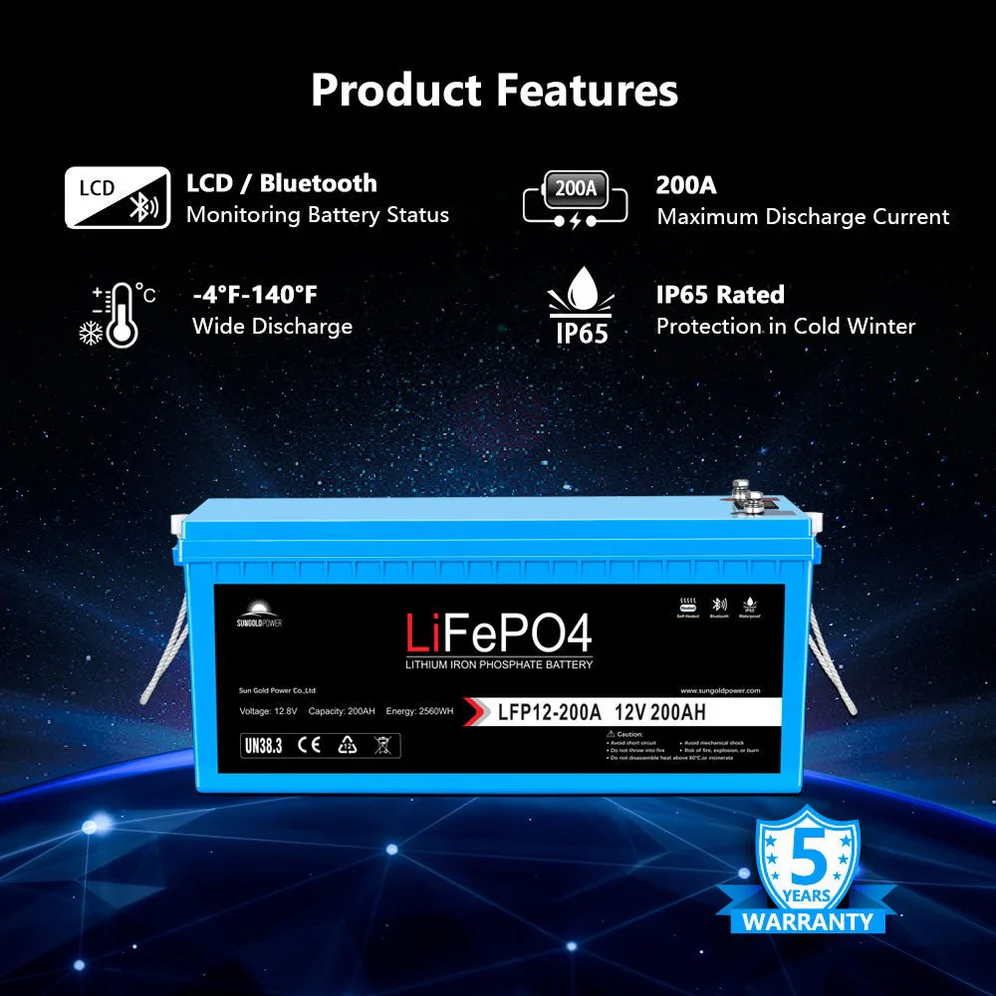
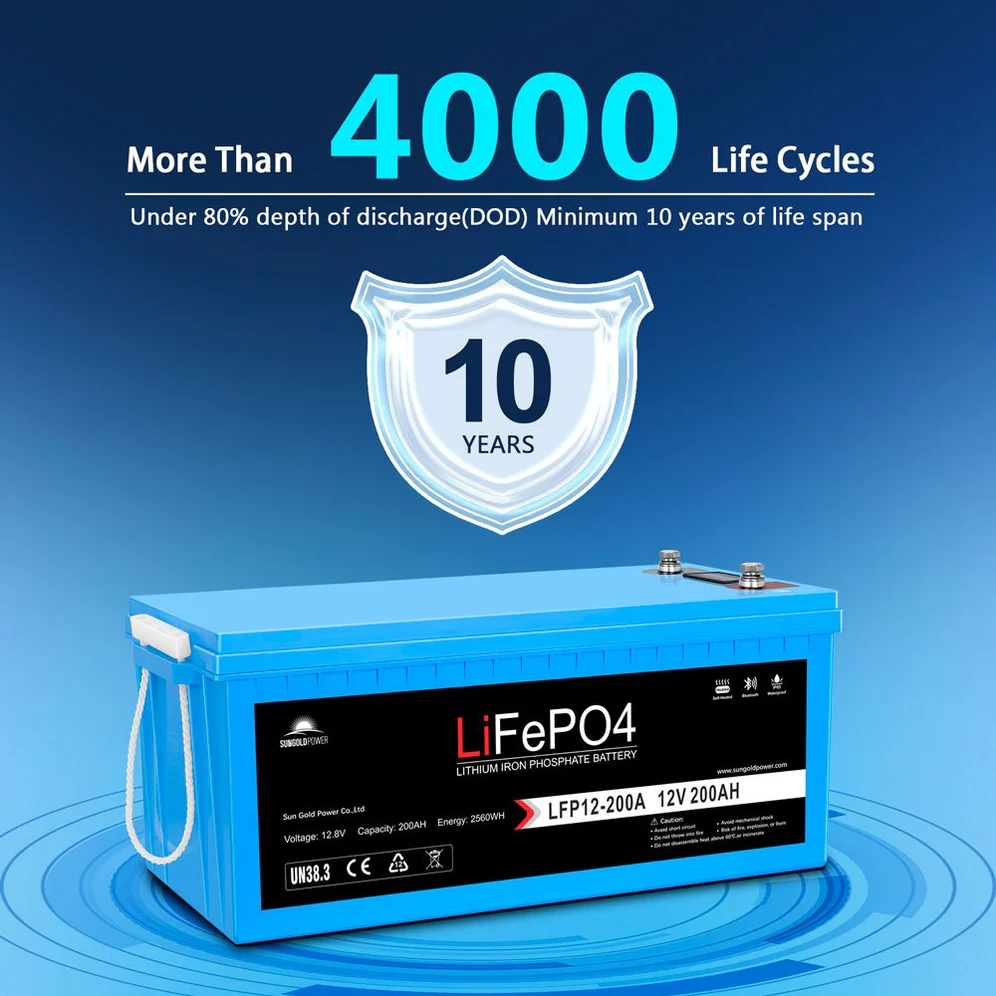
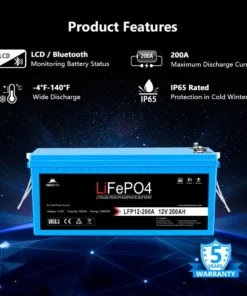
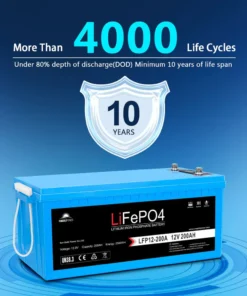
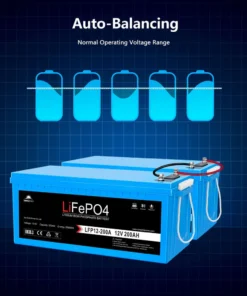
SunGoldPower’s 12 volt lithium battery is available in 100Ah and 200Ah capacities, each built on a LiFePO4 (Lithium Iron Phosphate) cell chemistry that delivers more than 4,000 charge cycles at 80% depth of discharge — roughly four to five times the cycle life of a conventional AGM or gel battery in the same voltage class. The self-heating function keeps the cells operational down to -4°F, the IP65 rating seals the case against dust ingress and low-pressure water jets, and the integrated Bluetooth BMS transmits real-time cell data directly to a smartphone. These batteries are built for solar storage, RV house banks, marine applications, and any off-grid system where weight, cycle life, and cold-weather reliability matter.
Table of Contents
- Specifications — 100Ah and 200Ah
- Why LiFePO4 Outperforms Lead-Acid in This Application
- Self-Heating and Cold-Weather Operation
- IP65 Protection and Build Quality
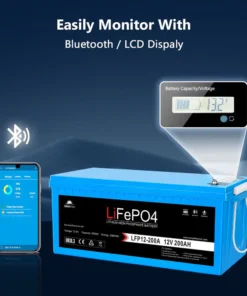
- Bluetooth BMS — What It Actually Monitors
- Frequently Asked Questions
Specifications — 100Ah and 200Ah
| Specification | 100Ah | 200Ah |
|---|---|---|
| Nominal Voltage | 12.8V | 12.8V |
| Nominal Capacity | 100Ah | 200Ah |
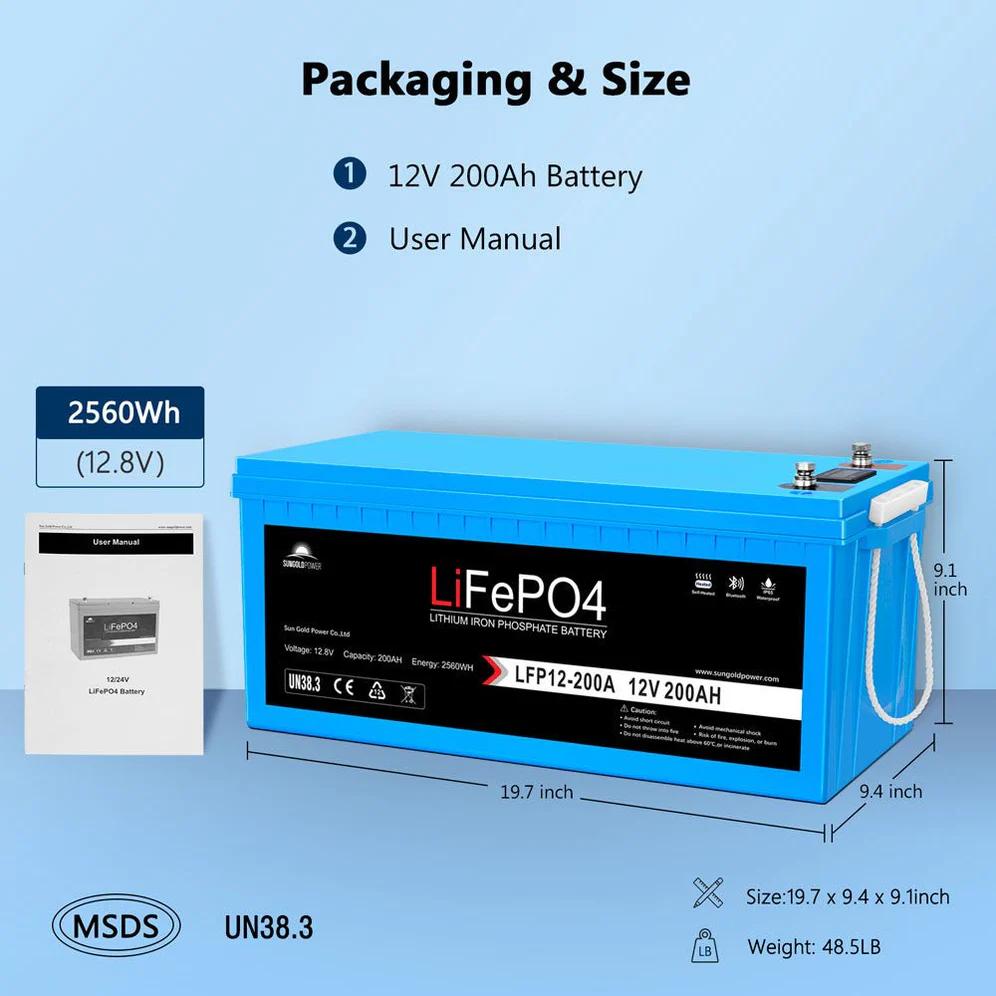
| Energy | 1,280Wh | 2,560Wh |
| Efficiency | >99.5% | >99.5% |
| Voltage Window | 10.8–14.6V | 10.8–14.6V |
| Max Continuous Charge Current | 100A | 150A |
| Peak Discharge Current | 200A (15s + 2s) | 245A (15s + 2s) |
| Recommended Charge Current | 50A | 100A |
| Recommended Discharge Current | 50A | 100A |
| Cycle Life (0.2C, 77°F, 80% DOD) | ≥4,000 | ≥4,000 |
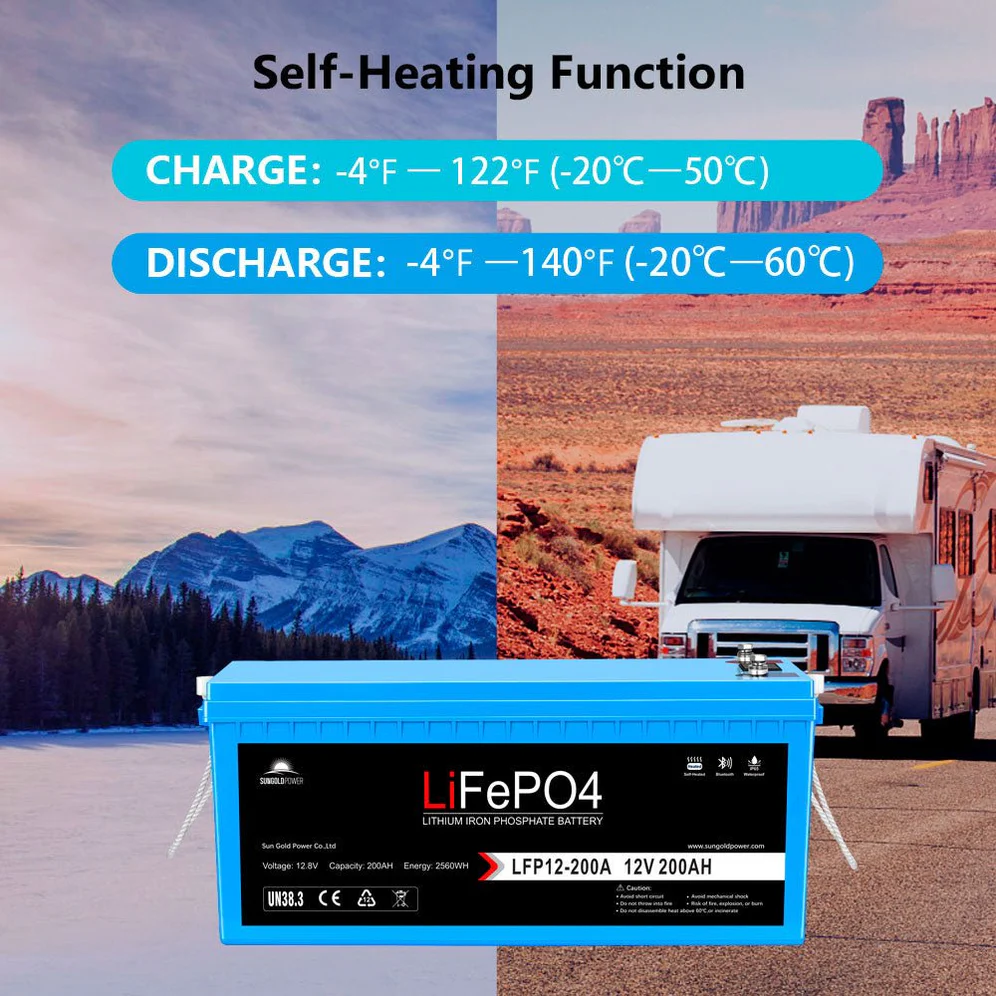
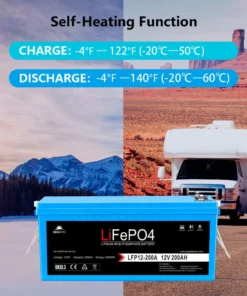
| Charge Temperature | -4°F to 113°F | -4°F to 113°F |
| Discharge Temperature | -4°F to 131°F | -4°F to 131°F |
| Case Material | ABS | ABS |
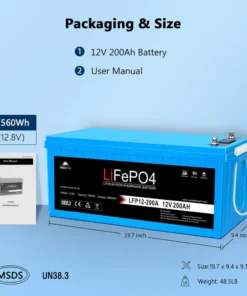
| Dimensions (L×W×H) | 12 × 6.6 × 8.9 in | 19.7 × 9.4 × 9.1 in |
| Weight | 22.7 lb | 48.5 lb |
| Terminal Type | M8 | M8 |
| IP Grade | IP65 | IP65 |
| Monitoring | LCD + Bluetooth | LCD + Bluetooth |
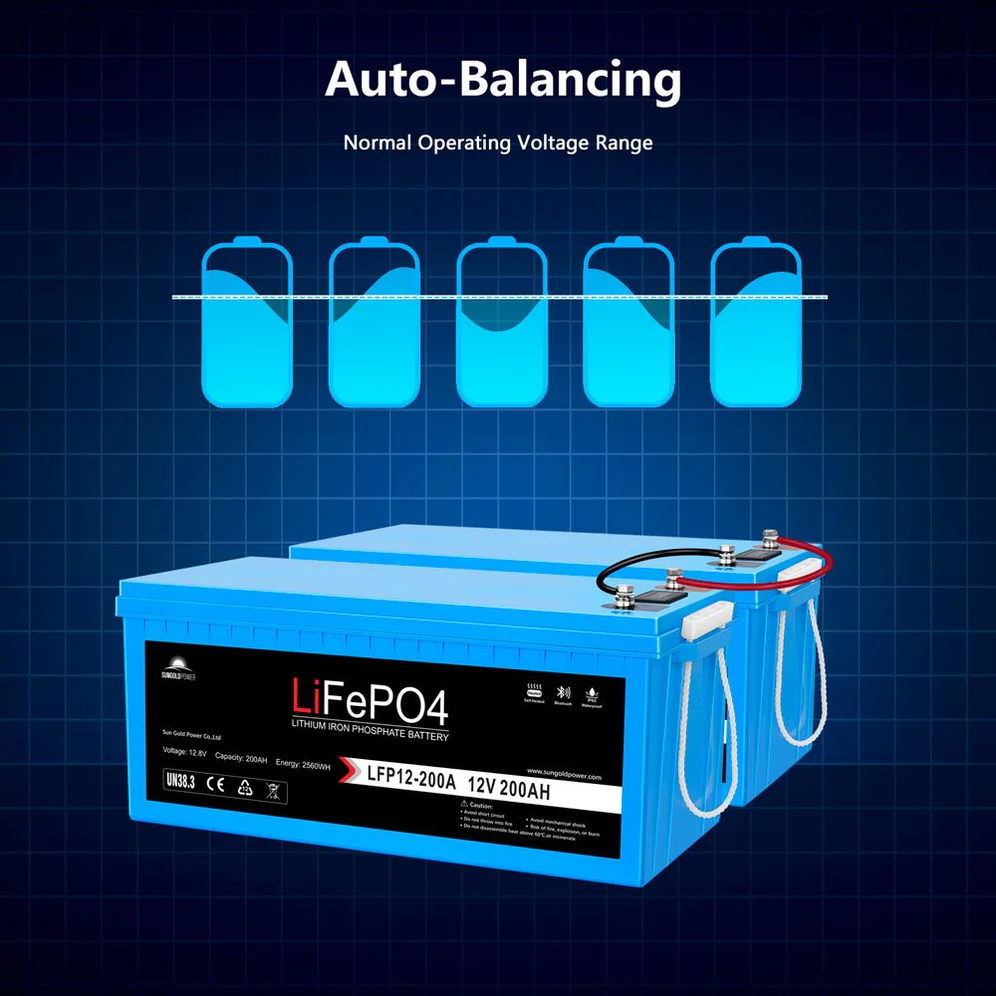
| Max Parallel | 4 units | 4 units |
| Max Series | 4 units | 4 units |
Why LiFePO4 Outperforms Lead-Acid in This Application
LiFePO4 is not simply a lighter version of lead-acid — it is a fundamentally different electrochemical architecture with practical advantages that compound over the life of an installation. A lithium deep cycle battery at 100Ah delivers its full rated capacity at any discharge rate within its operating range. A lead-acid battery at 100Ah is typically derated to 50–60Ah at the discharge rates that real solar and RV loads demand.
The differences that matter most in day-to-day use:
- Full usable capacity at any rate: LiFePO4 cells maintain near-flat voltage throughout the discharge curve. Lead-acid voltage sags progressively, reducing the effective capacity available to connected loads.
- No sulfation or memory effect: Lead-acid batteries degrade permanently when left partially discharged. LiFePO4 chemistry has no equivalent failure mode, making it tolerant of the irregular charge cycles common in solar and RV use.
- Weight advantage: The 100Ah unit weighs 22.7 lb. A lead-acid battery of equivalent usable capacity typically weighs 55–65 lb after derating.
- 4,000-cycle minimum life: At one cycle per day, this battery reaches end-of-warranty life after more than ten years of daily use.
Self-Heating and Cold-Weather Operation
The self-heating function is the feature that separates this battery from standard LiFePO4 units in cold-climate applications. Standard lithium cells cannot be charged safely below approximately 32°F — attempting to charge a cold lithium battery causes lithium plating on the anode, permanently reducing capacity and creating internal short-circuit risk.
The built-in heating element activates automatically when the BMS detects cell temperature below the safe charging threshold. The cells are warmed to a safe operating temperature before any charge current is allowed to flow, protecting both the battery and the connected charging system from the consequences of cold-temperature charging.
Discharge performance is maintained down to -4°F, meaning the battery continues to power loads through the night in freezing conditions. The -4°F lower limit applies to both charge and discharge operations — below that threshold, the BMS suspends all current flow until temperature recovers.
IP65 Protection and Build Quality
IP65 certification means the enclosure is completely sealed against dust ingress and withstands sustained low-pressure water jets from any direction. For a 12v solar battery installation in a marine bilge compartment, an exposed equipment bay, or an outdoor ground-mount battery enclosure, this rating provides meaningful real-world protection that standard IP20 or unrated battery cases cannot match.
The ABS case is impact-resistant and chemically stable across the -4°F to 131°F operating temperature range. M8 threaded terminals provide a secure, corrosion-resistant connection point compatible with standard solar and inverter cabling hardware.
Bluetooth BMS — What It Actually Monitors
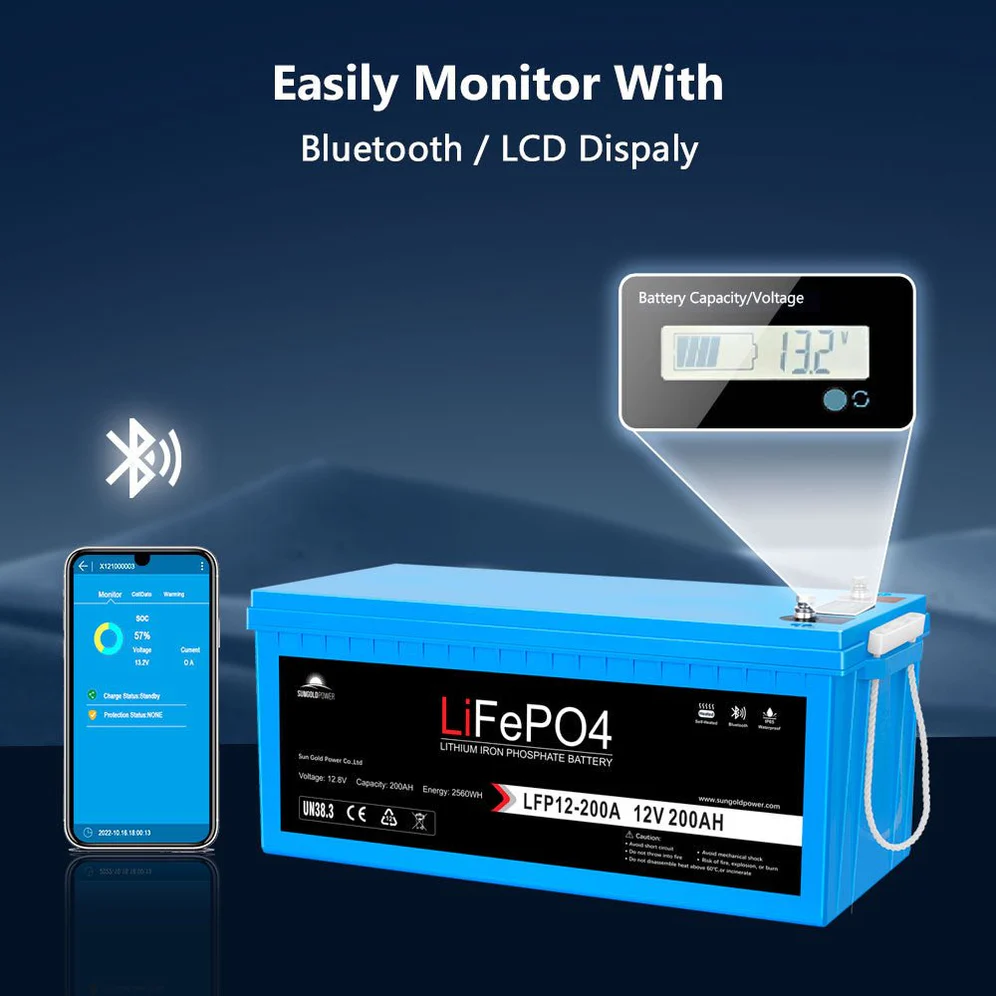
The Bluetooth BMS communicates directly with a smartphone via a dedicated app, providing access to data that most battery management systems keep internal. From the app, users can monitor:
- Individual cell voltages — identifies any cell drifting outside the balanced range before it becomes a failure event.
- State of charge — real percentage based on coulomb counting, not voltage estimation.
- Charge and discharge current — live amperage in both directions.
- Cell temperature — confirms self-heating activation and monitors thermal status under load.
- Cycle count — tracks actual usage against the 4,000-cycle rated life.
The LCD display on the battery case provides the same core data without requiring a phone — a practical feature for installations where pulling out a smartphone is inconvenient.
For solar applications, the battery for 12v solar panel Bluetooth monitoring makes it straightforward to verify that the solar charge controller is delivering the correct charge current and that the battery is reaching full state of charge on a daily basis.
Browse our full 12V LiFePO4 Batteries, Solar Battery Storage, and Off-Grid Power Systems collections for compatible components and complete system options.
Frequently Asked Questions
Q: Can the 100Ah and 200Ah versions be used together in the same bank? Mixing capacities in a parallel bank is not recommended. Both the 100Ah and 200Ah versions support up to four units in parallel, but all units in a parallel bank should be identical in capacity and state of charge at the time of connection to prevent unequal current sharing and BMS conflicts.
Q: What does the self-heating function do at very low temperatures? When cell temperature drops below the safe charging threshold — approximately 32°F for most LiFePO4 chemistries — the built-in heating element activates automatically and warms the cells before allowing any charge current to flow. Discharge can continue down to -4°F without heating activation.
Q: Is this a suitable lithium 12v battery for a marine installation? Yes. The IP65 rating protects the enclosure against sustained water exposure, and the M8 terminals are compatible with standard marine cabling hardware. The self-heating function is particularly useful in northern-latitude marine applications where overnight temperatures regularly drop below freezing during shoulder seasons.
Q: How does a batterie 12v lithium compare to AGM at the same price point? A batterie 12v lithium at equivalent purchase price typically delivers three to four times the usable energy over its service life when total cycle count and usable capacity are factored in. AGM batteries derate significantly at higher discharge rates, whereas LiFePO4 cells deliver their full rated capacity regardless of discharge rate within the operating range.
Q: What charge controller is required for this battery? Any MPPT or PWM solar charge controller with a lithium battery charging profile and configurable charge voltage is compatible. The recommended charge voltage for LiFePO4 is typically 14.4–14.6V — set the charge controller to this range and confirm it does not apply an equalisation charge, which is incompatible with lithium chemistry.
| Battery Capacity | 200ah [Brand New], 100ah, 200ah [Refurbished] |
|---|---|
| Quantity | 1 Unit, 2 Units, 4 Units |
Be the first to review “12V 100Ah / 200Ah LiFePO4 Deep Cycle Lithium Battery”
Related products
Sale!
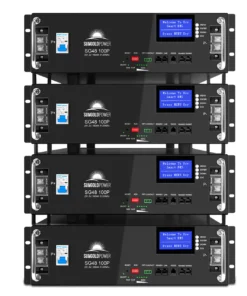
Lithium Solar Batteries
Original price was: $4,320.00.$3,888.00Current price is: $3,888.00.
Sale!
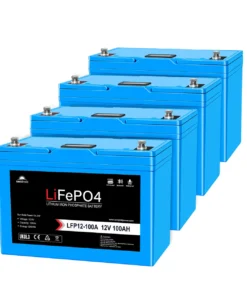
Lithium Solar Batteries
Original price was: $1,165.00.$1,048.50Current price is: $1,048.50.
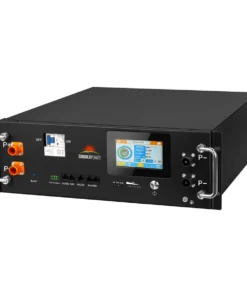
Lithium Solar Batteries
CoreX 5 Pro Server Rack 48V 100Ah Residential Energy Storage Battery — WiFi and Bluetooth
Price range: $1,035.00 through $4,104.00
This product has multiple variants. The options may be chosen on the product page
Sale!
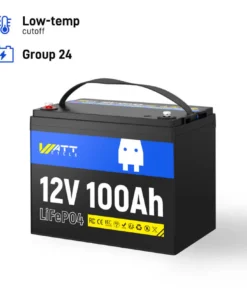
Lithium Solar Batteries
WattCycle 12V 100Ah LiFePO4 Battery – Reliable Power for Solar, RV & Off-Grid Use
Price range: $280.99 through $910.41
This product has multiple variants. The options may be chosen on the product page
Sale!
Lithium Solar Batteries
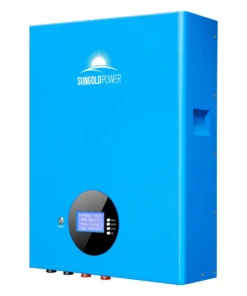
5.12KWH Wall-Mounted LiFePO4 Lithium Battery – Reliable Solar Battery Near Me
Price range: $959.99 through $3,446.17
This product has multiple variants. The options may be chosen on the product page
Sale!
Lithium Solar Batteries
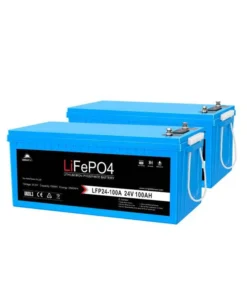
2× 24V 100Ah LiFePO4 Deep Cycle Lithium Battery — Bluetooth / Self-Heating / IP65
Original price was: $1,170.00.$1,053.00Current price is: $1,053.00.
Sale!
Lithium Solar Batteries
Original price was: $2,170.00.$1,953.00Current price is: $1,953.00.
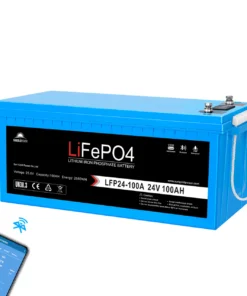
Price range: $530.10 through $2,088.00
This product has multiple variants. The options may be chosen on the product page
Reviews
There are no reviews yet.