
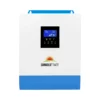
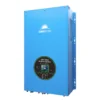
Off Grid Solar Inverters 8kW — Authentic [200A MPPT + Parallel]
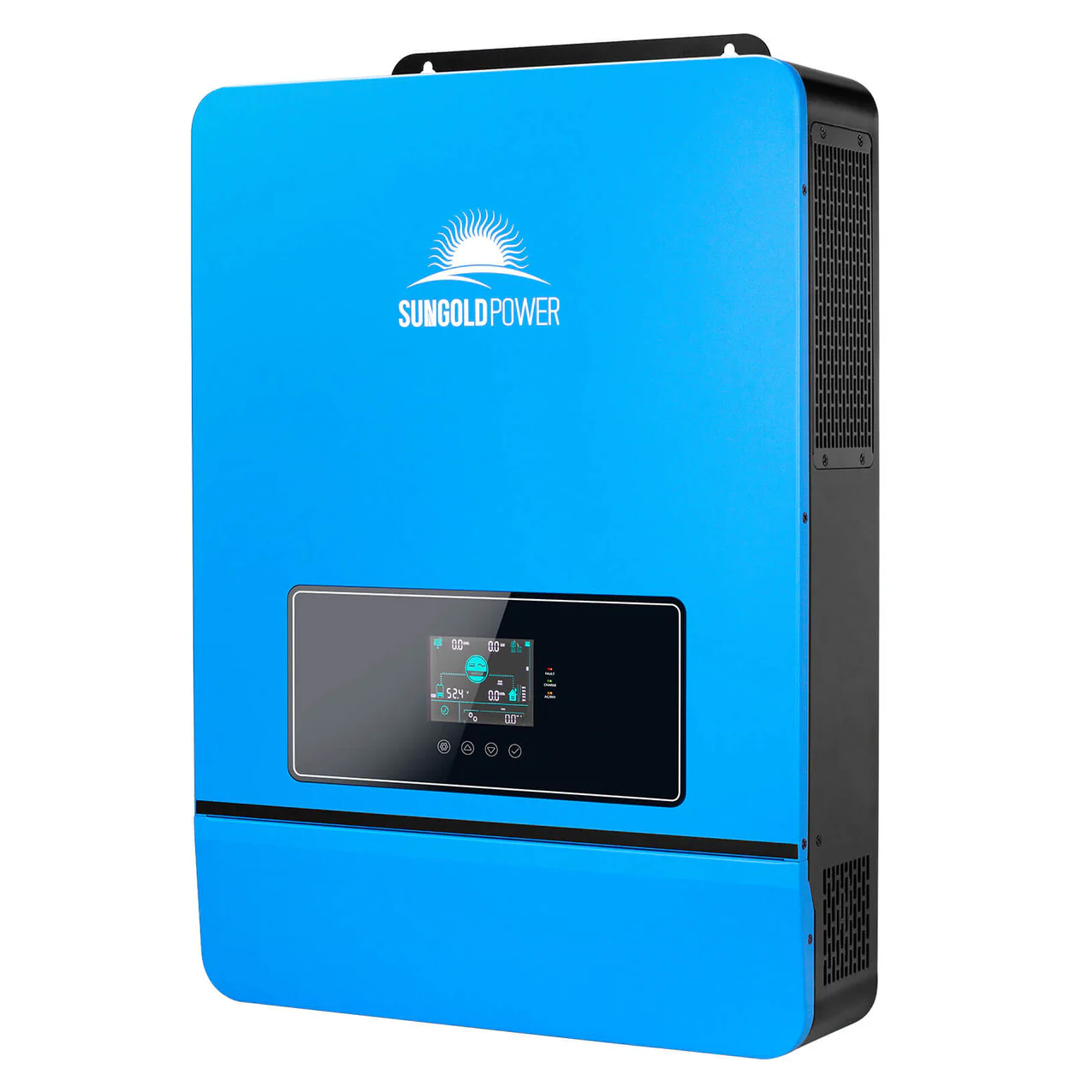
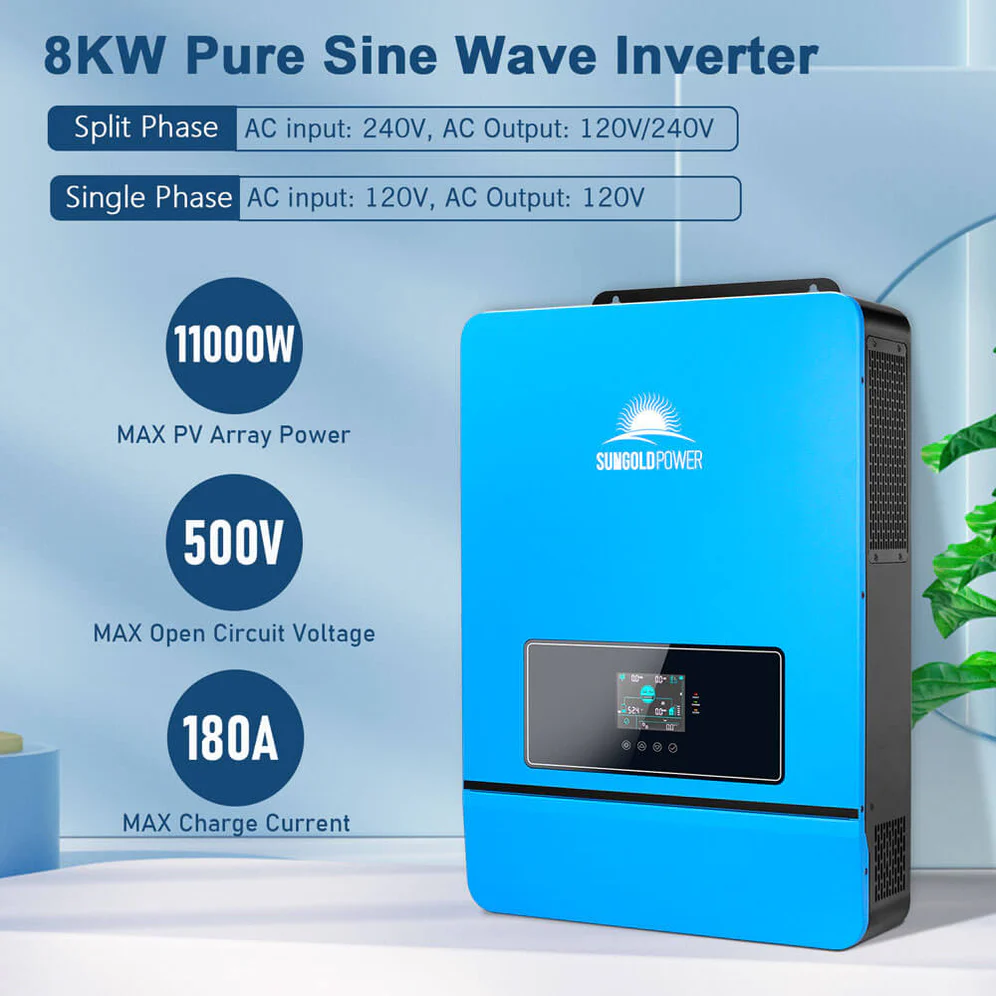
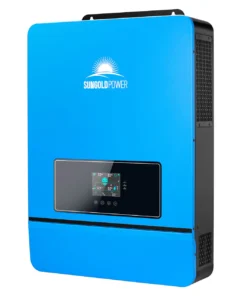
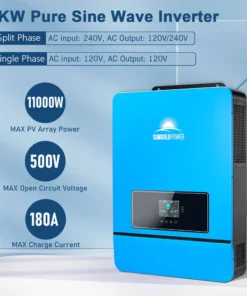
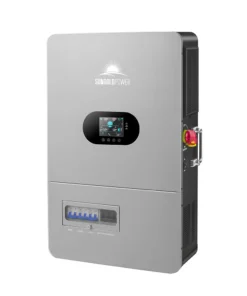
Off grid solar inverters with a built-in 200A MPPT solar charge controller are a different category from standard inverter-chargers — and the SPH8048P 8kW 48V split-phase unit is the specification that demonstrates why. This is a true solar-integrated inverter: MPPT solar charging at 200A maximum, 8kW continuous AC output at 120/240V split-phase, 16kW surge capacity and 6-unit parallel capability in a single hardware platform rated to IP20 for indoor installation. The offgrid inverter architecture accepts up to 11,000W of PV array input across two MPPT trackers, charges the 48V battery bank at up to 200A from combined AC and solar sources simultaneously and delivers pure sine wave AC output with 10-millisecond transfer time — all from one unit.
Table of Contents
- Product Specifications
- Built-In 200A MPPT Solar Charge Controller
- Dual MPPT Trackers
- 8kW Continuous Split-Phase Output
- 48V Inverters — Battery and Charging Specifications
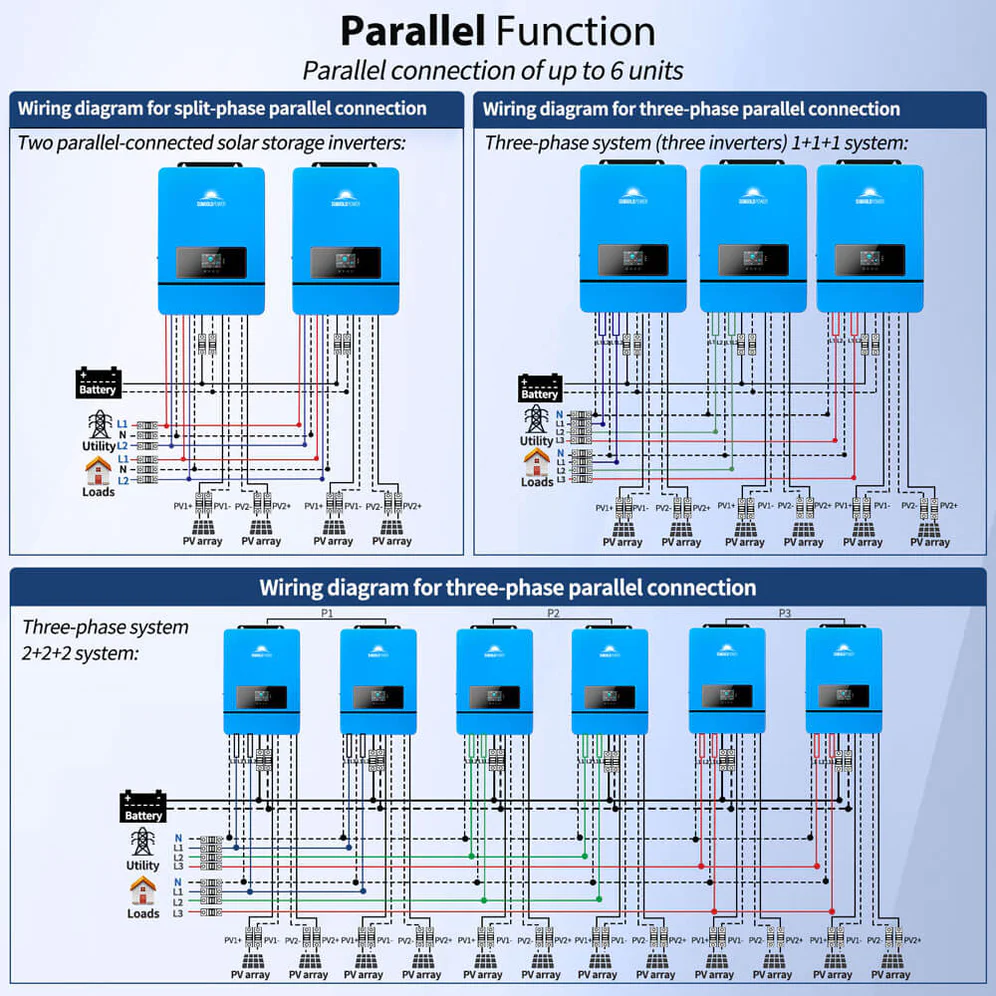
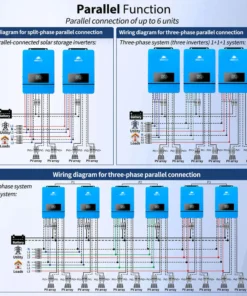
- Parallel Operation — Up to 6 Units
- Grid-On Inverter Capabilities
- FAQ
Product Specifications
| Parameter | SPH8048P |
|---|---|
| Rated Output Power | 8,000W |
| Max Peak Power | 16,000W |
| Rated Output Voltage | 120/240V AC (split phase / single phase) |
| Rated AC Frequency | 50/60Hz |
| Output Waveform | Pure Sine Wave |
| Switch Time | 10ms (typical) |
| Parallel Capacity | 6 units |
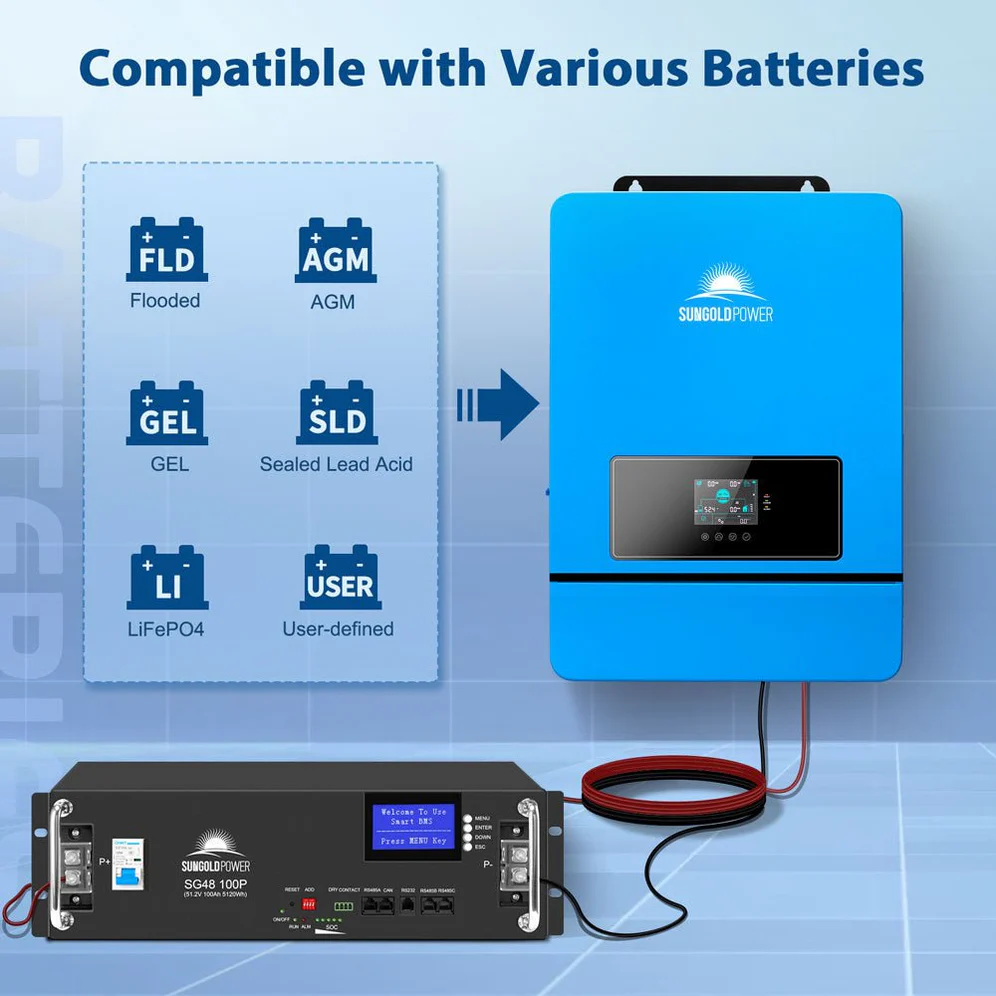
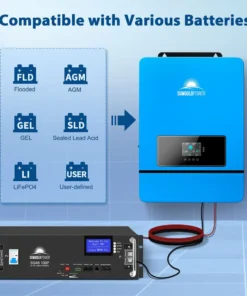
| Battery Type | Li-ion / Lead-Acid / User Defined |
| Rated Battery Voltage | 48V DC |
| Battery Voltage Range | 40–60V DC |
| Max MPPT Charging Current | 200A |
| Max Mains/Generator Charging | 100A |
| Max Hybrid Charging Current | 180A |
| MPPT Trackers | 2 |
| Max PV Array Power | 11,000W |
| Max PV Input Current | 22A / 22A |
| Max Open Circuit Voltage | 500V DC |
| MPPT Voltage Range | 125–425V DC |
| Mains Input Voltage Range | 90–140V AC (single phase) |
| Mains Frequency | 50/60Hz |
| Bypass Overload Current | 63A |
| MPPT Tracking Efficiency | 99.9% |
| Max Battery Inverter Efficiency | 92% |
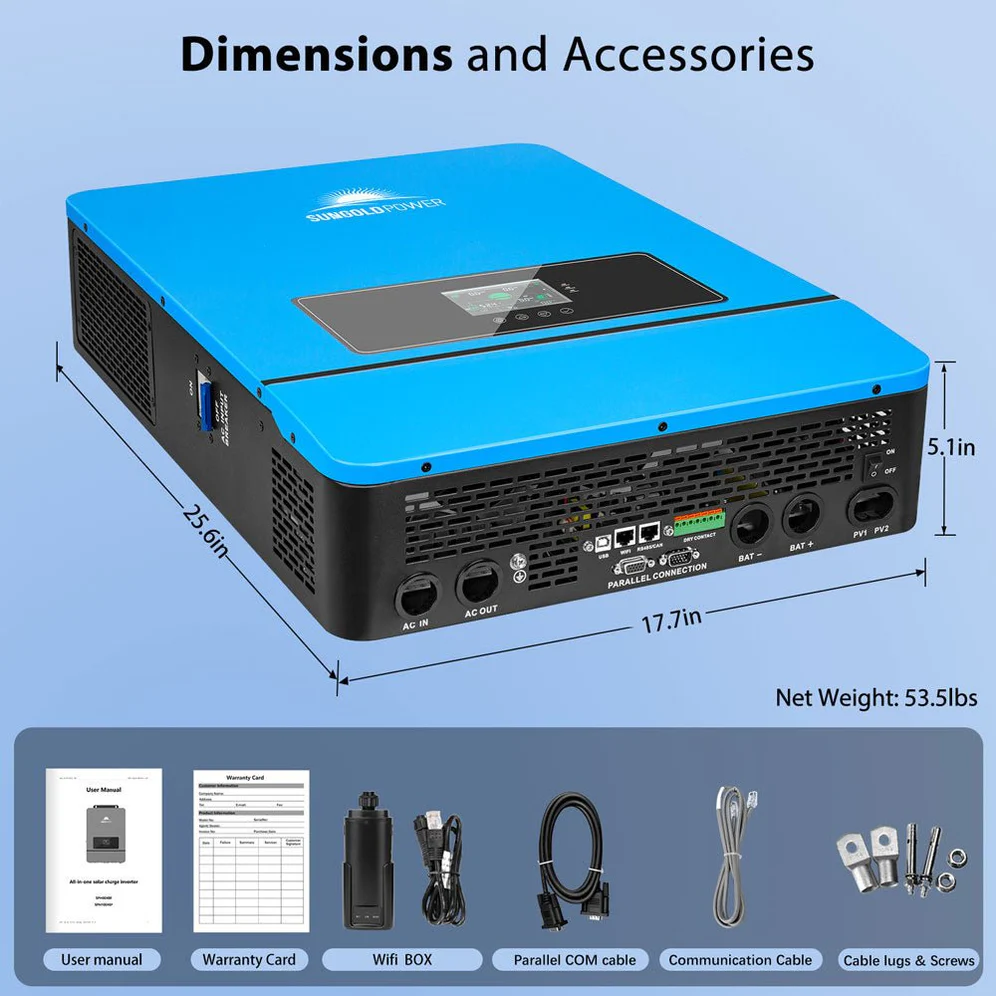
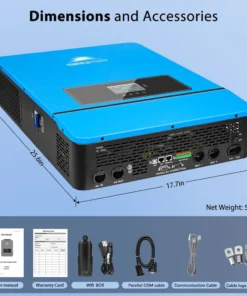
| Dimensions | 17.7 × 25.6 × 5.1 inch |
| Weight | 53.5 lb |
| Protection Degree | IP20, Indoor Only |
| Operating Temperature | 14–131°F (>113°F derated) |
| Noise | <60 dB |
| Cooling | Internal Fan |
| No-Load Consumption | 95W |
| Warranty | 2 Years |
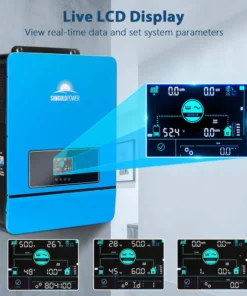
| Communication | RS485 / CAN / USB / Dry Contact |
| Optional Modules | Wi-Fi / GPRS |
| Certifications | IEC 62109-1, IEC 62109-2, UL1741, EN61000-6-1, EN61000-6-3, FCC Part 15 Class B, RoHS |
Built-In 200A MPPT Solar Charge Controller
The 200A MPPT (Maximum Power Point Tracking) solar charge controller integrated into the SPH8048P is the specification that separates it from inverter-chargers that require a separate charge controller. At 200A maximum charging current from combined solar and AC sources, and 100A maximum from mains or generator alone, this unit manages the complete energy flow from panels to battery to loads without external charge control hardware.
MPPT tracking efficiency of 99.9% means the controller continuously adjusts the electrical operating point of the PV array to extract maximum available power across all irradiance conditions — morning low-angle light, partial overcast, afternoon peak and evening decline. The 99.9% tracking efficiency figure is not theoretical — it reflects the quality of the MPPT algorithm’s ability to respond to rapidly changing irradiance without lagging behind the actual maximum power point.
Dual MPPT Trackers
Two independent MPPT trackers — each accepting up to 22A input with a 500V DC open-circuit voltage limit — allow the connected PV array to be configured in two independent strings. This is significant for:
- Mismatched arrays: Panels on different roof faces or orientations can be managed independently, preventing a shaded or differently oriented string from reducing the output of the entire array.
- Different panel specifications: Arrays using panels of different wattage or voltage can be split across two trackers for independent optimisation.
- Fault isolation: A wiring fault or failed panel in one string does not affect the charging performance of the other.
The combined maximum PV input of 11,000W across both trackers provides substantial solar charging capacity for a 48V battery bank paired with an 8kW inverter — appropriate for daily battery recharge cycles in high-consumption residential applications.
8kW Continuous Split-Phase Output
At 8,000W continuous output with 16,000W of surge capacity, the SPH8048P covers the realistic simultaneous load of a medium-to-large residential home. The 120/240V split-phase output — 2-leg configuration identical to standard North American service panel wiring — enables direct panel connection for complete home electrical coverage.
The 6HP motor load capacity specification directly addresses the most demanding single-phase motor loads encountered in residential applications: well pump motors, HVAC compressors and workshop equipment with high-inertia loads. This rating reflects real-world motor starting capability rather than a theoretical wattage-only specification.
48V Inverters — Battery and Charging Specifications
The 48v inverters classification — 48V DC nominal — provides the optimal voltage for residential off-grid systems at this output level. At 48V, the maximum MPPT charging current of 200A represents 9,600W of charging power — enough to recover a large LiFePO4 battery bank from 50% state of charge in 2–4 hours depending on bank capacity.
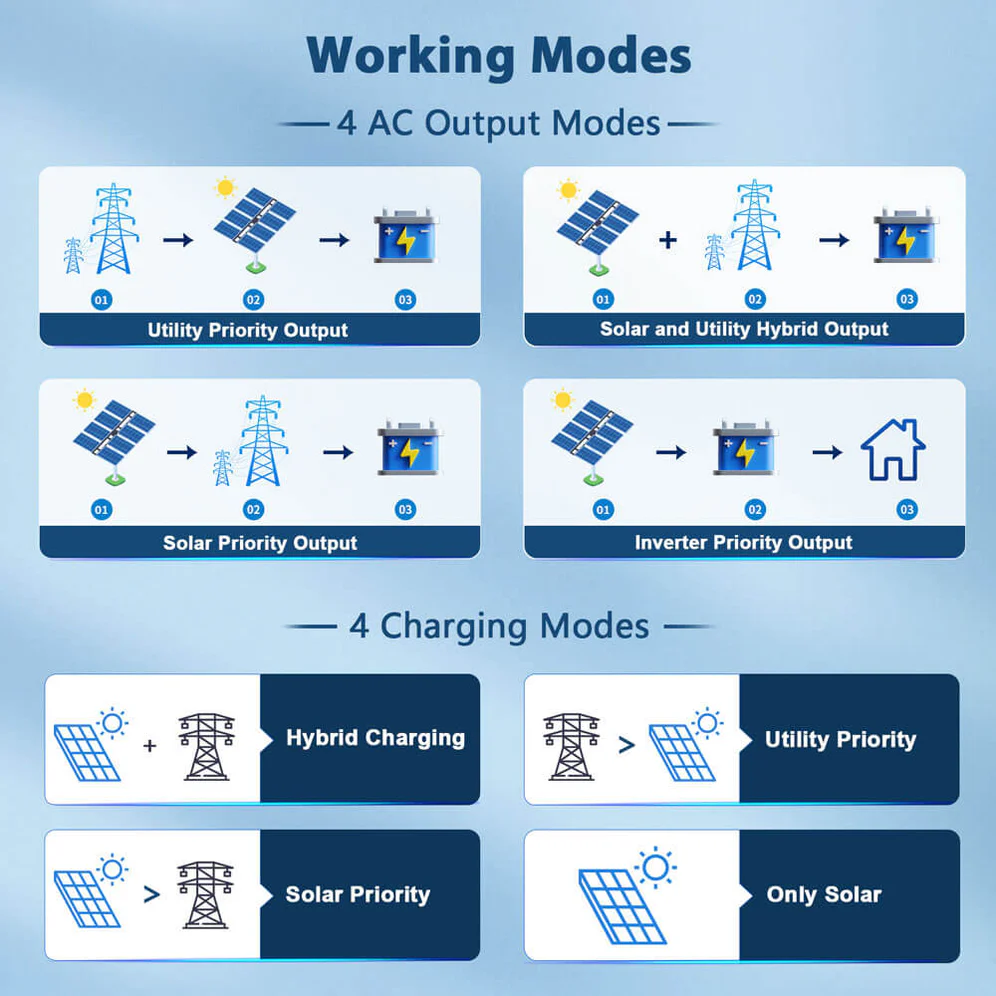
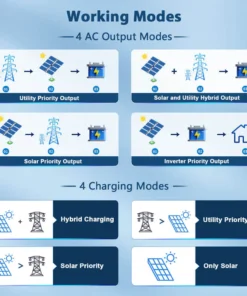
The hybrid charging maximum of 180A covers simultaneous solar and AC charging — the most efficient charging scenario where both PV and generator or shore power are available simultaneously. The 40–60V operating range accommodates the full discharge-to-charge voltage swing of both LiFePO4 and lead-acid battery chemistries at 48V nominal.
Parallel Operation — Up to 6 Units
Six-unit parallel capability enables combined output expansion from 8kW to 48kW. Parallel configurations support:
- Single-phase (120V AC): All units in phase-aligned parallel for maximum current at 120V.
- Split-phase (240V AC): Units configured across two legs for residential split-phase output at combined wattage.
- Three-phase (208V): Three-unit groups per phase for commercial three-phase output.
Parallel expansion requires the parallel kit and appropriate configuration of each unit via the communication interface — refer to the technical manual for parallel connection protocol before configuring a multi-unit installation.
Grid-On Inverter Capabilities
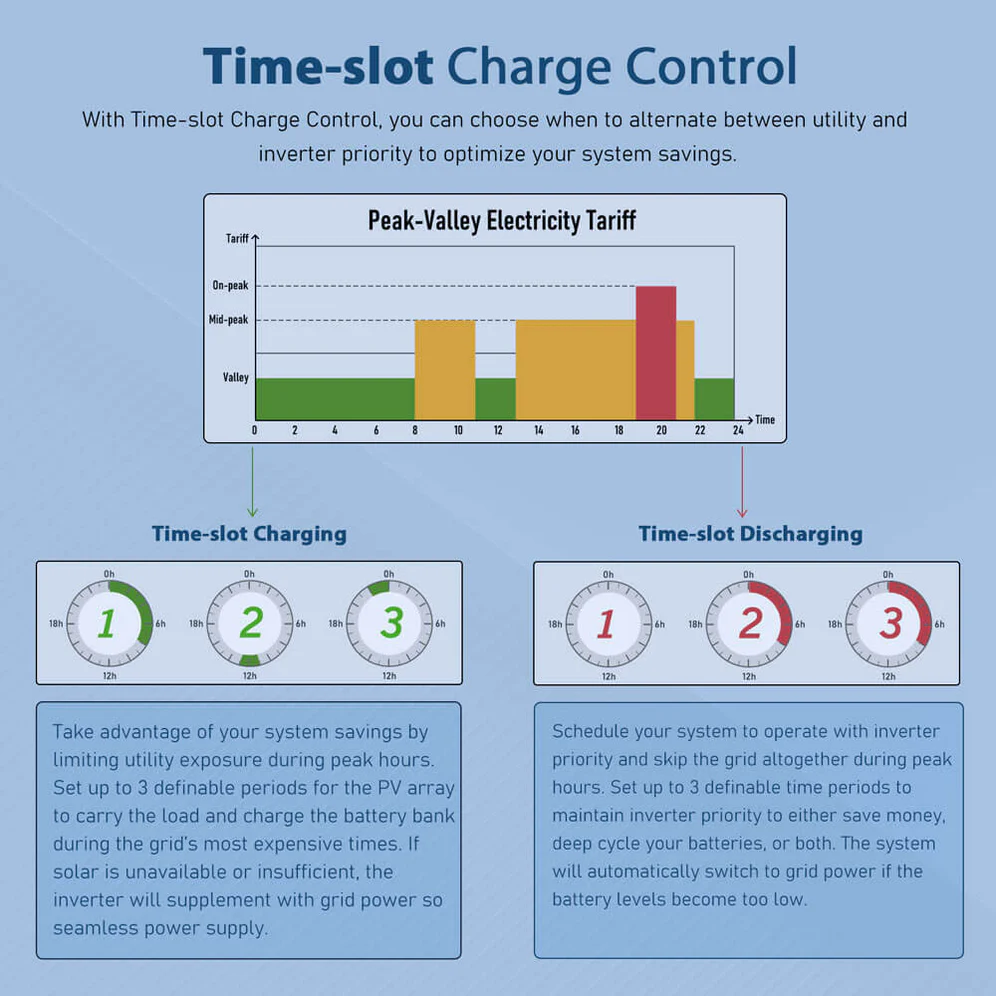
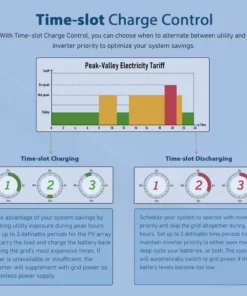
The grid on inverter capability of the SPH8048P — its ability to accept grid or generator AC input for battery charging and load bypass — enables hybrid operation alongside solar charging. When grid power is available, the unit charges the battery bank and passes AC to loads simultaneously. When grid power fails or is intentionally disconnected, the inverter continues powering loads from the battery bank without interruption.
This architecture supports transition to full off grid solar inverters operation over time — starting as a battery backup and solar charging system while grid-connected, then operating independently as the primary power source when the grid connection is abandoned.
Explore compatible solar kits and battery systems in our Off-Grid Solar Inverters, Solar Kits and Off-Grid Power Systems categories.
FAQ
What makes the SPH8048P different from standard off grid solar inverters without built-in MPPT? The integrated 200A MPPT solar charge controller eliminates the need for a separate charge controller unit, separate DC wiring between the charge controller and inverter, and separate configuration and monitoring of two devices. The SPH8048P manages all energy flows — solar charging, AC charging, battery management and AC output — from one hardware platform with one interface.
What is the 48v inverters battery charging specification? The 48v inverters SPH8048P charges at up to 200A combined from solar and AC sources, 100A from mains/generator alone, and 180A in hybrid mode (simultaneous solar and AC). At 200A into a 48V bank, the charger delivers approximately 9,600W of charging power — enabling rapid battery recovery during peak solar hours or generator runs.
Can this unit function as a grid on inverter and an off-grid inverter? Yes. The SPH8048P operates in both grid-connected and off-grid modes. When AC input is available (grid or generator), it charges batteries and passes power to loads. When AC input is unavailable, it invertes from battery for load supply. The 10ms transfer time maintains load continuity through source transitions.
What certifications does this off grid solar inverter carry? The SPH8048P carries IEC 62109-1 and IEC 62109-2 (international inverter safety standards), UL1741 (North American inverter/charger standard for grid interconnection and off-grid use), EN61000-6-1 and EN61000-6-3 (European EMC standards), FCC Part 15 Class B (North American RF emissions) and RoHS (hazardous substance restriction compliance).
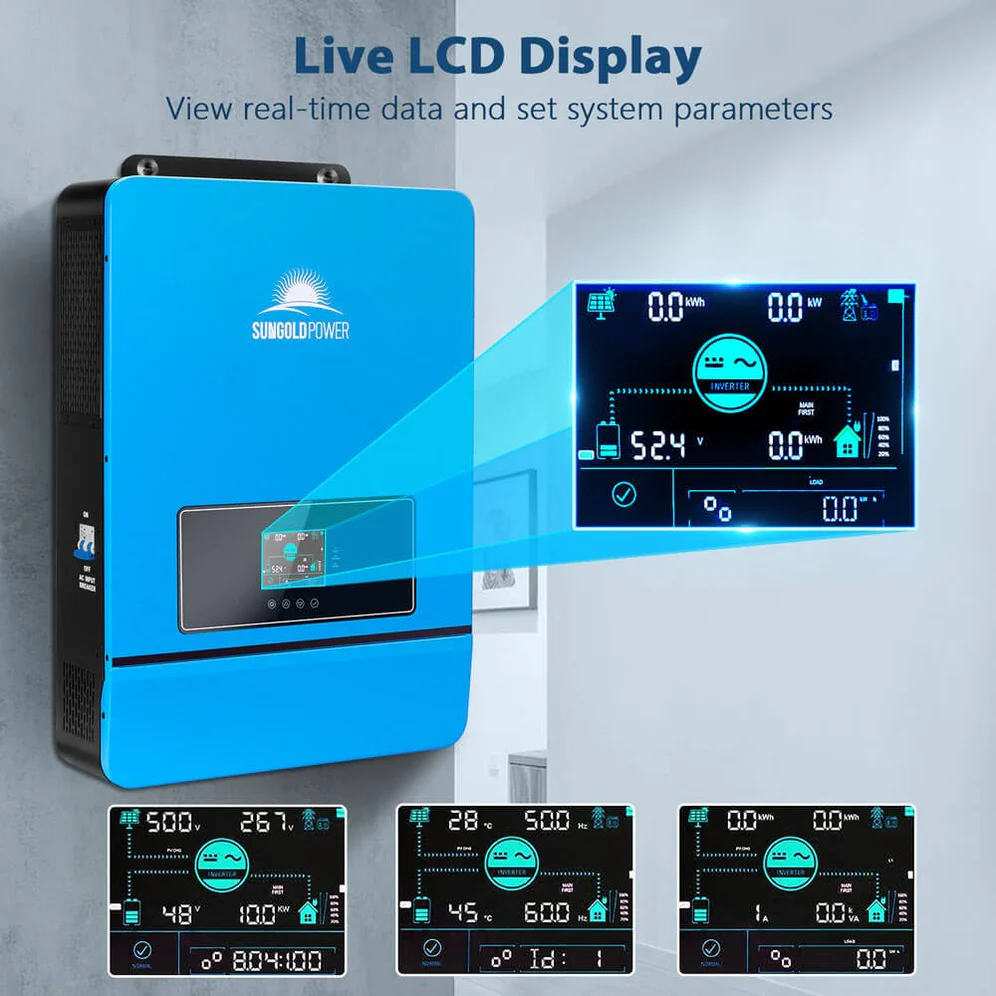
What communication interfaces are available for monitoring and control? Built-in interfaces include RS485, CAN, USB and dry contact for external control signals. Optional Wi-Fi and GPRS modules enable remote monitoring and control via smartphone app or web interface for installations where direct physical access to the unit is inconvenient.
| Battery Option | 2 X SG48100P [10.24kwh], 2 X SG48200T [20.48kwh], Only Inverter |
|---|
Be the first to review “8kW 48V Split Phase Solar Inverter SPH8048P”
Related products
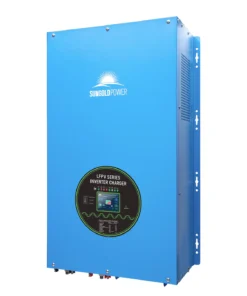
best solar inverter
12kW / 15kW / 18kW 48V Split Phase Pure Sine Wave Inverter Charger
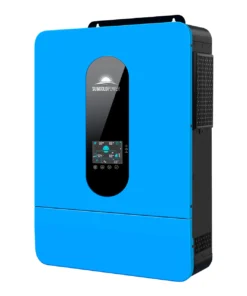
best solar inverter
best solar inverter
best solar inverter
best solar inverter
4000W DC 24V Split Phase Pure Sine Wave Inverter With Charger 120/240VAC
best solar inverter
best solar inverter
Reviews
There are no reviews yet.