
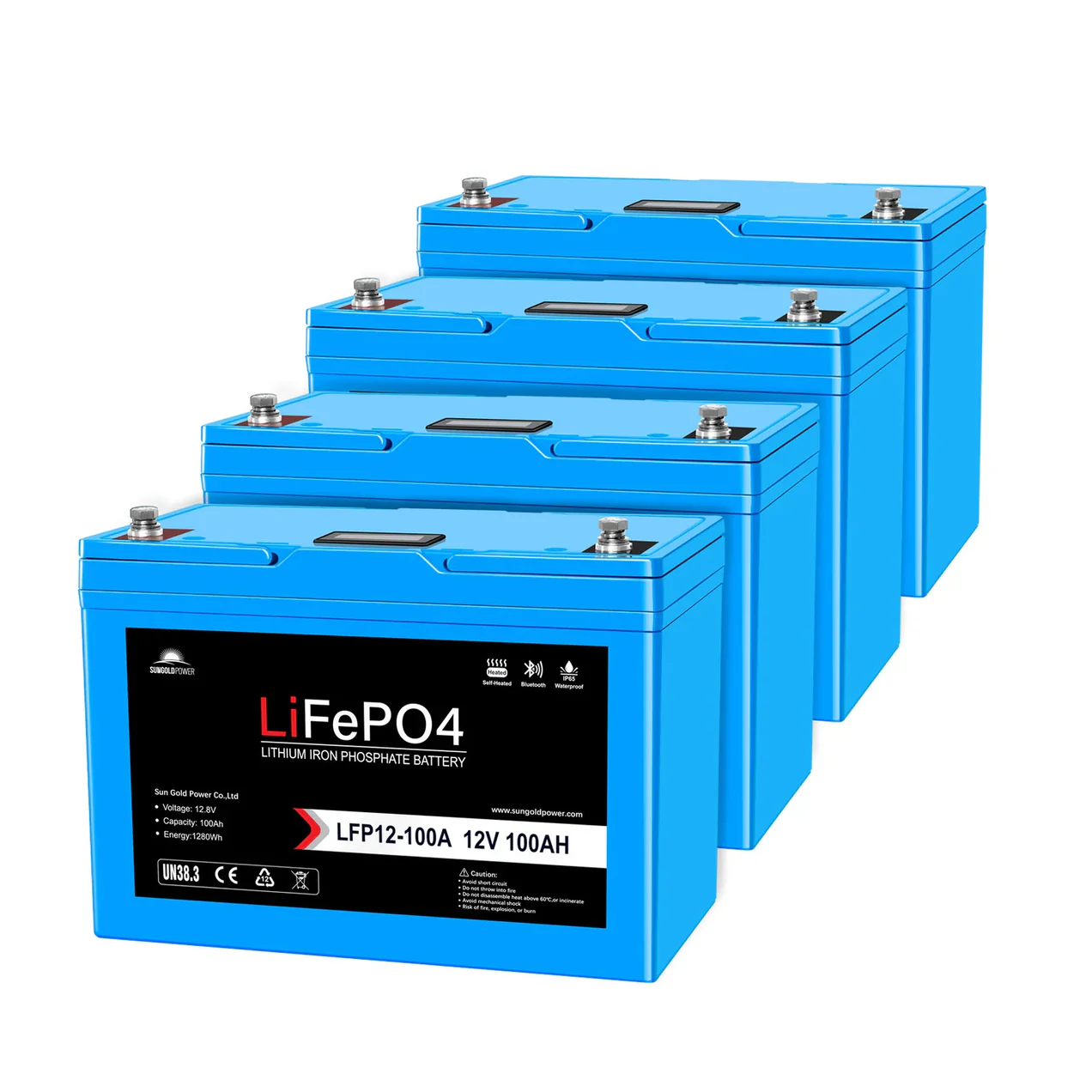
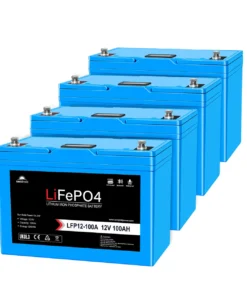


LiFePO4 Solar Battery — 4 × 12V 100Ah, 400Ah Total, Self-Heating, Bluetooth BMS, IP65
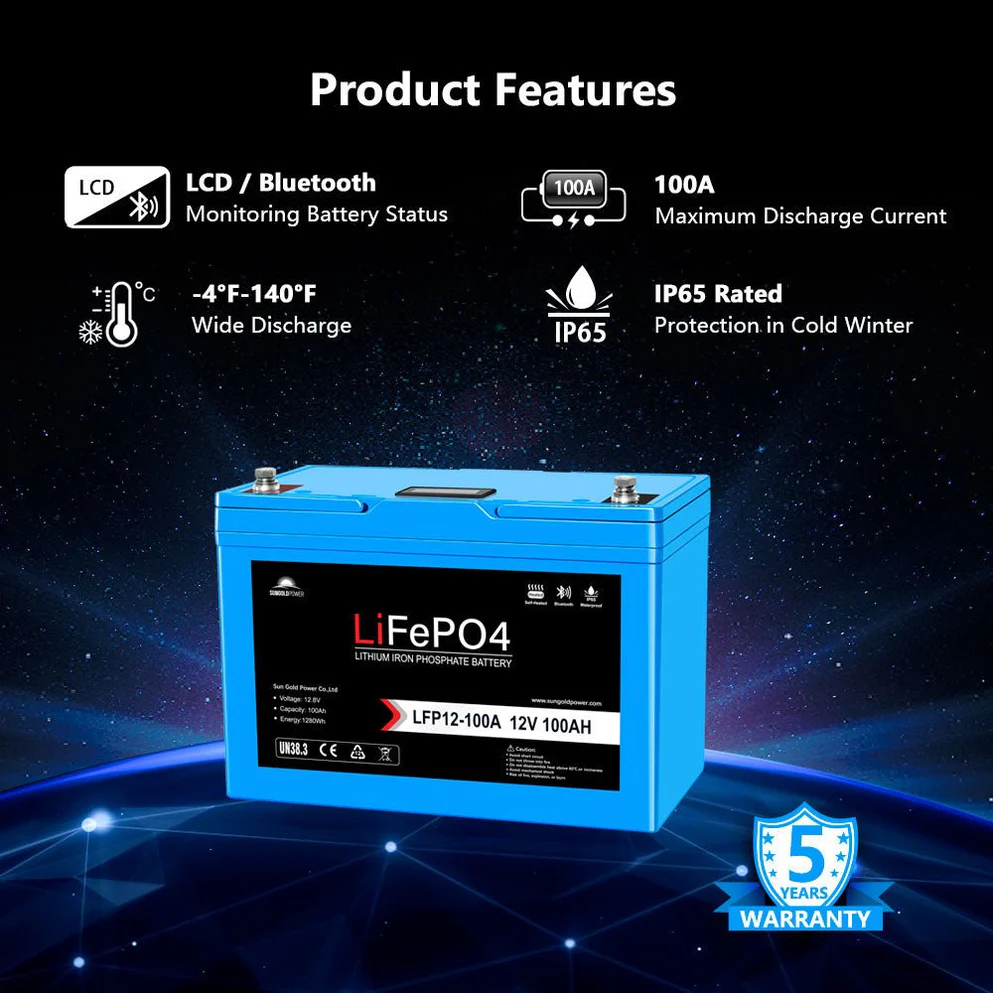
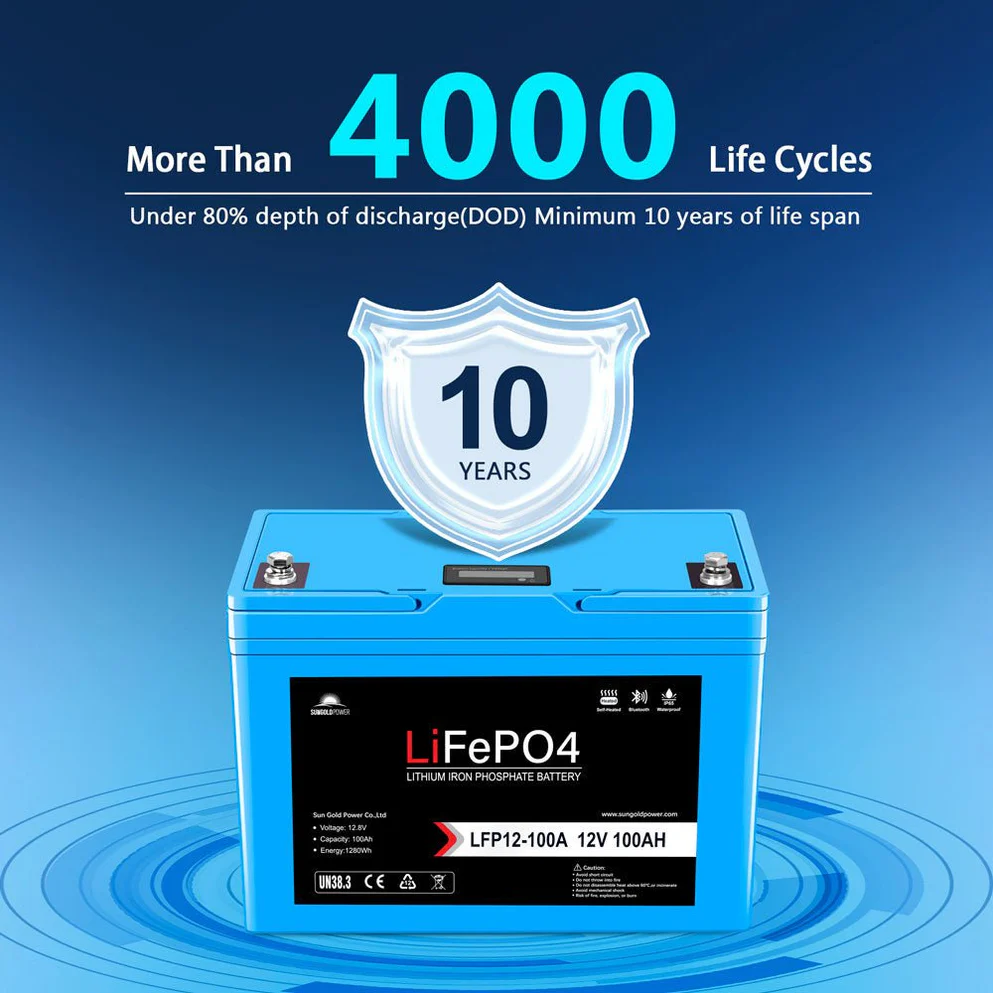
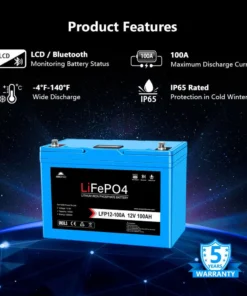
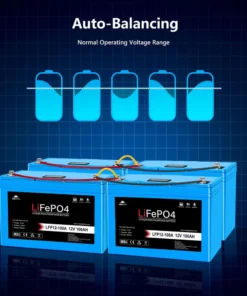
Four SunGoldPower 12V 100Ah LiFePO4 solar battery units in parallel form a 400Ah bank at 12V — 5,120Wh of stored energy — at a total weight of 90.8 lb, which is roughly half the weight of a lead-acid bank of equivalent usable capacity. Each unit delivers more than 4,000 cycles at 80% depth of discharge, includes a self-heating function for cold-climate charging reliability, carries an IP65 ingress protection rating, and monitors cell-level data via Bluetooth BMS. This is a capable starting point for a standalone off-grid solar system, a full-season RV house bank, or a marine installation where the weight savings over lead-acid translate directly into usable payload.
Table of Contents
- Specifications
- Why Four 100Ah Units Instead of Two 200Ah Units
- 400Ah in a Solar System — Practical Capacity Planning
- Parallel Wiring at This Scale
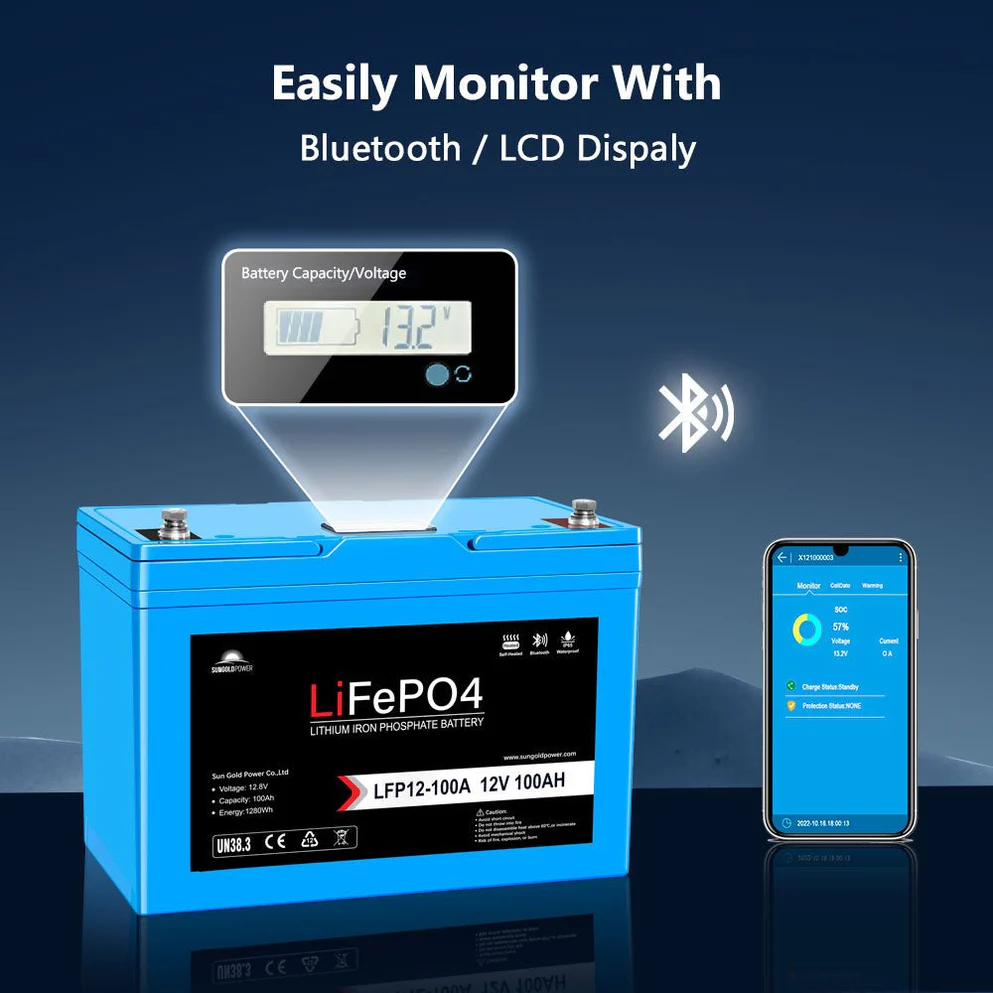
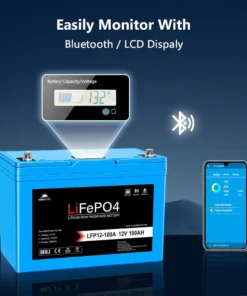
- Bluetooth BMS on Each Unit
- Frequently Asked Questions
Specifications
| Specification | Per Unit | 4-Unit Parallel Bank |
|---|---|---|
| Nominal Voltage | 12.8V | 12.8V |
| Nominal Capacity | 100Ah | 400Ah |
| Energy | 1,280Wh | 5,120Wh |
| Efficiency | >99.5% | >99.5% |
| Voltage Window | 10.8–14.6V | 10.8–14.6V |
| Max Continuous Charge Current | 100A | 400A |
| Peak Discharge Current | 200A (15s + 2s) | 800A |
| Recommended Charge Current | 50A | 200A |
| Recommended Discharge Current | 50A | 200A |
| Cycle Life (0.2C, 77°F, 80% DOD) | ≥4,000 | ≥4,000 |
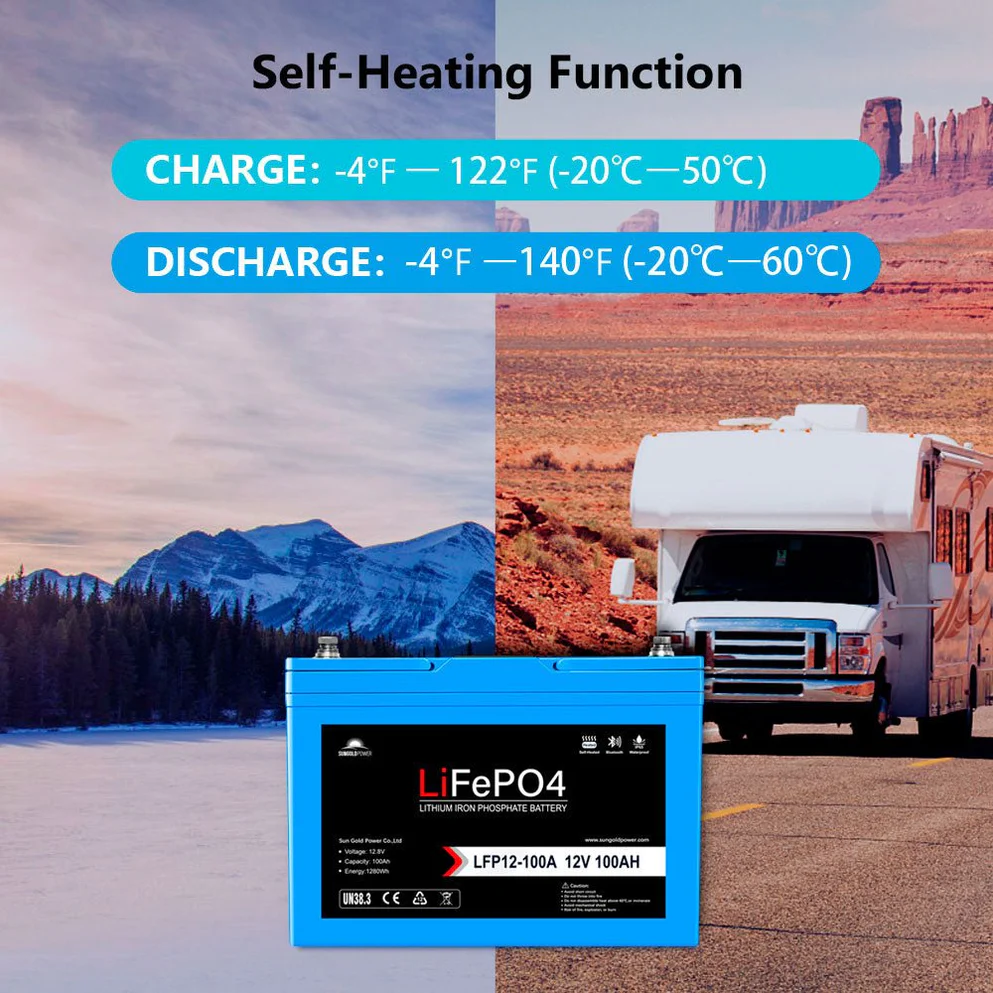
| Charge Temperature | -4°F to 113°F | -4°F to 113°F |
| Discharge Temperature | -4°F to 131°F | -4°F to 131°F |
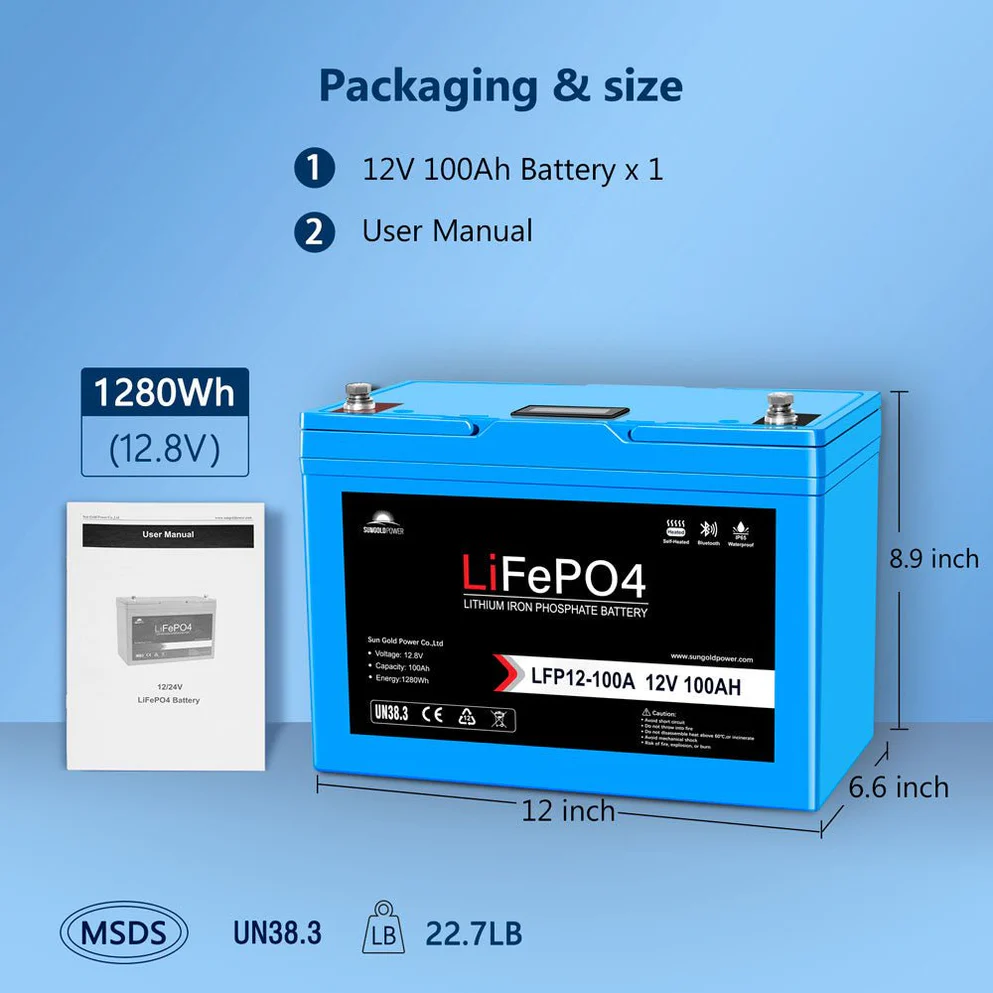
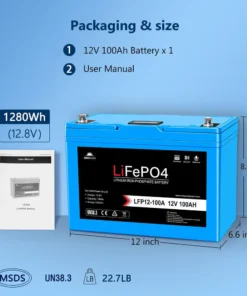
| Dimensions (L×W×H) | 12 × 6.6 × 8.9 in | — |
| Weight per unit | 22.7 lb | 90.8 lb total |
| Terminal Type | M8 | M8 |
| IP Grade | IP65 | IP65 |
| Monitoring | LCD + Bluetooth per unit | 4 independent BMS |
Why Four 100Ah Units Instead of Two 200Ah Units
The choice between four 100Ah units and two 200Ah units for a 400Ah bank involves tradeoffs worth understanding before committing to either configuration.
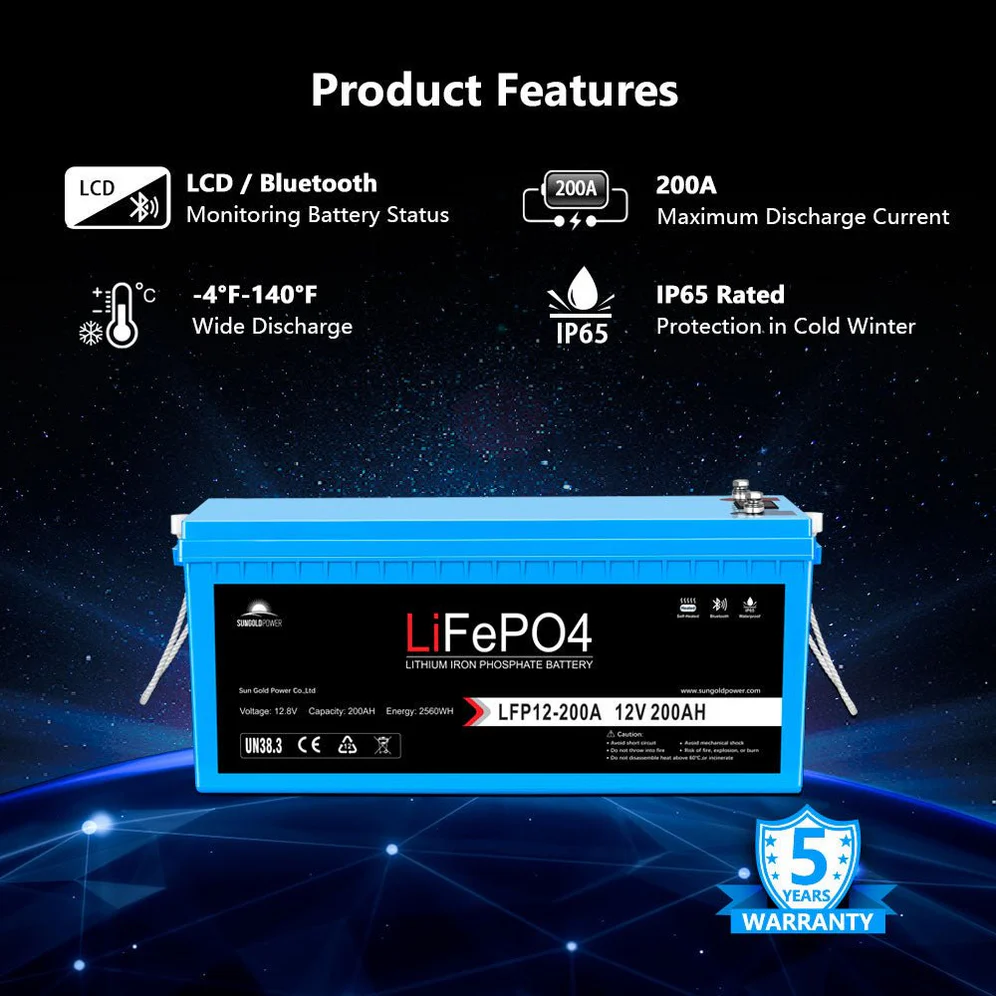
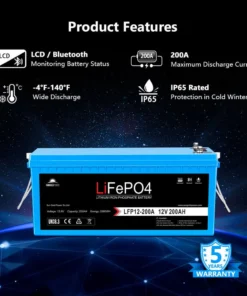
- Physical size: The 100Ah unit measures 12 × 6.6 × 8.9 inches and weighs 22.7 lb. Four of them are easier to move, position, and install in tight battery compartments than two 200Ah units at 19.7 × 9.4 × 9.1 inches and 48.5 lb each. In RV bays and sailboat bilge compartments where access is restricted, the smaller unit is often the practical choice.
- Redundancy: Four independent BMS units provide more granular fault isolation. If one 100Ah unit’s BMS trips, 300Ah of the bank continues to operate. If one 200Ah unit trips in a two-unit bank, 50% of capacity is lost.
- Incremental scaling: Four 100Ah units is the maximum parallel configuration for this model, so the bank cannot expand further. If future expansion is anticipated, the 200Ah units reaching the same four-unit maximum at 800Ah may be the better long-term choice.
400Ah in a Solar System — Practical Capacity Planning
At 80% depth of discharge, a lifepo4 battery solar bank of 400Ah provides 320Ah of regularly accessible capacity — 4,096Wh. For a 12V off-grid solar system:
- A 1,500W load running through an inverter draws approximately 125A from the 12V bank per hour — the 320Ah accessible capacity provides roughly 2.5 hours of that continuous load.
- A realistic cabin off-grid profile drawing 50W average continuously — refrigerator cycling, LED lighting, phone charging, a fan — consumes 50Wh per hour, drawing approximately 3.9Ah per hour from the 12V bank. The 320Ah accessible capacity covers approximately 82 hours of that average load profile — more than three days of autonomy.
- Solar replenishment at 100A charging current (1,280W at 12.8V from a matching solar array) restores the bank from 50% to full in approximately two hours of peak production.
Parallel Wiring at This Scale
Four units require the same wiring discipline as described for the 200Ah bank, with one additional consideration: the 100Ah units are lighter and easier to move, which means installers sometimes rush the wiring phase. The cable length and gauge requirements are equally strict regardless of unit weight.
Each of the four units connects directly to a common busbar — not daisy-chained from unit to unit. Cable length from each battery terminal to the busbar should be identical within a few inches. Gauge should be sized for the maximum expected current per cable run, not the total bank current.
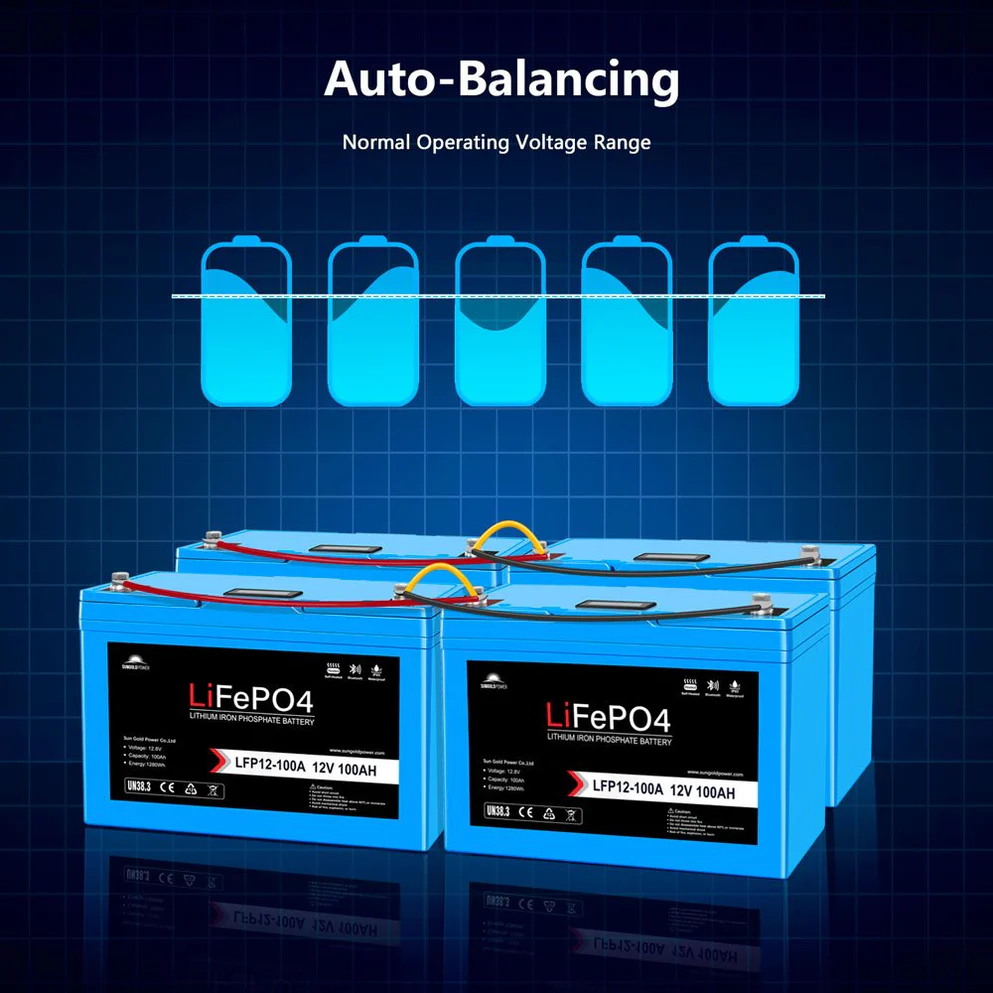
After installation, confirm balance using the Bluetooth BMS on each unit — all four should show similar charge and discharge currents during a complete cycle before the installation is considered complete.
Bluetooth BMS on Each Unit
Four independent Bluetooth BMS units mean four independent data streams. Most BMS apps display one unit at a time — cycle through each unit after installation and during the first few charge/discharge cycles to confirm that all four are performing consistently. Any unit showing significantly different cell voltages, state of charge, or current at the same point in a cycle warrants investigation before regular use.
Browse our full 12V LiFePO4 Batteries, Solar Battery Banks, and Off-Grid Solar Systems for compatible busbars, charge controllers, and inverters.
Frequently Asked Questions
Q: Why choose four 100Ah units over two 200Ah units for a 400Ah bank? The 100Ah units are smaller and lighter — easier to install in tight compartments — and provide more granular fault redundancy since each has an independent BMS. The 200Ah units in a two-unit bank deliver the same total capacity with fewer connection points and simpler wiring. The right choice depends on physical installation constraints and whether redundancy or simplicity matters more for the application.
Q: What solar array is needed to charge a 400Ah bank in one day? To charge 320Ah of usable capacity (80% DOD) within six hours of peak solar production, the charge controller needs to deliver approximately 53A continuously — roughly 680W at 12.8V. A 1,000W solar array with a 60–80A MPPT controller provides comfortable margin. Larger arrays shorten charge time and provide more buffer on partially cloudy days.
Q: Can this bank power a 2,000W inverter? Yes. The four-unit parallel bank delivers up to 200A continuously at 12V — approximately 2,560W of continuous DC power, sufficient to run a 2,000W inverter at full load accounting for inverter efficiency losses. Peak discharge of 800A supports large inrush currents from motor loads during startup.
Q: How does the IP65 rating hold up in a marine bilge? IP65 certifies protection against dust ingress and sustained water jets — it does not certify submersion protection. For a bilge installation subject to occasional water splash and condensation, IP65 is appropriate. For any installation where the battery could be submerged, IP67 or IP68 is required.
Q: What is the batterie 12v lithium cycle life compared to AGM? A batterie 12v lithium LiFePO4 at 4,000 cycles compares to 300–500 cycles for a quality AGM battery at the same 80% depth of discharge. Over the typical ten-year service life of an off-grid solar installation, a single set of LiFePO4 batteries covers the entire period, while AGM batteries typically require three to four replacement sets at equivalent cost or more.
Be the first to review “LiFePO4 Solar Battery 4×100Ah Authentic 12V IP65 BMS”
Related products
Lithium Solar Batteries
Lithium Solar Batteries
Lithium Solar Batteries
Lithium Solar Batteries
Lithium Solar Batteries
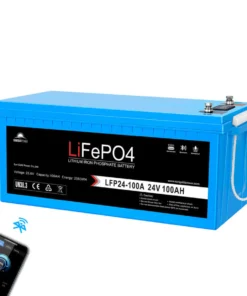
Premium Solar Batteries for Sale-24V 100Ah LiFePO4 Lithium Battery
Lithium Solar Batteries
Lithium Solar Batteries
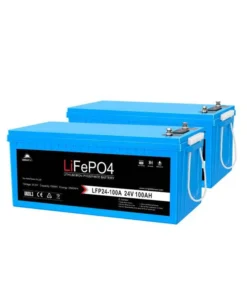
2× 24V 100Ah LiFePO4 Deep Cycle Lithium Battery — Bluetooth / Self-Heating / IP65
Reviews
There are no reviews yet.