
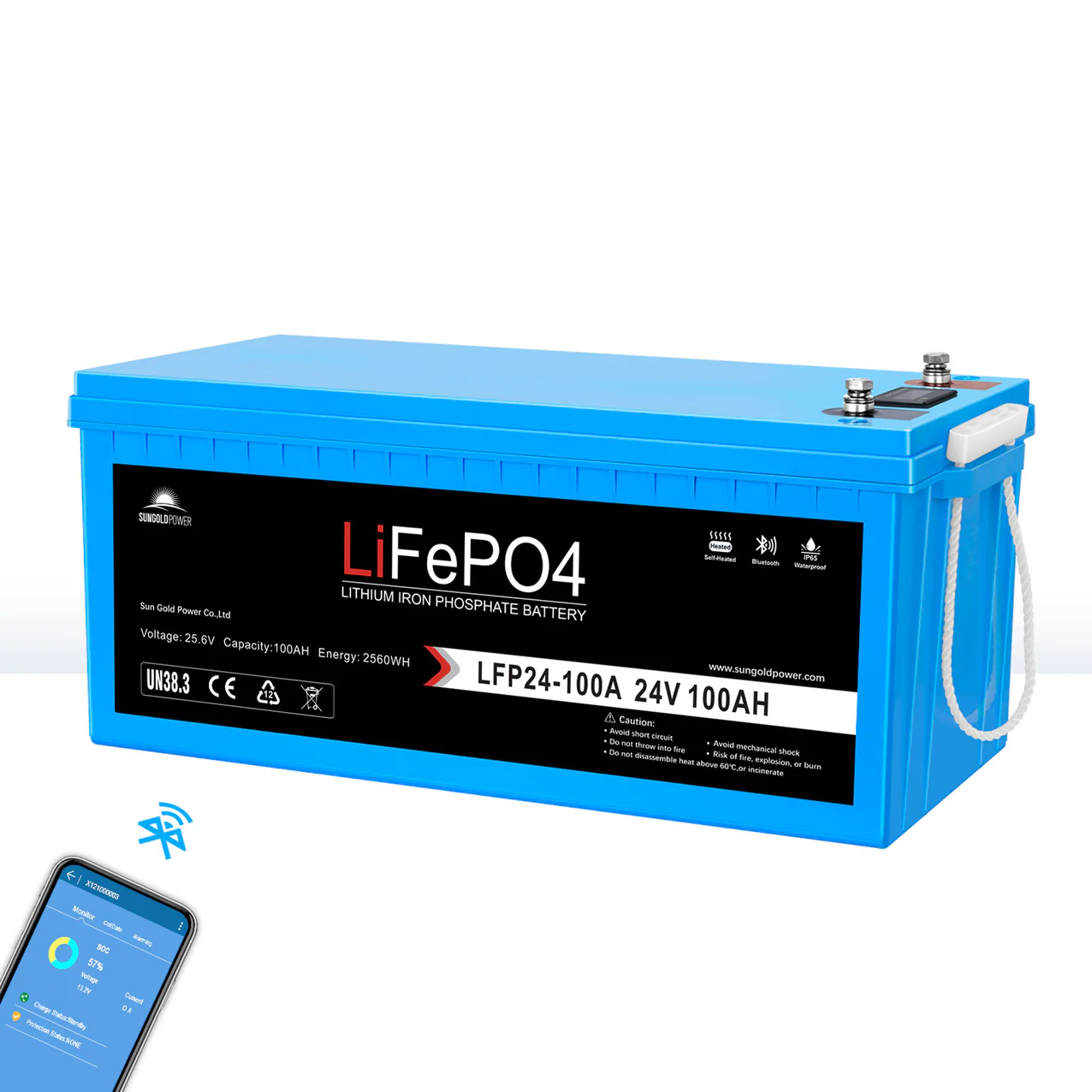
24V Solar Battery 100Ah LiFePO4 — Authentic [IP65 + BMS]
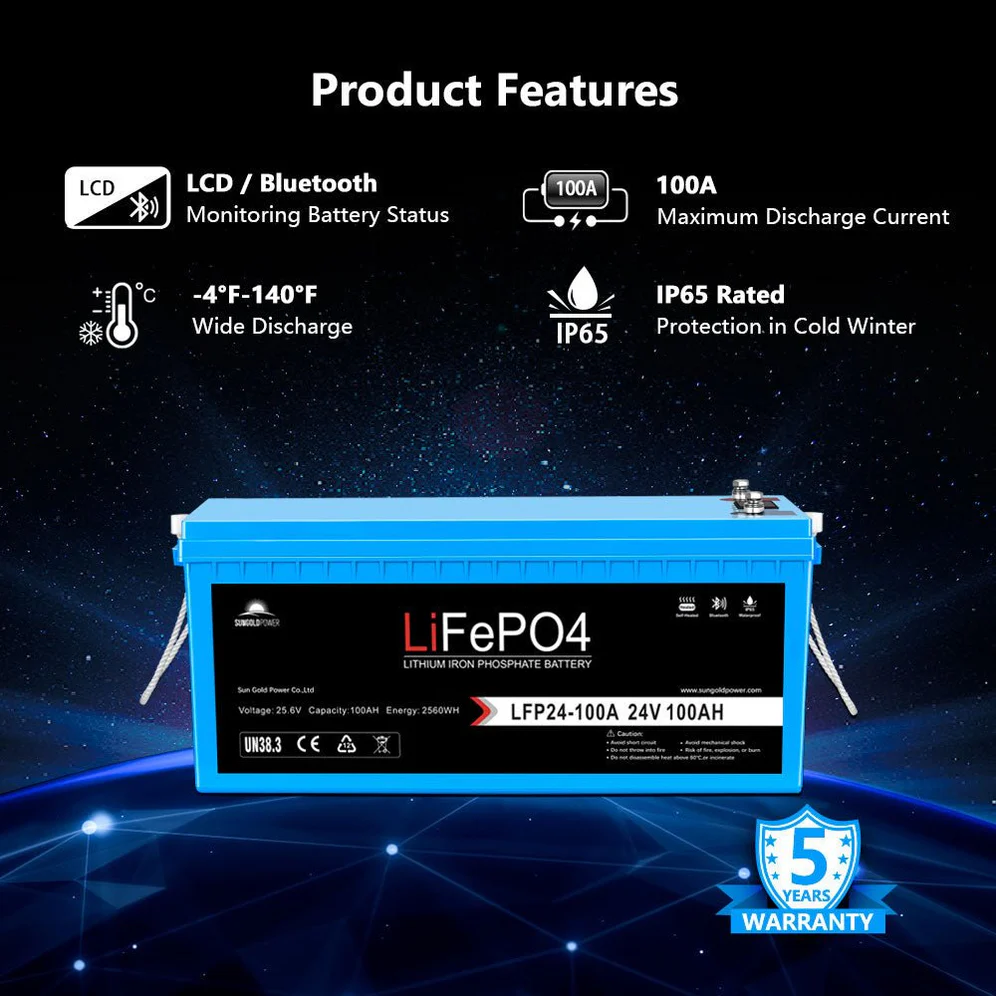
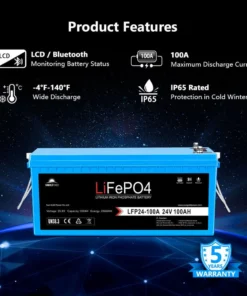
The 24V solar battery that handles the conditions cheaper lithium batteries cannot — self-heating activation below 33.8°F, IP65 sealed enclosure, 4,000+ deep cycle rating and a 100A BMS that monitors every cell in real time through Bluetooth. This 100Ah LiFePO4 (Lithium Iron Phosphate) unit delivers 2,560Wh of usable energy storage at 25.6V nominal, built on automotive-grade Grade A cells with UL1973 certification and a 5-year warranty. It is the appropriate choice for RV, van life, off-grid cabin, marine and backup power installations where cycle life, cold-weather performance and genuine IP protection are non-negotiable specifications.
Table of Contents
- Complete Product Specifications
- Self-Heating — Why Cold-Weather Battery Performance Is Non-Negotiable
- IP65 Enclosure — What the Rating Actually Confirms
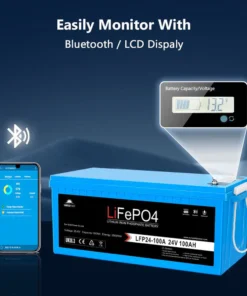
- Bluetooth BMS — Real-Time Monitoring from Any Smartphone
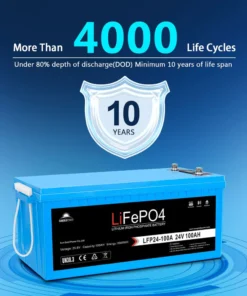
- 4,000+ Cycle Life — The Long-Term Economics of LiFePO4
- Grade A UL1973-Certified Cells — The Foundation of Everything
- Parallel Expansion — Building a Larger Storage System
- FAQ
Complete Product Specifications
| Parameter | Detail |
|---|---|
| Nominal Characteristics | |
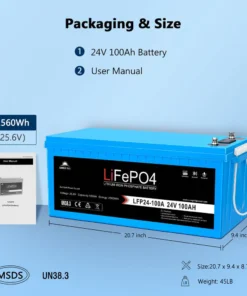
| Nominal Voltage | 25.6V |
| Nominal Capacity | 100Ah |
| Nominal Energy | 2,560Wh (2.56kWh) |
| Efficiency | >99.5% |
| Recommended Connection | Parallel |
| Charge and Discharge | |
| Voltage Window | 21.6–29.2V |
| Max Continuous Charge Current | 100A |
| Peak Discharge Current | 200A ±3A (10s) |
| Recommended Charge Current | 50A |
| Recommended Discharge Current | 50A |
| Operating Conditions | |
| Cycle Life (0.2C, 77°F, 80% DOD) | 4,000+ cycles |
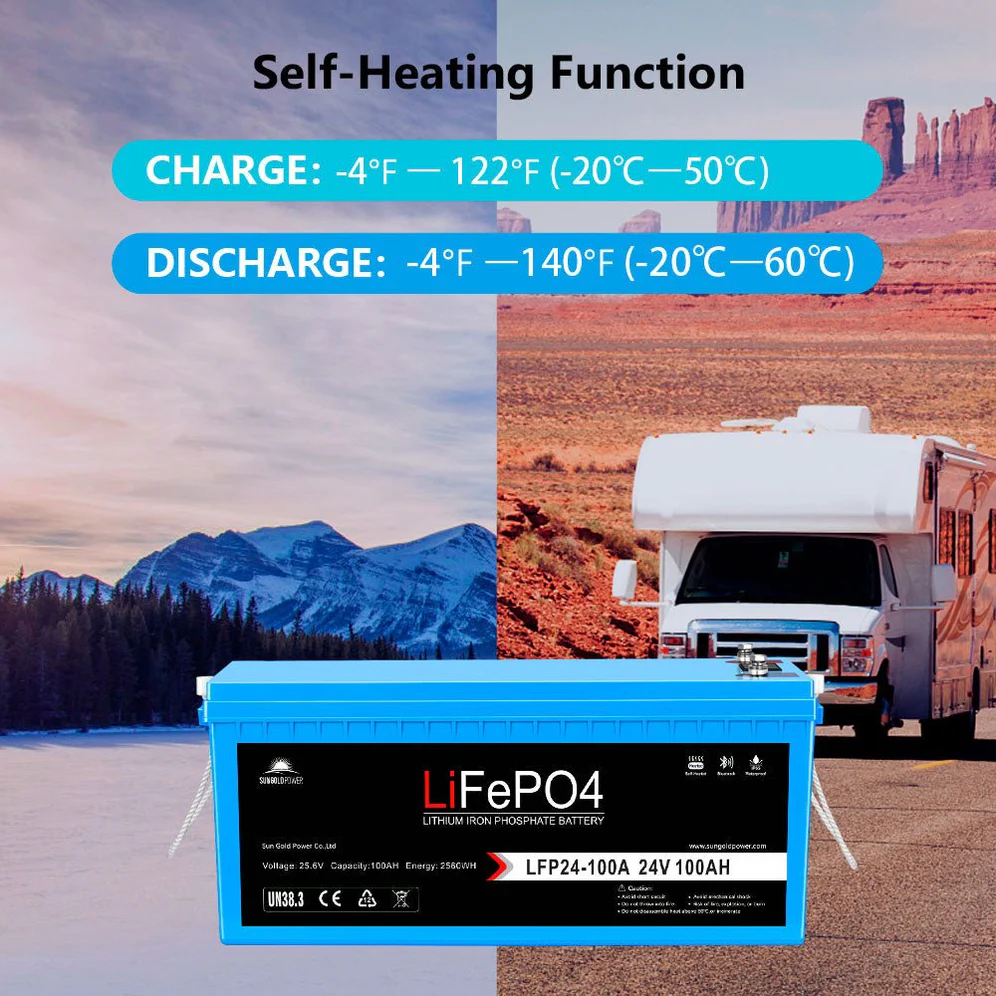
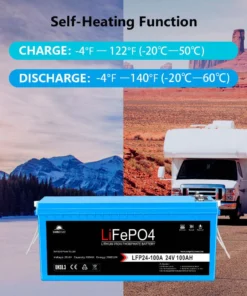
| Charge Temperature Range | -4°F to 113°F (-20°C to 45°C) |
| Discharge Temperature Range | -4°F to 131°F (-20°C to 55°C) |
| Mechanical | |
| Case Material | ABS |
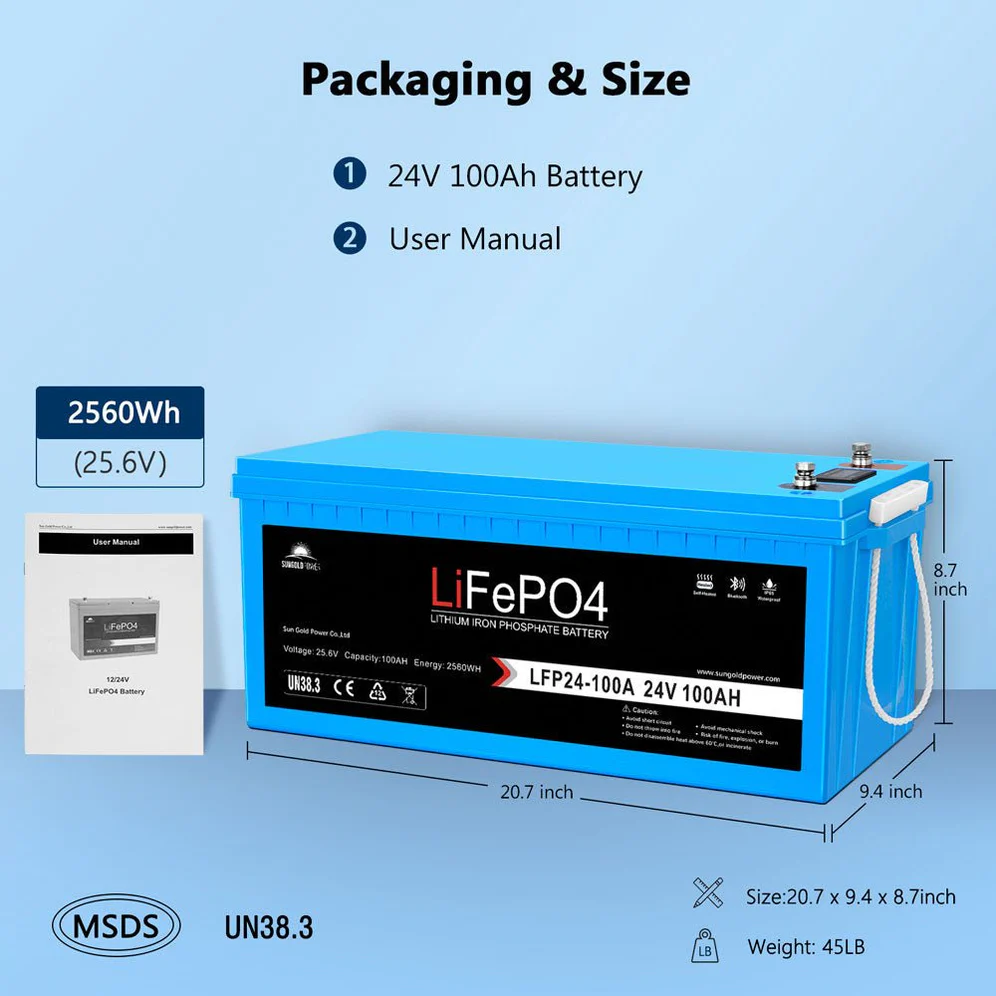
| Dimensions (L×W×H) | 20.7 × 9.4 × 8.7 inch |
| Weight | 45 lb |
| IP Grade | IP65 |
| BMS and Monitoring | |
| Monitoring | LCD display |
| BMS Communication | Bluetooth (M865) |
| Cell Certification | UL1973 |
| Warranty | 5 Years |
Self-Heating — Why Cold-Weather Battery Performance Is Non-Negotiable
Standard LiFePO4 batteries face a fundamental electrochemical limitation in cold temperatures: as cell temperature drops toward and below freezing, internal resistance rises and charge acceptance falls sharply. A battery that accepts 50A of charge current at 77°F may accept only 10–15A at 14°F — and below 14°F, charging a cold LiFePO4 cell causes irreversible lithium plating on the anode, permanently degrading capacity.
This unit’s self-heating system eliminates the problem entirely.
- Auto-activation threshold: Self-heating activates automatically when cell temperature drops below 33.8°F (1°C) — before the charge-acceptance penalty becomes significant.
- Deactivation threshold: Heating stops when cell temperature reaches 42.8°F (6°C) — a narrow activation band that minimises the energy consumed by heating while ensuring the cells are always within their optimal charge temperature window.
- Practical consequence: This battery charges correctly in a winter campsite, an unheated boat bilge or a cold-climate cabin — environments where a solar panel batteries installation without self-heating would accumulate charge damage across every cold-weather charging cycle.
The self-heating function consumes a small amount of stored energy to operate — in extremely cold conditions this represents a minor energy overhead, but the alternative is battery damage that reduces capacity permanently and shortens service life far below the rated 4,000-cycle specification.
IP65 Enclosure — What the Rating Actually Confirms
IP65 is an IEC (International Electrotechnical Commission) standard rating that confirms two things: the “6” means complete protection against dust ingress — no dust particle enters the enclosure under any test condition. The “5” means protection against water projected from a nozzle at any direction. This is not splash resistance or humidity resistance — it is tested against a 6.3 L/min water jet from any angle for 15 minutes.
For solar batteries for sale buyers evaluating storage location options, the practical consequence of IP65 is significant:
- Engine compartments and bilges: Salt spray, condensation and spray from road water are all within IP65 protection scope.
- Outdoor ground-mount installations: Rain, garden hoses and cleaning washdowns are all within protection scope.
- Unheated sheds and garages: Condensation from temperature cycling is fully managed.
- Marine applications: Bilge exposure and spray on open-water vessels are within IP65 scope.
A battery without IP65 rating requires a weatherproof enclosure in any of these environments. This unit does not.
Bluetooth BMS — Real-Time Monitoring from Any Smartphone
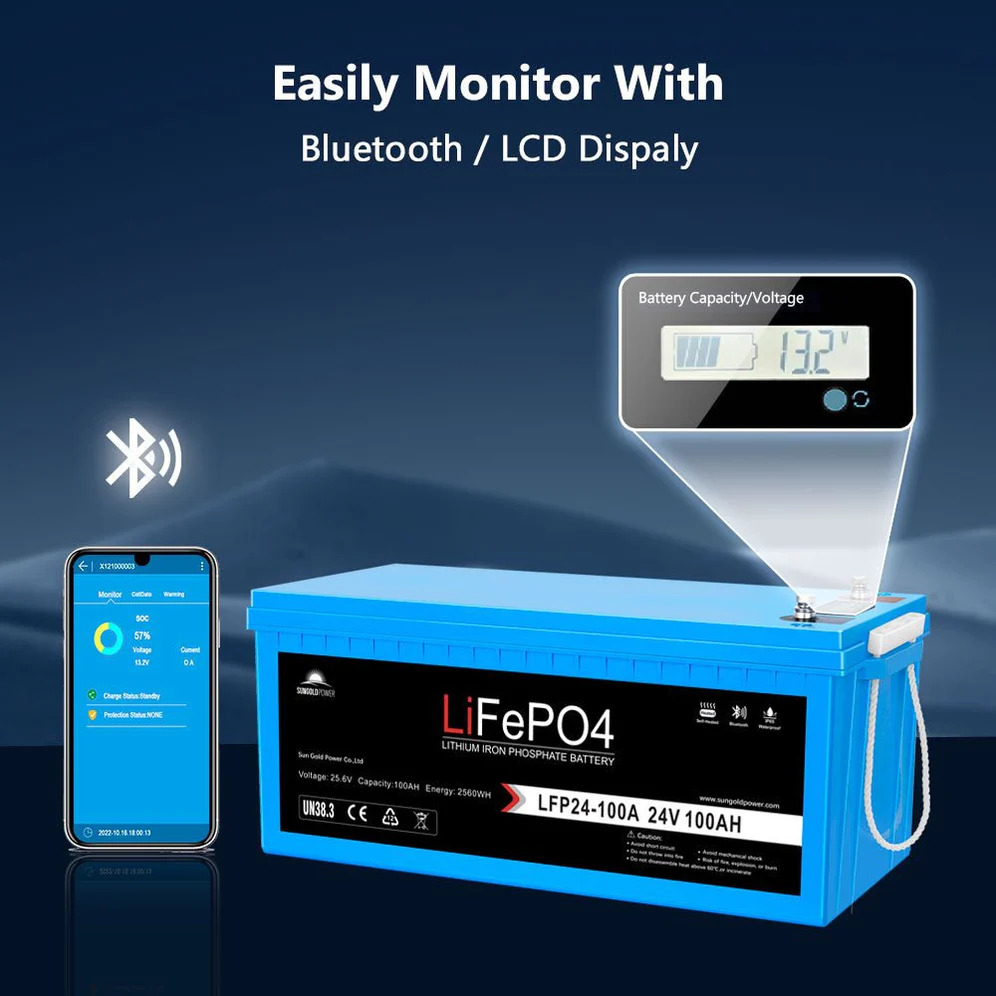
The M865 Bluetooth module transmits real-time battery data to any paired smartphone — no separate monitoring hardware, no wiring runs to a display, no additional cost. The data transmitted includes:
- State of charge (SOC): Percentage of remaining capacity in real time, updated continuously.
- Voltage: Cell-level and pack-level voltage, enabling early identification of cell imbalance.
- Current: Instantaneous charge and discharge current, confirming that charging sources and loads are operating within specification.
- Temperature: Cell temperature monitoring, confirming self-heating activation and deactivation events.
The LCD display on the battery provides the same data without the smartphone connection — useful for installations where Bluetooth range or phone availability is a constraint.
For a lithium solar batteries installation in an RV, van or remote cabin, the Bluetooth monitoring eliminates the guesswork around battery state that characterises older lead-acid monitoring approaches — state of charge is accurate, instantaneous and visible from anywhere the phone has Bluetooth range.
4,000+ Cycle Life — The Long-Term Economics of LiFePO4
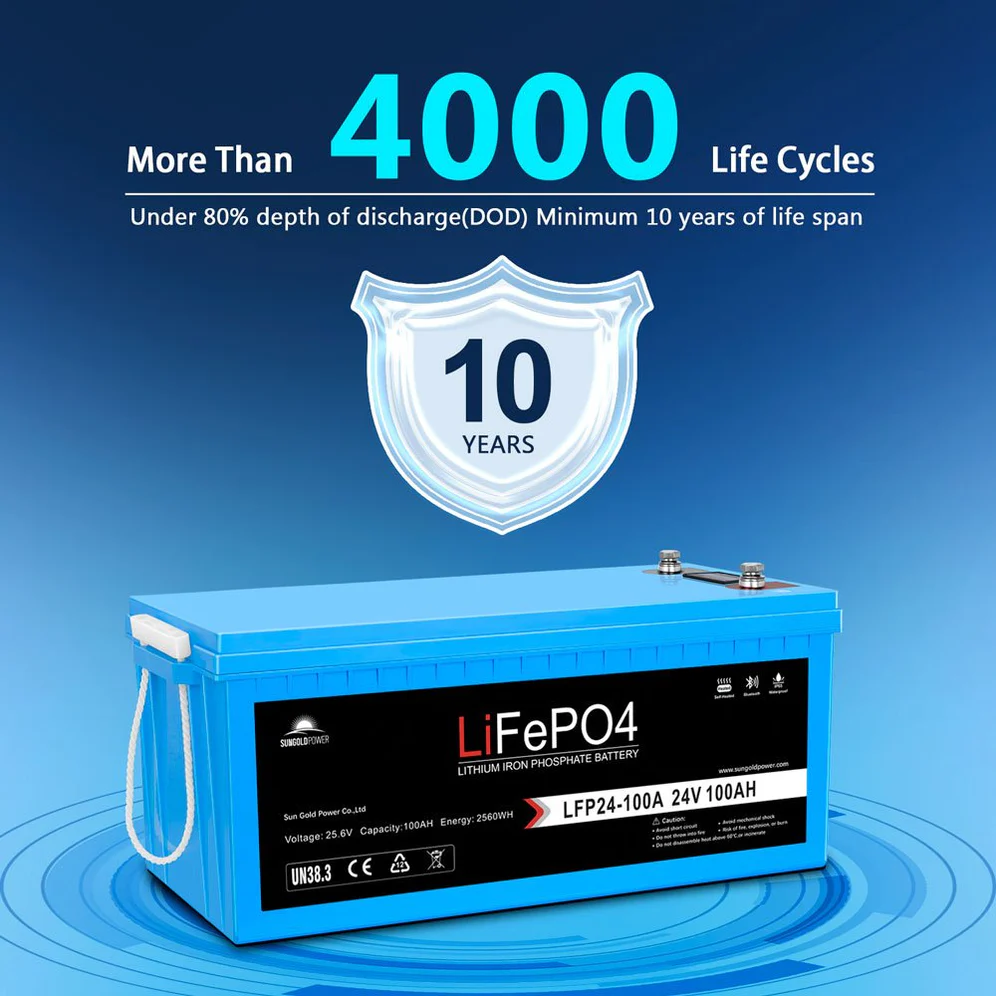
Four thousand cycles at 80% depth of discharge (DOD), measured at 0.2C rate and 77°F — this is the rated cycle life that determines the long-term value of this 24V solar battery relative to lead-acid alternatives.
At one charge-discharge cycle per day — the standard usage pattern for an off-grid solar installation — 4,000 cycles represents approximately 11 years of daily use before capacity falls below 80% of rated. The actual calendar life at this cycle rate aligns with the 10-year lifetime statement in the product documentation.
Compare this to sealed lead-acid (SLA) batteries commonly used in solar and RV applications: typical cycle life at 80% DOD is 300–500 cycles — approximately 1–1.5 years of daily cycling. A 24V 100Ah SLA bank requires replacement approximately 8 times in the period a LiFePO4 battery of equivalent capacity serves the same installation. The total cost over 11 years — purchase price plus 7 replacement cycles — consistently favours LiFePO4 despite the higher initial cost.
Grade A UL1973-Certified Cells — The Foundation of Everything
UL1973 is the Underwriters Laboratories standard for stationary and motive battery systems used in light electric rail applications and stationary energy storage. Cells manufactured to this standard have been independently evaluated for electrical performance, thermal management, mechanical integrity and abuse tolerance — characteristics that directly determine how a battery behaves under the real-world stress of deep cycling, high-rate discharge and thermal extremes.
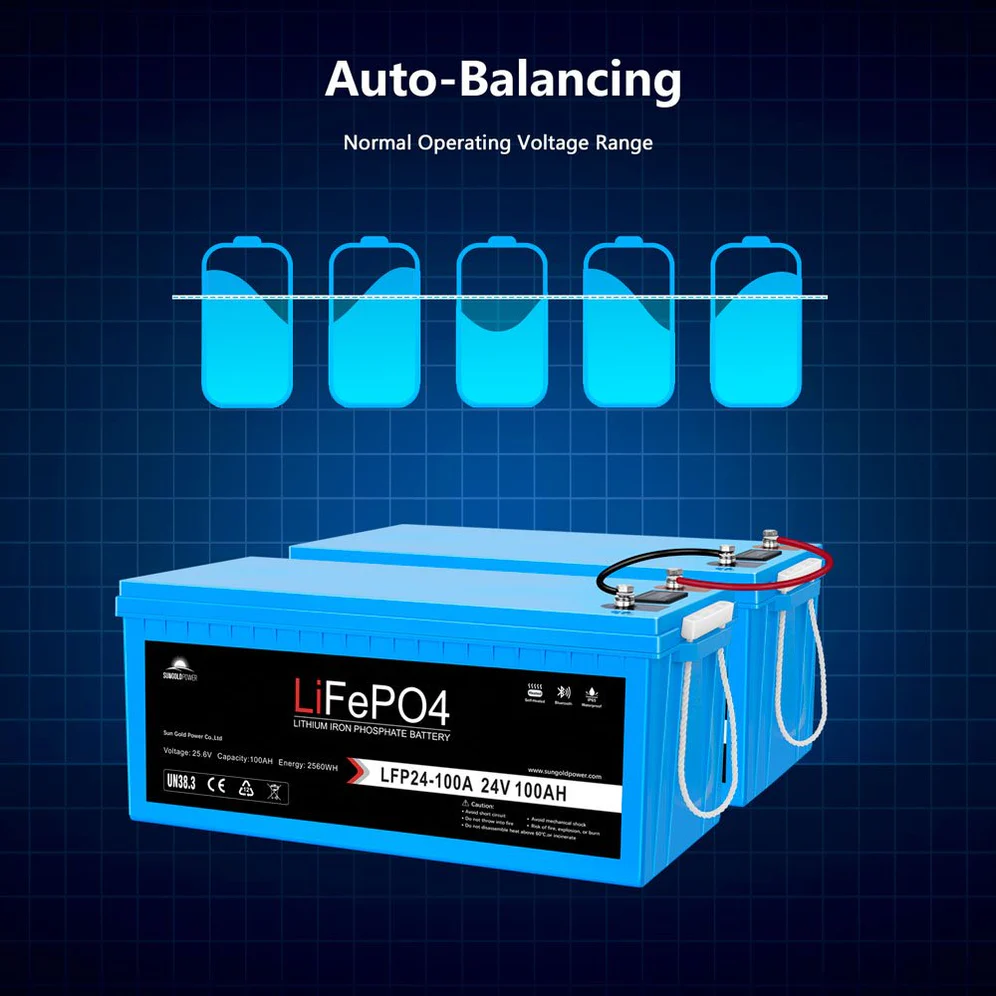
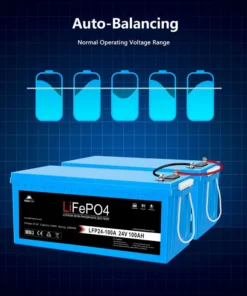
Grade A cell designation means the cells used in this battery are first-quality production cells — not B-grade cells with capacity deviations or cosmetic defects, and not recycled cells extracted from other battery systems. Grade A cells exhibit tighter capacity matching across cells in the same pack, which reduces the burden on the BMS to manage imbalance and extends the effective service life of the assembled battery.
Parallel Expansion — Building a Larger Storage System
Connect multiple units in parallel to increase total system capacity without increasing voltage — parallel connection keeps the bank at 24V while multiplying the amp-hours and watt-hours proportionally.
- 2 units in parallel: 200Ah, 5.12kWh
- 4 units in parallel: 400Ah, 10.24kWh
- More units: Scale further as energy requirements grow
For series/parallel configurations targeting 48V system voltage: connect two 24V units in series to create a 48V / 100Ah bank (5.12kWh), then add additional series pairs in parallel for higher capacity.
Explore compatible solar charge controllers and inverter chargers in our Solar Battery Storage, Off-Grid Solar Systems and Solar Kits categories.
FAQ
What makes this a better 24V solar battery than lead-acid alternatives at the same capacity? 4,000 cycles at 80% DOD versus 300–500 cycles for sealed lead-acid at the same depth — LiFePO4 lasts approximately 8–10 times longer in daily solar cycling applications. Combined with the flat discharge curve (voltage holds near nominal until near-full depletion rather than dropping progressively), accurate Bluetooth state-of-charge monitoring and self-heating for cold-weather charging, this unit outperforms lead-acid on every metric that matters for a long-term solar installation.
Can a 12V solar panel charge a 24V battery? No — a standard 12V solar panel produces open-circuit voltages of approximately 18–22V and cannot charge a 24V battery bank that requires a minimum charge voltage of approximately 25.6V. Charging a 24V battery from a 12V panel requires a boost charge controller (MPPT or PWM boost type) that steps up the panel output voltage to the battery’s required charge voltage. A standard 24V MPPT charge controller connected to a 24V panel array — or to a 12V panel array configured for 24V output through series connection — charges this battery correctly.
What are the self-heating specifications and when does it activate? Self-heating activates automatically when cell temperature drops below 33.8°F (1°C) and stops when cell temperature reaches 42.8°F (6°C). The function is fully automatic — no user activation required. It prevents the lithium plating damage that occurs when LiFePO4 cells are charged below freezing, and maintains charge acceptance at the full rated 100A maximum continuous current even in cold-climate installations.
What solar bank size does 4 units in parallel create? Four units in parallel creates a 24V / 400Ah / 10.24kWh solar bank. This capacity is appropriate for an off-grid cabin or large RV consuming approximately 5–8kWh per night, providing full overnight coverage with buffer capacity. Additional units can be added beyond four — the parallel architecture scales continuously as capacity requirements grow.
What does the IP65 rating mean for outdoor and marine installations? IP65 confirms complete dust ingress protection and protection against direct water jets from any angle — the standard that covers rain, spray, hose cleaning and marine bilge exposure. This battery can be installed in outdoor enclosures, engine compartments, open bilge locations and unheated sheds without additional weatherproofing. IP65 does not cover submersion — do not install in locations where the battery may be submerged in water.
| Quantity | 1 Unit, 2 Units, 4 Units |
|---|
Be the first to review “24V 100Ah LiFePO4 Deep Cycle Lithium Battery — Bluetooth / Self-Heating / IP65”
Related products
Lithium Solar Batteries
Lithium Solar Batteries
Lithium Solar Batteries
LiFePO4 200Ah Battery – Premium 48V 200Ah LiFePO4 Battery Price & Performance
Lithium Solar Batteries
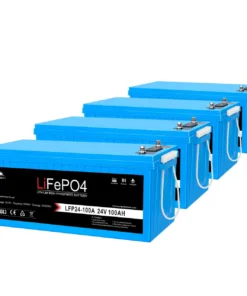
4× 24V 100Ah LiFePO4 Deep Cycle Lithium Battery — Bluetooth / Self-Heating / IP65
Lithium Solar Batteries
Lithium Solar Batteries
PowerMax 51.2V 314Ah Outdoor Energy Storage Battery — UL1973 / UL9540A / CEC Listed
Reviews
There are no reviews yet.