
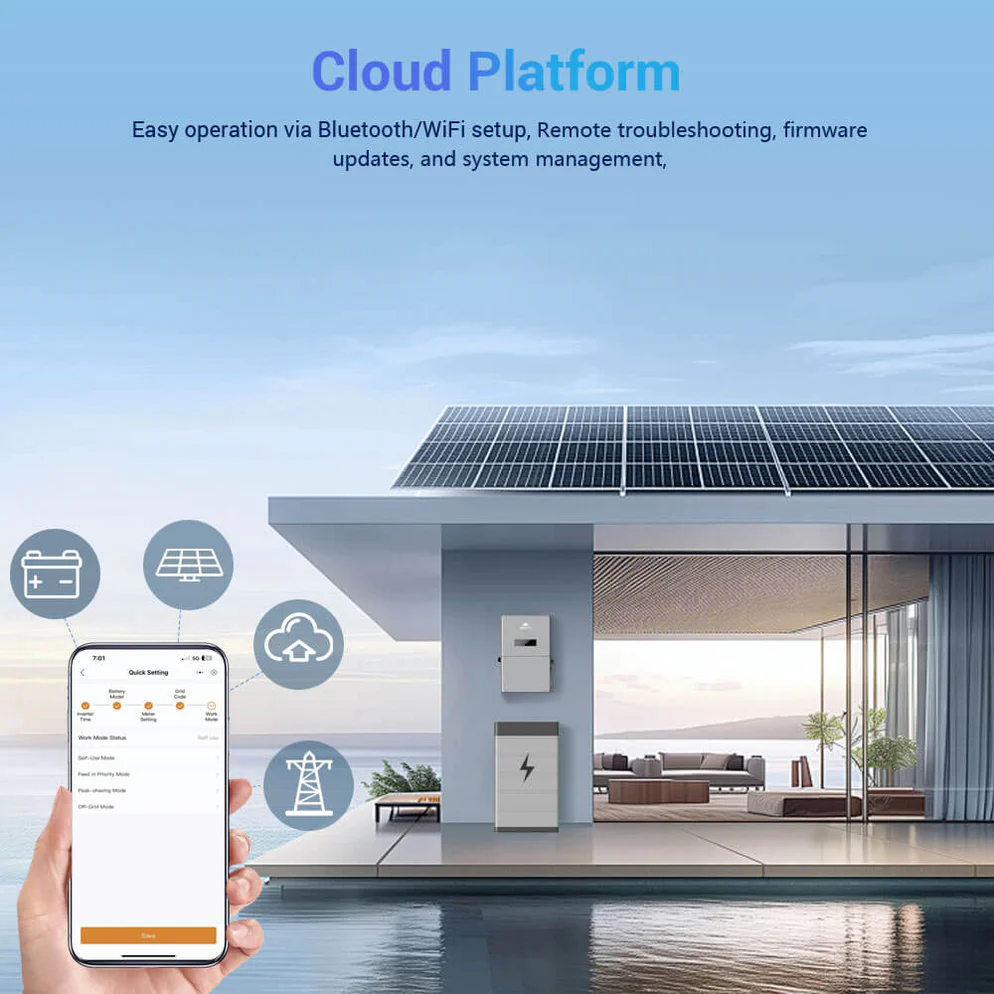
Hybrid Inverter Solar 11.4kW HV — Authentic [APS Transmitter]
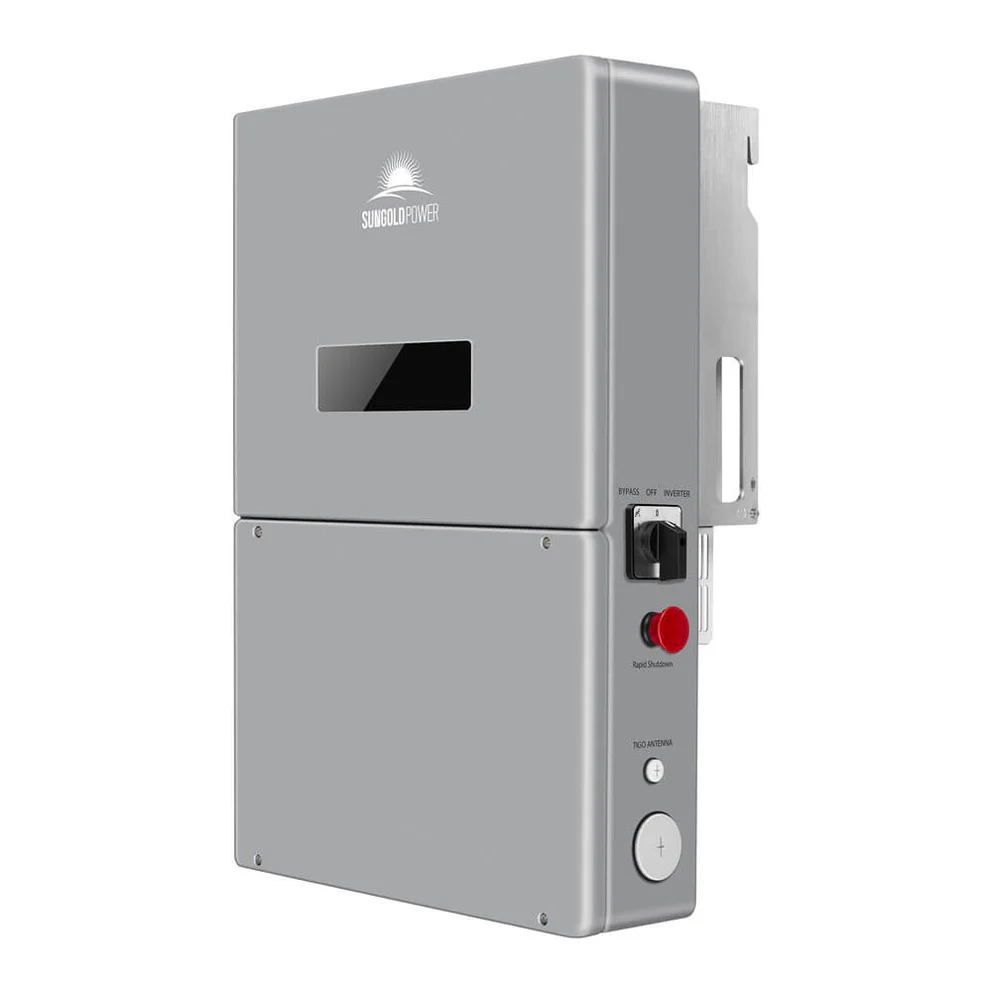
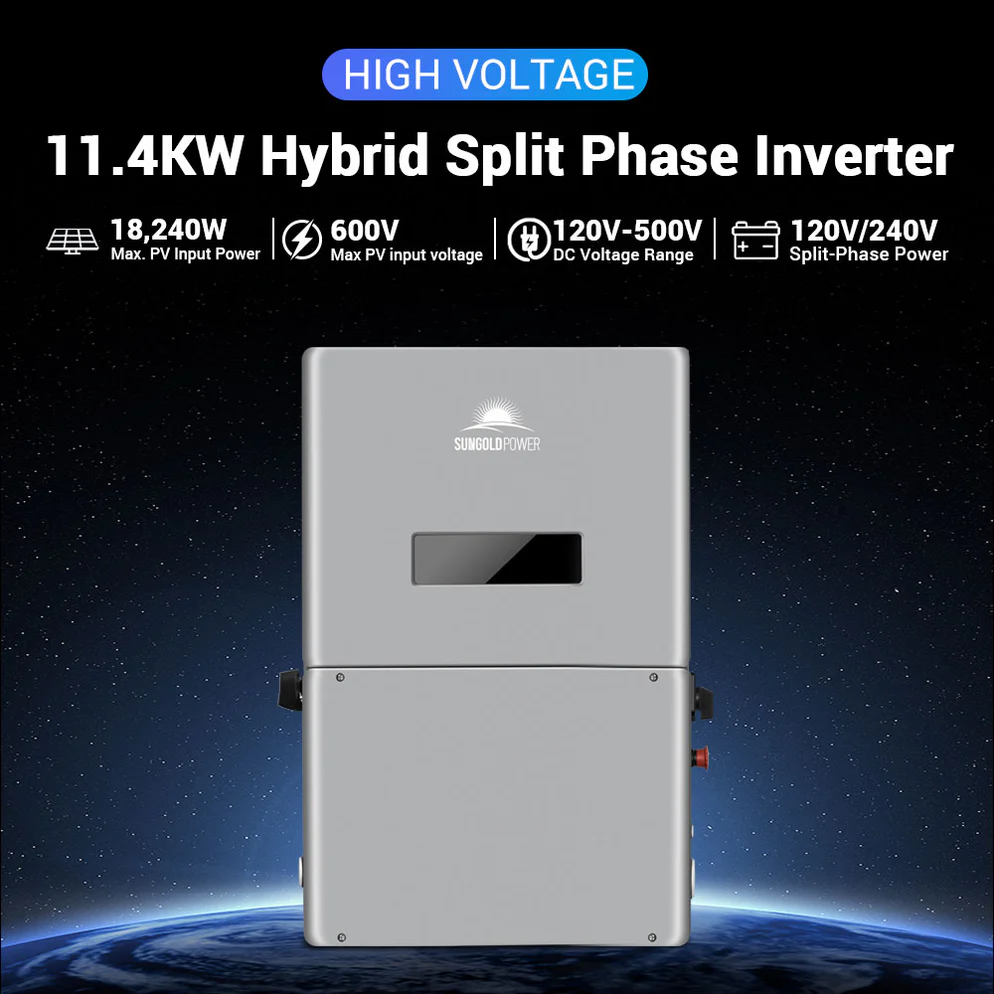
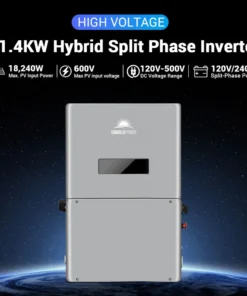
The hybrid inverter solar specification for high voltage battery systems — the SG11.4KHB-HV accepts battery bank voltages from 120V to 500V DC, opening it to the growing range of high-voltage residential storage systems that operate above the 48V nominal standard. At 11,400W continuous split-phase 120/240V output, 18,240W of PV input capacity across four independent MPPT trackers and TYPE 4X / IP66 enclosure rating, this unit is the appropriate choice when the battery architecture requires high-voltage DC, when installation demands the most robust enclosure specification available in the residential inverter class, or when the APS (Advanced Power Sensor) transmitter functionality is required for utility grid interaction compliance. Natural convection cooling — no fans — and operation at 13,120 feet elevation confirm this as the most environmentally resilient hybrid inverter in this batch.
Table of Contents
- Complete Product Specifications
- High Voltage Battery Architecture — 120V to 500V DC
- Four Independent MPPT Trackers
- 97.6% Peak Efficiency — What It Means for Energy Yield
- IP66 TYPE 4X — The Most Robust Enclosure in This Batch
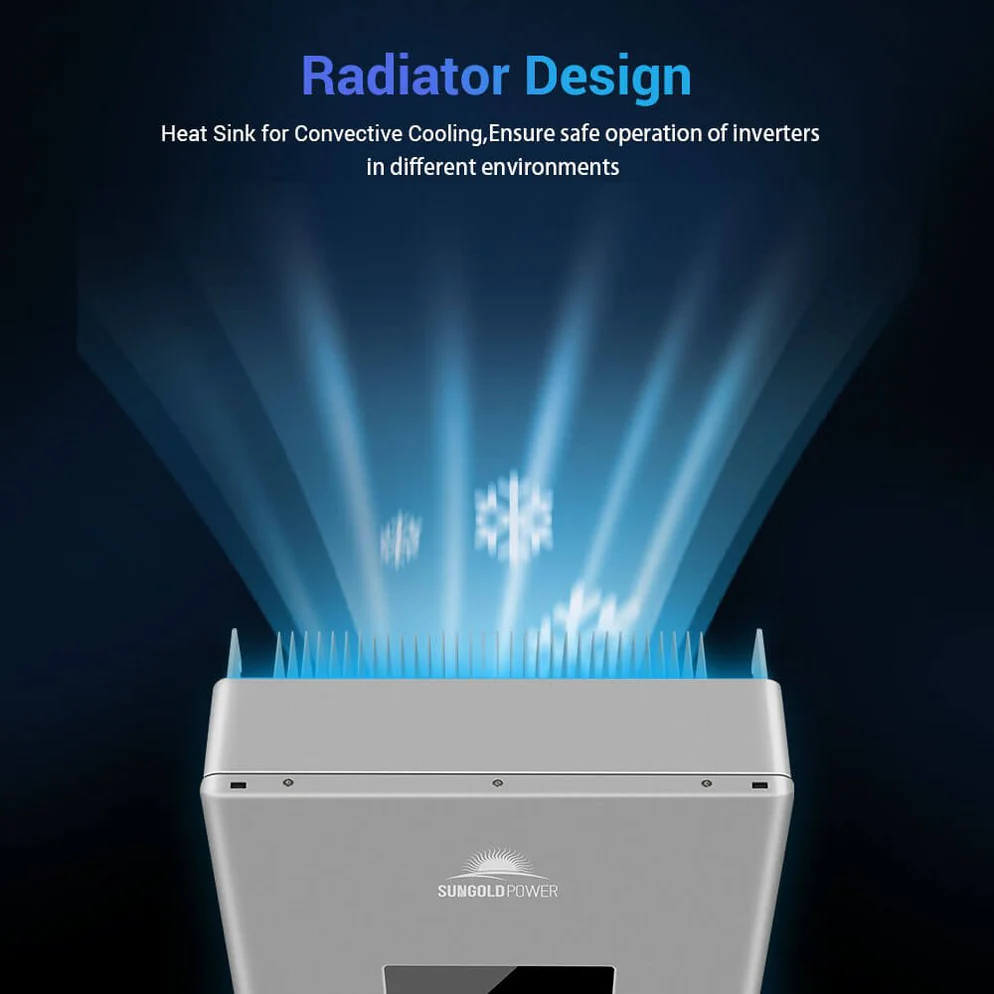
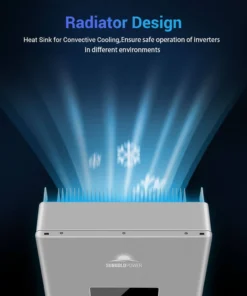
- Natural Convection Cooling — Silent Operation
- APS Transmitter — Advanced Utility Interaction
- Certification Stack — High Voltage Compliance
- FAQ
Complete Product Specifications
| Parameter | SG11.4KHB-HV |
|---|---|
| PV Input | |
| Recommended Max PV Power | 18,240W |
| Max Input Voltage | 600V DC |
| MPPT Voltage Range | 80–550V DC |
| Max Input Current per String | 16A |
| Number of MPPTs / Strings per MPPT | 4 / 1 |
| Energy Storage | |
| Battery Type | Lithium-ion (high voltage) |
| Battery Voltage Range | 120–500V DC |
| Max Charge / Discharge Current | 50A |
| Battery Communication | CAN / RS485 |
| AC Output — Grid | |
| Rated Output Power | 11,400W |
| Rated Output Voltage | 240V, 60Hz |
| Rated Output Current | 47.5A |
| THD (I) | <3% |
| AC Input — Grid | |
| Input Voltage Range | 211–264V AC |
| Max Input Current | 71.3A |
| Frequency Range | 58.8–61.2Hz |
| AC Output — Backup and Off-Grid | |
| Rated Output Power | 11,400W |
| Max Apparent Output Power | 18,200VA (10s peak) |
| Backup Switch Time | <10ms |
| Phase | Split-Phase (240V) |
| AC Output Voltage | 240V AC |
| AC Output Voltage Range | 211–264V AC |
| Rated Frequency | 60Hz |
| Rated Output Current (continuous) | 47.5A |
| Power Factor | >0.99 (0.8 leading – 0.8 lagging) |
| THD (V) at linear load | <3% |
| Efficiency | |
| PV Max Efficiency | 97.6% |
| BAT Charged by PV Max Efficiency | 98.5% |
| BAT Charged/Discharged to AC Max | 97.0% |
| General | |
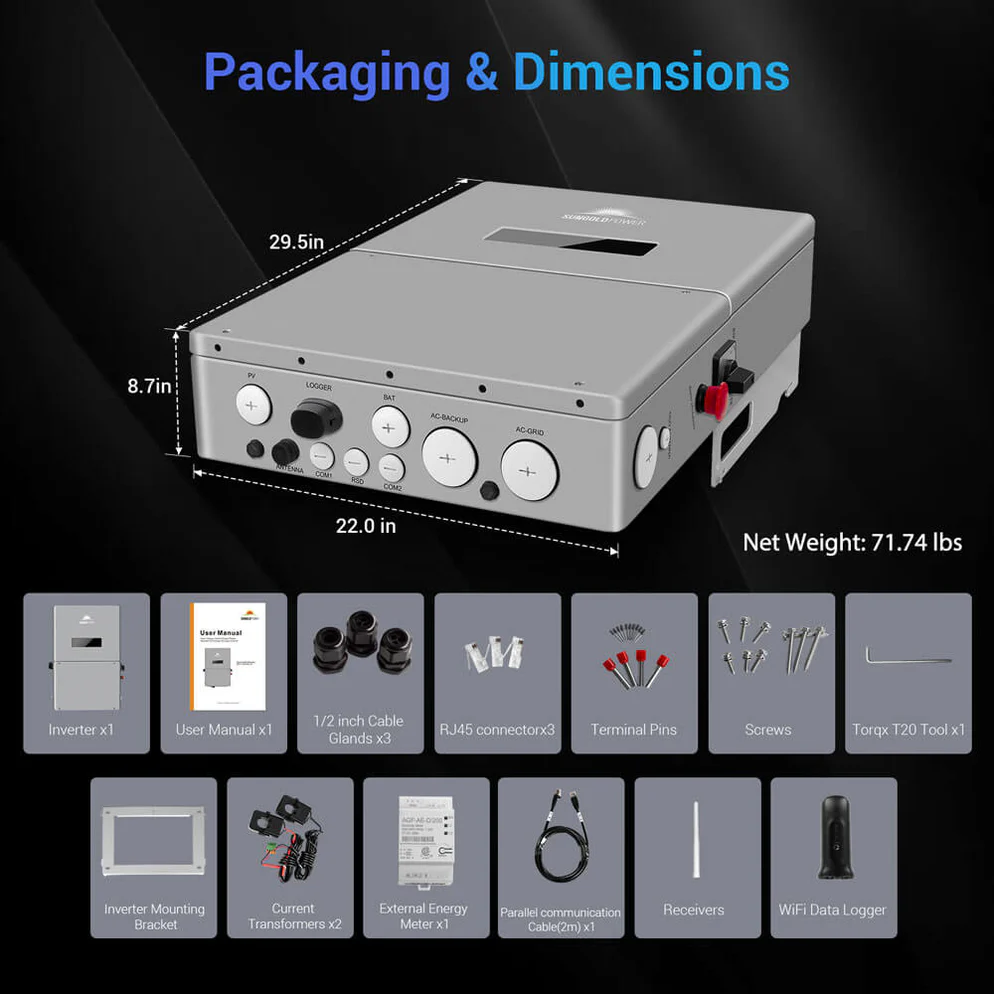
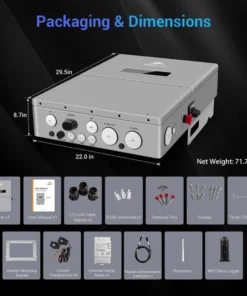
| Dimensions (H×W×D) | 29.53 × 22.05 × 8.66 inch (750 × 560 × 220 mm) |
| Weight | 71.74 lb / 32.54 kg |
| Operating Temperature | -25 to +60°C / -13 to +140°F |
| Ingress Protection | TYPE 4X / IP66 |
| Noise | <30 dB(A) |
| Cooling Method | Natural convection (no fan) |
| Max Operating Altitude | 13,120 ft (4,000 m) |
| Certifications | UL 1741SB, UL 1741SA, IEEE 1547.1-2020, UL 1699B, UL 1998, FCC Part 15 Class B, California Rule 21, HECO Rule 14H (pending), NEC 690.12-2020, CAN/CSA C22.2 No. 107.1-16 |
| Warranty | 10 Years |
High Voltage Battery Architecture — 120V to 500V DC
The SG11.4KHB-HV is the only unit in this batch designed specifically for high voltage battery systems — accepting DC battery input across the 120–500V range rather than the 40–64V range of the 48V-nominal units. This changes the applicable battery technology entirely.
Standard residential 48V LiFePO4 banks — stacked 100Ah server-rack batteries or stackable wall-mounted units — are not compatible with this inverter. The SG11.4KHB-HV is designed for:
- High voltage LFP systems — manufacturer-integrated HV battery packs operating at 100V, 150V, 200V or higher nominal voltages from brands such as Pylontech Force H, BYD HVM, LG RESU Prime and similar high-voltage residential storage products.
- Custom high-voltage battery stacks — series-connected battery modules assembled to operate in the 120–500V range.
- AC-coupled battery integration — high-voltage battery systems connected via AC coupling where the battery management system specifies a high-voltage DC interface.
The 50A maximum charge/discharge current at high voltage means the power throughput is comparable to 48V systems at higher amperage — at 400V nominal, 50A represents 20,000W of battery interface power, fully capable of servicing the 11,400W continuous output without limiting the system.
Four Independent MPPT Trackers
Four single-string MPPT trackers — each accepting 16A maximum at up to 600V DC open-circuit — provide the most granular PV array optimisation of any unit in this batch. Four separate strings at four separate maximum power points means the array segmentation capability is maximum: north, south, east and west-facing panels each on their own tracker, or four separate roof sections with different shading profiles each independently managed.
The 80–550V MPPT operating voltage range accommodates series strings from approximately 3 panels to 12 panels at standard residential panel voltages — covering every realistic single-string configuration without exceeding the input current limit. The 600V maximum input voltage provides safety margin above the operating range for cold-weather voltage rise in string open-circuit conditions.
97.6% Peak Efficiency — What It Means for Energy Yield
The 97.6% PV-to-AC maximum conversion efficiency and 98.5% PV-to-battery efficiency are the highest in this batch — and the practical consequence is measurable over the system lifetime.
At 97.6% PV conversion efficiency versus a hypothetical 94% unit, a 15kW solar array generates approximately 540 additional kilowatt-hours per year in useful energy output. Over a 10-year warranty period, that is 5,400kWh of additional energy — the equivalent of powering a typical US home for approximately six months. Efficiency is not a marketing figure: it is a direct multiplier on every solar panel you install.
The 97.0% battery-to-AC discharge efficiency confirms that energy stored in the battery bank reaches the AC output circuit with minimal conversion loss — ensuring the full capacity of an expensive battery bank is available as usable AC energy rather than waste heat.
IP66 TYPE 4X — The Most Robust Enclosure in This Batch
IP66 exceeds IP65: while IP65 provides protection against direct water jets, IP66 provides protection against powerful water jets — a higher pressure water penetration test that corresponds to hose-down cleaning scenarios and high-rainfall exposure conditions. TYPE 4X is the NEMA rating that adds corrosion resistance to the TYPE 4 (IP66 equivalent) water and dust protection.
The practical consequence is installation flexibility beyond what IP65 units offer:
- Coastal environments — salt spray corrosion resistance from the TYPE 4X stainless hardware and coated enclosure surfaces.
- High-rainfall climates — protection against horizontal driving rain and direct hose exposure without compromising seal integrity.
- Industrial settings — resistance to washdown cleaning with pressurised water, appropriate for agricultural and light industrial applications.
- Outdoor installations without additional housing — TYPE 4X / IP66 is appropriate for permanent outdoor wall mounting in exposed locations in essentially all North American climate environments.
Natural Convection Cooling — Silent Operation
No fan. The SG11.4KHB-HV relies entirely on natural convection for thermal management — hot air rises through the enclosure vents passively without any mechanical components.
The operational benefits are:
- Zero fan noise: The only audible specification is <30 dB(A) — quieter than a whispered conversation, attributable entirely to the high-frequency switching noise of the inverter electronics rather than mechanical fan noise. For residential installations in occupied spaces, this is a meaningful quality-of-life specification.
- No fan failure mode: Cooling fans are the most common mechanical failure point in inverter hardware. Natural convection eliminates this failure mode entirely.
- Unfiltered altitude performance: Fan-cooled inverters lose cooling capacity at altitude as air density decreases. The SG11.4KHB-HV’s 4,000m (13,120 ft) maximum operating altitude — the highest in this batch — is achievable precisely because natural convection scales appropriately with ambient temperature rather than air density.
The trade-off is physical size — natural convection requires more heat sink surface area than forced-air cooling, which is why this unit’s dimensions (29.53 × 22.05 × 8.66 inch) are larger than fan-cooled units at the same output rating.
APS Transmitter — Advanced Utility Interaction
The APS (Advanced Power Sensor) transmitter included with the SG11.4KHB-HV enables export power management — the ability to monitor net grid export and limit or curtail export power to comply with utility export limits or rate structures.
Utilities in California, Hawaii, New York and other states with high solar penetration increasingly require or encourage export limitation — inverters that cannot monitor and control their export contribution cannot satisfy these requirements. The APS transmitter provides real-time grid export measurement that the inverter uses to actively manage export power output in compliance with utility-specified limits.
For HECO Rule 14H compliance (currently pending), California Rule 21 compliance and similar advanced grid interaction requirements, the APS transmitter is not optional — it is the hardware that enables utility-required export control functionality.
Certification Stack — High Voltage Compliance
The SG11.4KHB-HV carries certifications specifically relevant to high-voltage battery system integration and advanced grid interaction:
- UL 1741SA / UL 1741SB: Advanced inverter smart functions — required for interconnection in California, Hawaii and utilities with advanced inverter mandates.
- UL 1699B: Arc fault protection — required for NEC 690.11 compliance.
- UL 1998: Software safety standard — the high-voltage battery interface and battery management communication require software safety validation that 48V systems do not.
- IEEE 1547.1-2020: The testing standard that accompanies IEEE 1547 interconnection requirements.
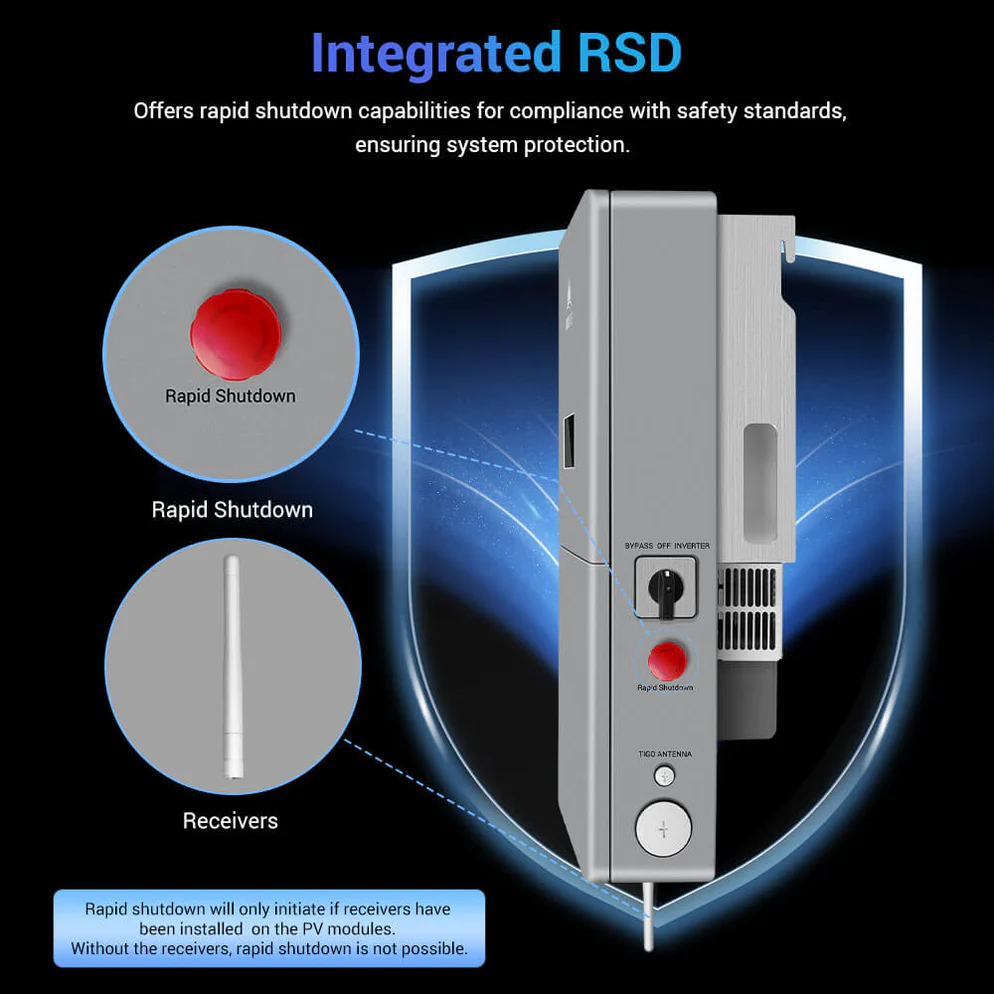
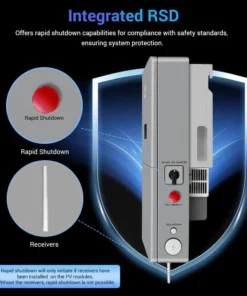
- NEC 690.12-2020: Rapid shutdown compliance.
- CAN/CSA C22.2 No. 107.1-16: Canadian Standards Association certification for power conversion equipment.
Explore high-voltage battery-compatible hybrid inverter options in our Hybrid Solar Inverters, Solar Kits and Off-Grid Power Systems categories.
FAQ
What battery systems are compatible with this hybrid inverter solar high voltage unit? The SG11.4KHB-HV is compatible with high-voltage lithium-ion battery systems operating in the 120–500V DC range — the voltage specification shared by products such as Pylontech Force H series, BYD HVM series, LG RESU Prime series and similar high-voltage residential storage products. Standard 48V nominal battery stacks are not compatible. Confirm your target battery system’s DC bus voltage against the 120–500V operating range before specifying this inverter.
Why does natural convection cooling give this unit a higher altitude rating than fan-cooled inverters? Fan cooling efficiency declines with altitude because air density decreases — less air mass moves through the cooling circuit per unit time, reducing heat removal capacity. Natural convection also declines with altitude but does so in proportion to the ambient temperature differential rather than air density, which is a more favourable scaling relationship at high altitude. The result is that the SG11.4KHB-HV maintains its full rated output to 4,000m (13,120 ft) — a rating that fan-cooled inverters at this output level typically cannot match.
What does the APS transmitter do that a standard inverter cannot? A standard inverter measures its own AC output — it knows how much power it is generating. It does not know how much of that power is going to local loads versus being exported to the grid. The APS transmitter monitors the grid connection point and provides real-time net export data — the difference between generation and local consumption. The inverter uses this data to actively limit export power, satisfying utility export control requirements without relying on the utility’s own monitoring.
Is IP66 TYPE 4X meaningfully better than IP65 NEMA 3R for outdoor installation? Yes, in specific environments. IP65 protects against direct water jets at 6.3 L/min — appropriate for rain and cleaning. IP66 protects against powerful water jets at 100 L/min — appropriate for hose-down and driving rain. TYPE 4X adds corrosion resistance that TYPE 3R does not specify. For coastal environments, agricultural applications with washdown exposure and any installation in highly corrosive atmospheres, TYPE 4X / IP66 provides meaningfully superior enclosure protection.
What is the efficiency advantage of this hybrid solar power inverter at 97.6% versus comparable units? At 97.6% PV-to-AC conversion efficiency versus a 94% unit, a 15kW solar array produces approximately 540 additional kWh per year in useful energy — over a 10-year period, this represents approximately 5,400 kWh additional generation from the same solar array. At current US average electricity rates, this represents several thousand dollars of additional energy value over the warranty period, making efficiency a meaningful economic differentiator rather than a secondary specification.
Be the first to review “High Voltage 11.4kW Hybrid Split Phase Inverter with APS Transmitter SG11.4KHB-HV Category: Hybrid Solar Inverters”
Related products
best solar inverter
12kW / 15kW / 18kW 48V Split Phase Pure Sine Wave Inverter Charger
Pure Sine Inverter With Charger
2000W / 3000W / 4000W DC 12V Pure Sine Wave Inverter with Charger
best solar inverter
4000W DC 24V Pure Sine Wave Inverter With Charger 120VAC 50/60Hz
best solar inverter
best solar inverter
6000W DC 24V Split Phase Pure Sine Wave Inverter with Charger
best solar inverter
4000W DC 12V Split Phase Pure Sine Wave Inverter With Charger 120/240VAC
best solar inverter
best solar inverter
Reviews
There are no reviews yet.