
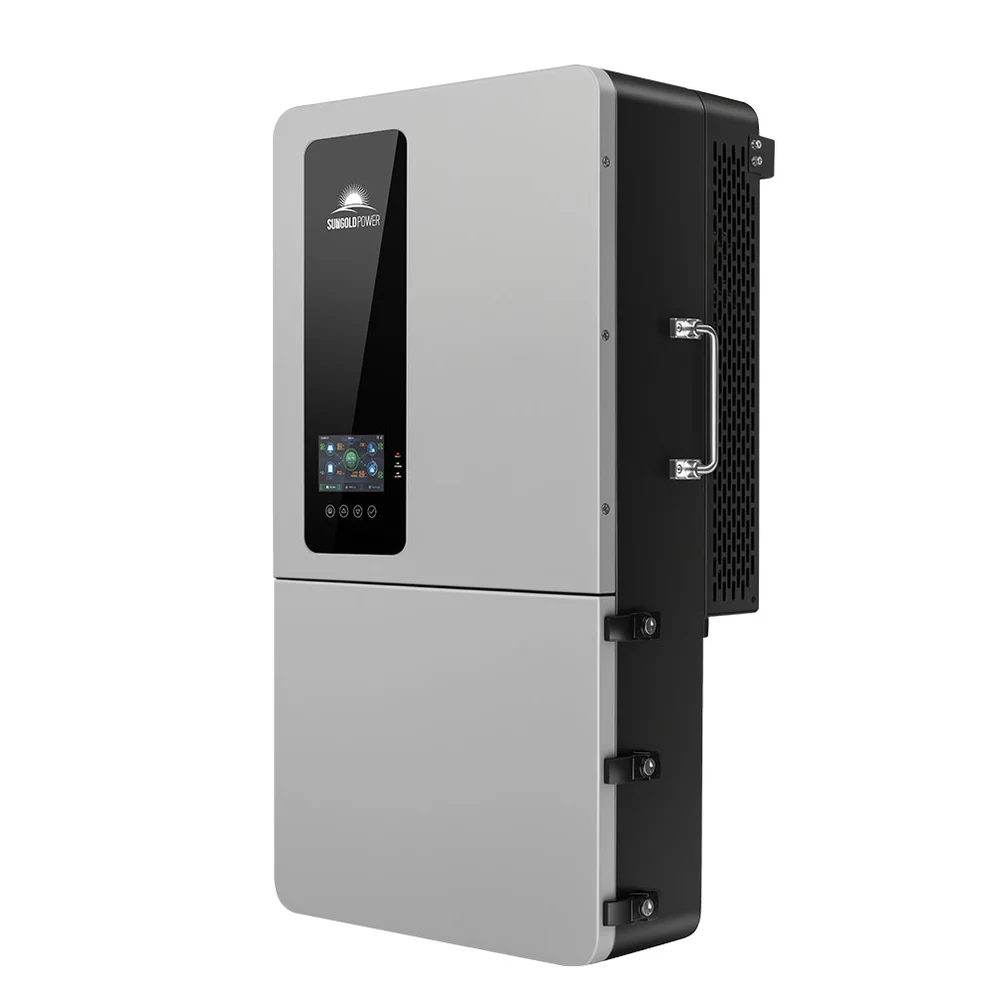
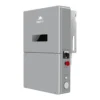
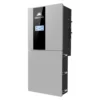
Solar Hybrid Inverter 12kW 48V — Authentic [72kW Scalable + 200A]
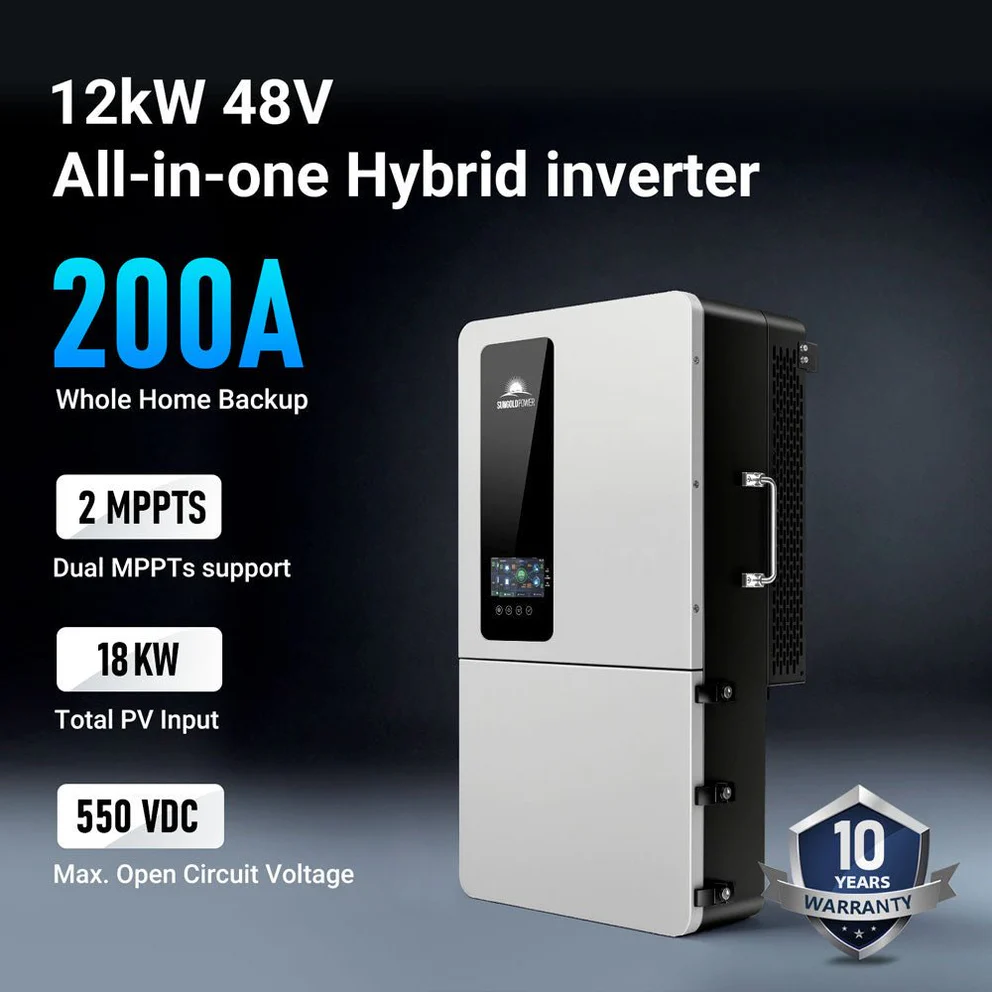
The solar hybrid inverter for buyers who think beyond the initial installation — the SGS-12K18MAX is a 12kW 48V all-in-one hybrid unit that scales to 72kW through six-unit parallel operation, accepts 18kW of PV input across two dual-channel MPPT trackers, passes 200A of utility current through the main electrical panel during normal grid operation and delivers 12,000W of continuous 120/240V or 10,400W of three-phase 120/208V backup output during grid outages. The AFCI (Arc Fault Circuit Interrupter) integration, 240A hybrid charging current and IP65 enclosure position this as the most capable all-in-one unit in the SGS series — built for homes, farms and small businesses where energy demand today is only part of the equation.
Table of Contents
- Complete Product Specifications
- 18kW PV Input — Dual Dual-Channel MPPT Architecture
- 200A Passthrough — The Whole-Home Standard
- 72kW Parallel Scalability
- 240A Hybrid Charging — Maximum Battery Recovery
- Split-Phase and Three-Phase Output
- Integrated AFCI and Protection Suite
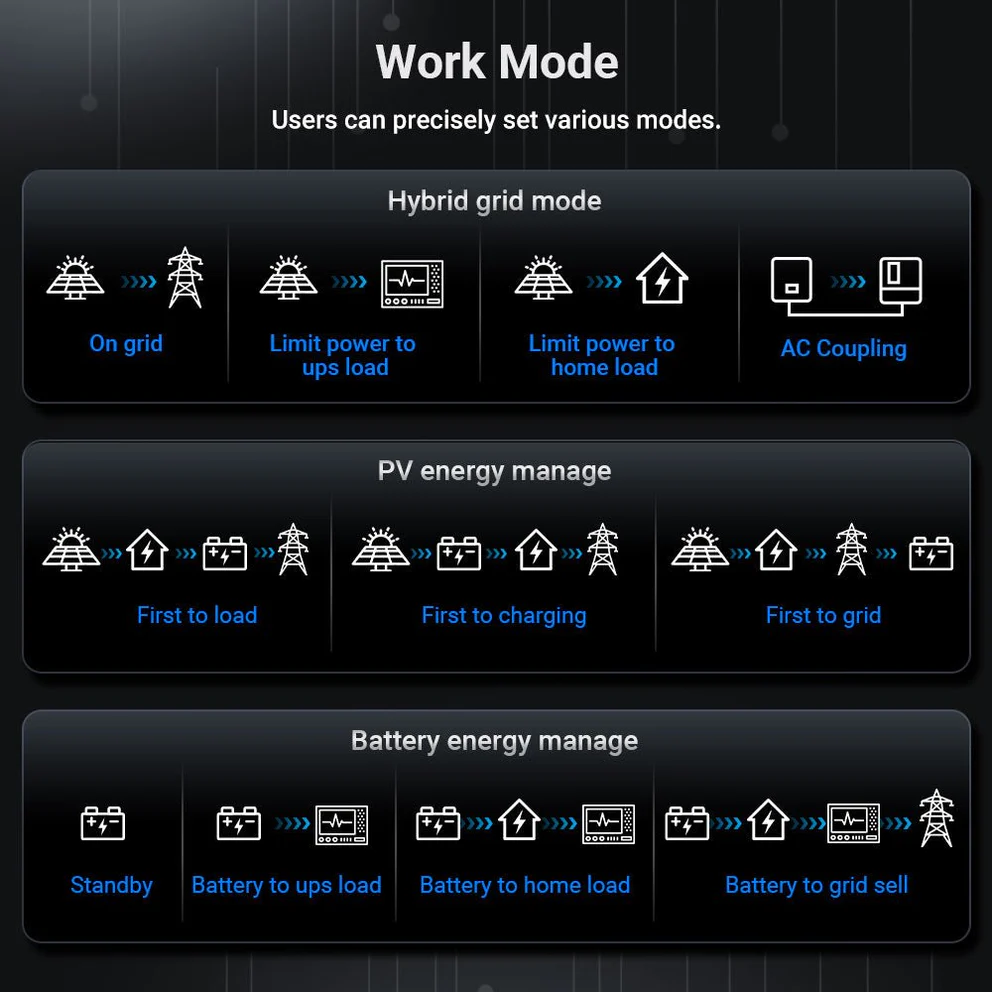
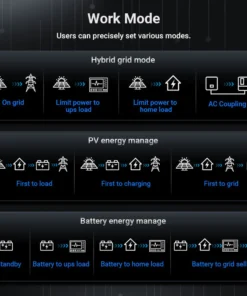
- Smart Energy Management
- FAQ
Complete Product Specifications
| Parameter | SGS-12K18MAX |
|---|---|
| Inverter Output | |
| Rated Output Power | 12,000W (@240V) / 10,400W (@208V) |
| Max Peak Power | 1.5× rated (10s) |
| Rated Output Voltage | 120/240V AC (split-phase) / 120/208V (three-phase) |
| Load Motor Capacity | 6HP |
| Rated AC Frequency | 50/60Hz |
| Output Waveform | Pure Sine Wave |
| Parallel Capacity | 6 units (72kW combined) |
| Battery | |
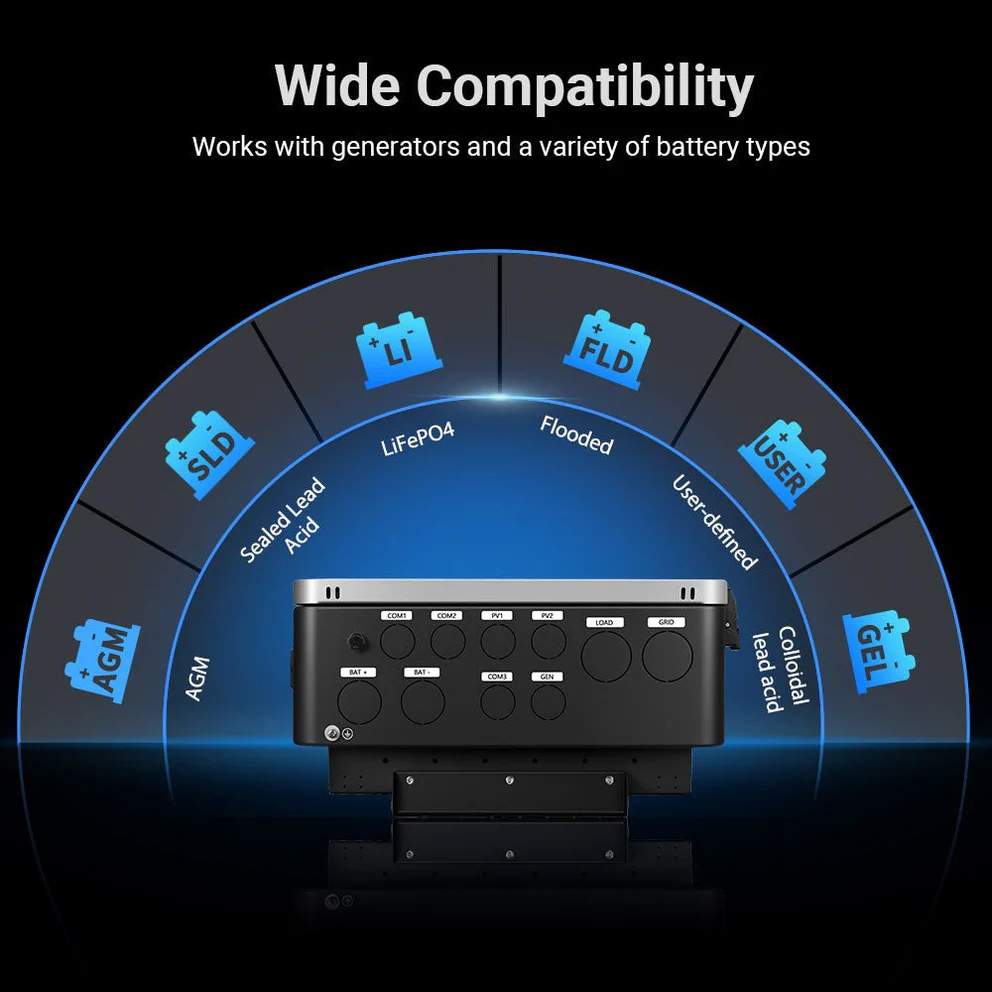
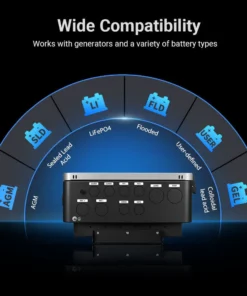
| Battery Type | Li-ion / Lead-Acid / User Defined |
| Rated Battery Voltage | 48V DC |
| Battery Voltage Range | 40–60V DC |
| Max Grid Charging Current | 200A |
| Max Generator Charging Current | 200A |
| Max Hybrid Charging Current | 240A |
| PV Input | |
| Number of MPPT Trackers | 2 (dual channel each) |
| Max PV Array Power | 9,000W + 9,000W |
| Max Input Current (per channel) | 32A / 32A |
| Short Circuit Current | 40A / 40A |
| Max Open Circuit Voltage | 550V DC / 550V DC |
| MPPT Voltage Range | 125–450V DC / 125–450V DC |
| MPPT Tracking Efficiency | 99.9% |
| Grid / Generator Input | |
| Input Voltage Range | 90–140V AC |
| Frequency Range | 50/60Hz |
| Continuous Grid Passthrough Current | 200A |
| Protection | |
| Reverse Polarity Protection | Yes |
| Output Overvoltage Protection | Varistor |
| Output Overcurrent Protection | Yes |
| Ground Fault Monitoring | Yes |
| Grid Monitoring | Yes |
| Pole-Sensitive Leakage Current | Yes |
| AFCI | Yes (integrated) |
| RSD | Yes |
| General | |
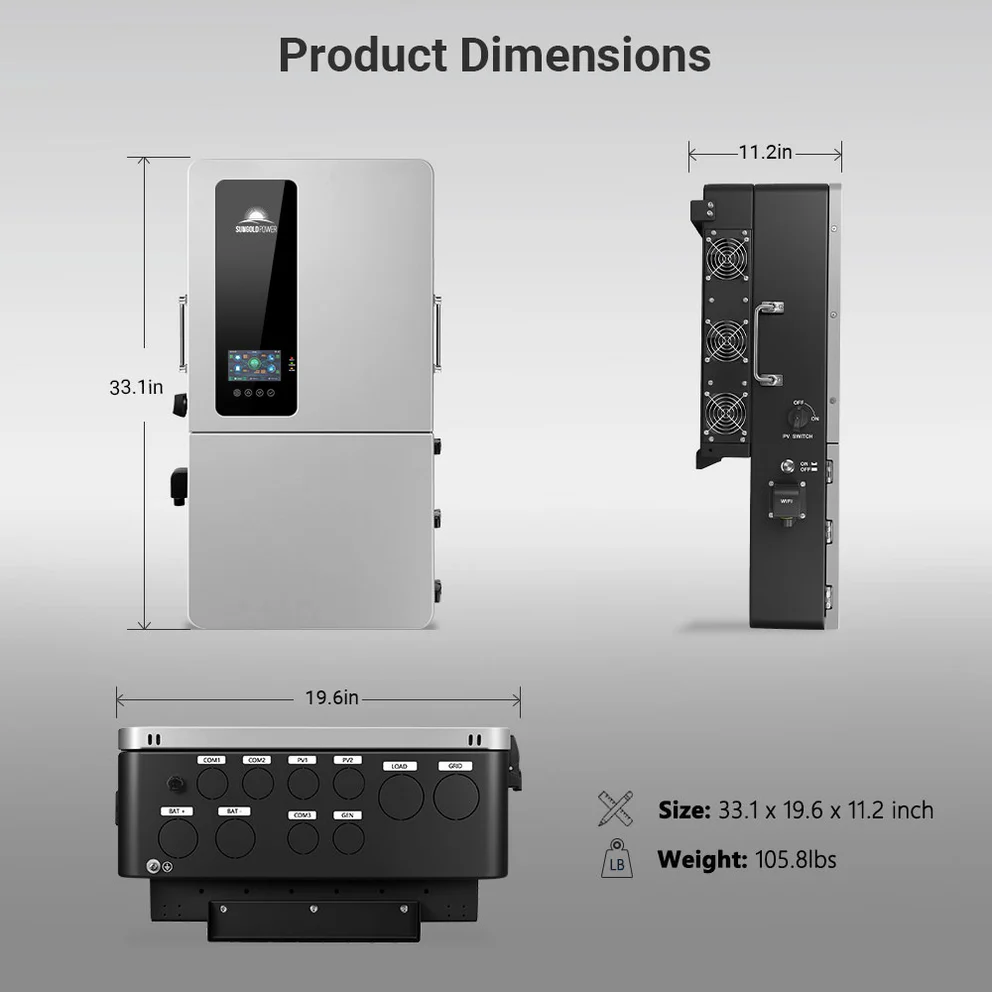
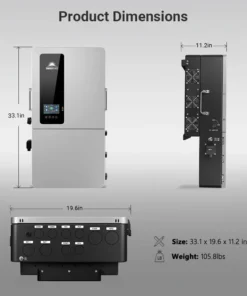
| Dimensions (W×H×D) | 33.07 × 17.32 × 10.24 inch (840 × 440 × 260 mm) |
| Weight | 105.82 lb / 48 kg |
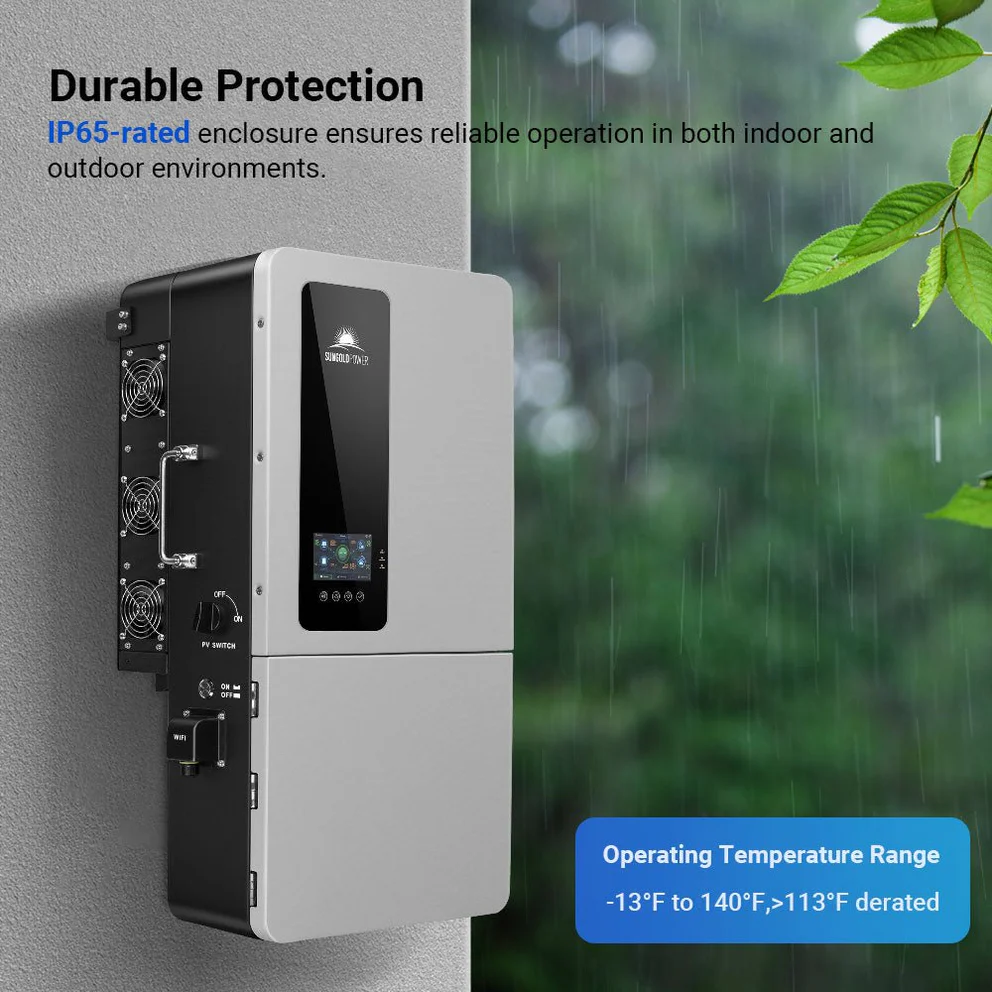
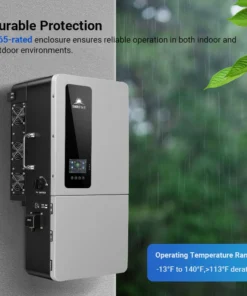
| Ingress Protection | IP65 |
| Operating Temperature | -13 to 140°F / -25 to +60°C (derated above 113°F) |
| Noise | <60 dB |
| Self-Consumption | <100W |
| Cooling | Heat sink + intelligent fan |
| Communication | RS485 / CAN / USB / Dry Contact; Optional WiFi / GPRS |
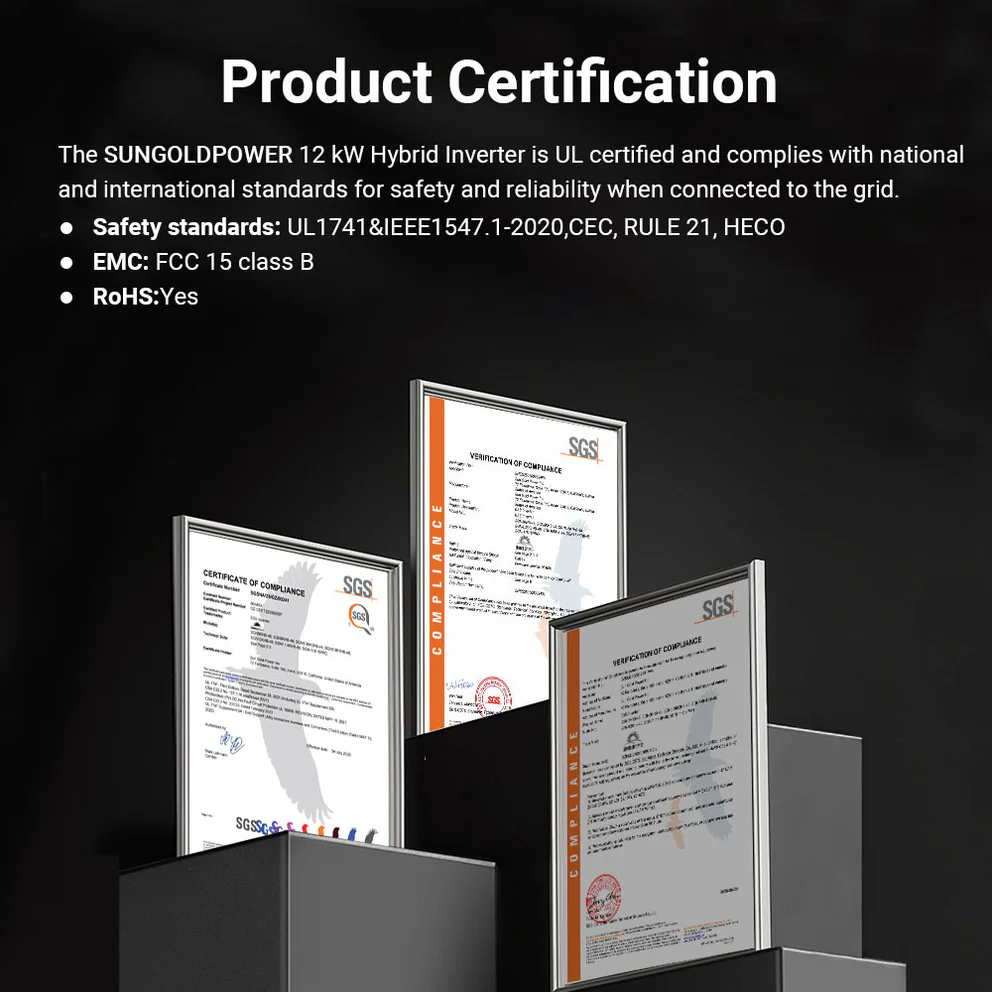
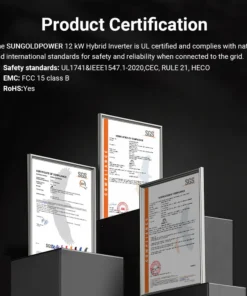
| Safety Standards | UL 1741, IEEE 1547.1-2020, CEC, Rule 21, HECO |
| EMC | FCC Part 15 Class B |
| RoHS | Yes |
| CEC Listed | Yes |
18kW PV Input — Dual Dual-Channel MPPT Architecture
The SGS-12K18MAX uses two MPPT trackers, each with dual input channels — providing four independent PV string inputs total, accepting 9,000W per tracker for a combined 18,000W of PV array capacity. This architecture is different from the three-single-channel MPPT design of the SGN series and produces a different wiring topology.
Each MPPT tracker’s dual channels are current-additive — two strings connected to the same MPPT tracker operate at the same voltage but contribute independent current. This means strings of identical panels at the same orientation are most efficiently deployed on a single dual-channel tracker, while strings at different orientations or with different shading profiles are better separated across the two different MPPT trackers.
The practical result for a large rooftop installation:
- Up to 18kW of solar panels connected through four string inputs without additional combiners or external MPPT equipment.
- Flexible string configuration — 2, 3 or 4 strings depending on panel voltage and desired string current balance.
- 99.9% MPPT tracking efficiency — the maximum power point is tracked continuously with sub-1% deviation, ensuring maximum energy extraction across all irradiance conditions.
200A Passthrough — The Whole-Home Standard
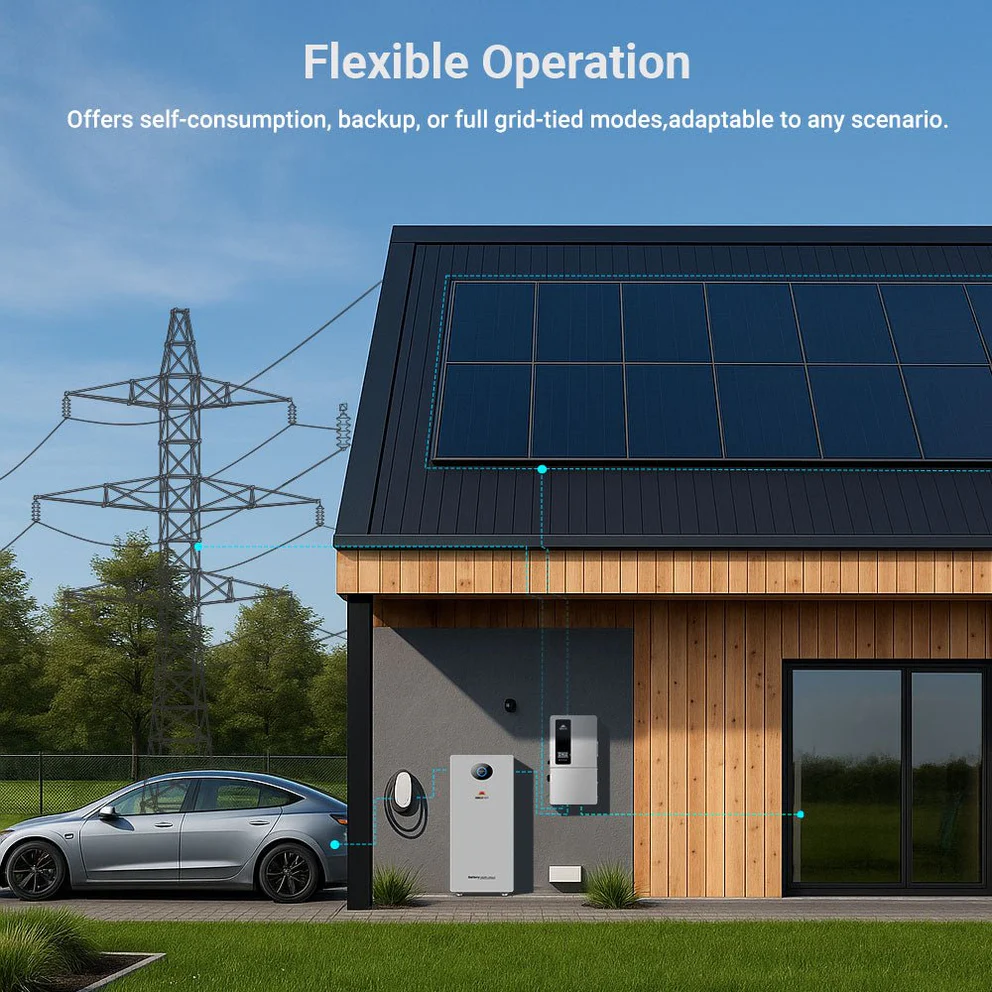
The 200A continuous grid passthrough current matches the rated service amperage of a standard North American residential electrical panel — no sub-panel, no load segregation, no circuit limitations during normal grid-connected operation. The SGS-12K18MAX connects between the utility meter and the main electrical panel, passing the full 200A service current through to every circuit in the house transparently when grid power is present.
When grid power fails, the inverter transitions to backup output within 10 milliseconds — the 12,000W continuous backup output from solar and battery powers the same full panel that was previously running from grid power. The 200A passthrough is the specification that makes this transition seamless for the homeowner: the house does not notice the difference between grid power and inverter power.
72kW Parallel Scalability
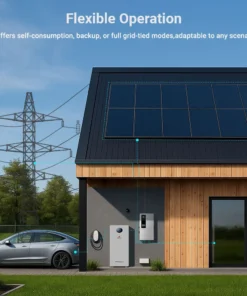
Six SGS-12K18MAX units in parallel deliver 72kW of combined output — operating in single-phase, split-phase or three-phase configurations depending on the connected load requirements. This scalability is the specification that makes the SGS-12K18MAX appropriate not just as a residential solar hybrid inverter but as a scalable commercial or agricultural installation platform.
A farm or small business that installs one SGS-12K18MAX today and needs 36kW or 48kW in three years does not replace the initial investment — it adds parallel units to the existing installation. The communication interface manages load sharing, phase synchronisation and system-wide monitoring across all parallel units automatically.
The hybrid solar inverter system architecture at 72kW combined output covers light commercial operations, agricultural facilities and multi-structure properties that genuinely require output beyond what any single-unit residential inverter can deliver.
240A Hybrid Charging — Maximum Battery Recovery
In hybrid charging mode — simultaneous solar and grid or generator charging — the SGS-12K18MAX reaches 240A of combined charging current into the 48V battery bank, or approximately 11,520W of total charging power. This is the highest battery recovery rate available in this unit class.
The practical significance is generator runtime reduction. A property running a generator for battery recovery during an extended cloudy period can fully recharge a 40kWh LiFePO4 bank in approximately 3.5 hours at 240A combined charging — versus 6–8 hours on a 100A charger. Less generator runtime means less fuel, less noise and less wear on the generator — and the battery returns to full capacity before the next solar generation period.
Split-Phase and Three-Phase Output
The SGS-12K18MAX is the only unit in this batch capable of both 120/240V split-phase and 120/208V three-phase AC output — making it the appropriate choice for properties with three-phase electrical service or commercial buildings that require three-phase power for equipment operation.
- Split-phase (120/240V): Standard North American residential configuration — two 120V legs, enabling simultaneous 240V and 120V load operation.
- Three-phase (120/208V): Commercial configuration — three 120V phases enabling three-phase motor loads, three-phase HVAC systems and commercial kitchen equipment.
The output voltage selection is made during installation configuration — the unit does not switch between modes during operation.
Integrated AFCI and Protection Suite
The integrated AFCI (Arc Fault Circuit Interrupter) protection is a specification that distinguishes the SGS-12K18MAX from units without this feature. AFCI detects the waveform signatures of electrical arcing — the cause of thousands of residential electrical fires annually — and disconnects the circuit before the arc can ignite surrounding materials. NEC 690.11 requires AFCI protection in solar PV systems in most US jurisdictions; having it integrated into the inverter eliminates the need for separate AFCI equipment installation.
The protection suite beyond AFCI includes:
- Ground fault monitoring: Detects current leakage to ground that could indicate insulation failure or shock hazard.
- Pole-sensitive leakage current monitoring: Detects unbalanced leakage between positive and negative DC conductors — a more sensitive fault detection capability than standard ground fault monitoring.
- Grid monitoring: Continuously verifies grid voltage and frequency are within acceptable parameters before allowing grid export or import.
- RSD (Rapid Shutdown Device): NEC 690.12-2020 compliant rapid shutdown — a safety requirement for all US rooftop solar installations that allows emergency responders to de-energise the PV array quickly.
Smart Energy Management
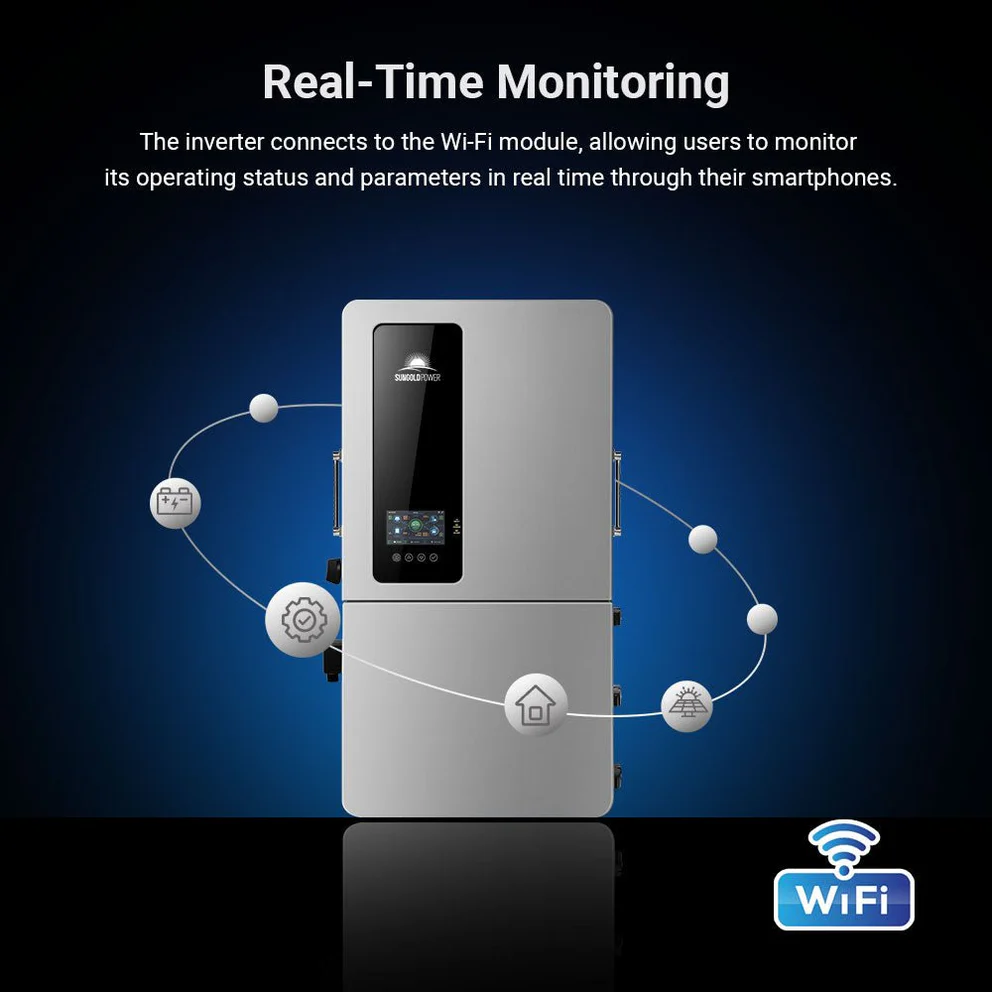
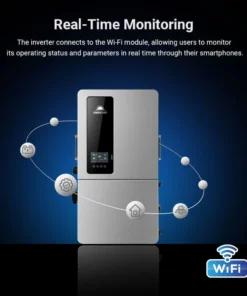
The Wi-Fi / GPRS optional communication module enables remote monitoring, configuration and firmware updates via smartphone app — providing real-time visibility of solar generation, battery state, grid import/export and load consumption from anywhere with internet connectivity. The RS485 and CAN interfaces support integration with smart home systems, building management platforms and utility demand-response programmes.
Explore the complete hybrid solar power system range in our Hybrid Solar Inverters, Solar Kits and Off-Grid Power Systems categories.
FAQ
What is a solar hybrid inverter and how does the SGS-12K18MAX implement it? A solar hybrid inverter manages three energy sources — solar generation, battery storage and the utility grid — from a single unit, routing power between them based on availability, demand and configured priorities. The SGS-12K18MAX implements this by accepting 18kW of PV input, interfacing with a 48V battery bank at 240A hybrid charging, passing 200A of utility current through to the main panel during normal operation and switching to 12kW of backup output within 10ms during grid outages — all from one IP65-rated unit.
What is the difference between the hybrid solar inverter system parallel capability and simply buying a larger single unit? Parallel operation provides redundancy that a single large unit cannot: if one unit requires service, the remaining units continue operating at reduced combined output rather than a complete system outage. For commercial and agricultural applications where power continuity is operationally critical, the ability to maintain partial operation during maintenance is a significant resilience advantage. Parallel operation also allows incremental capacity addition as loads grow — adding one unit at a time rather than replacing the entire system.
How does the 240A hybrid charging rate affect battery recovery time practically? At 240A into a 48V bank, the charging power is approximately 11,520W. A 40kWh LiFePO4 battery bank depleted to 20% state of charge (32kWh depletion) recovers to full charge in approximately 2.8 hours at this rate — fast enough to fully recharge from a morning generator run before the afternoon solar window begins. The same bank on a 100A charger takes approximately 6.7 hours — potentially longer than the available solar generation window.
Does the integrated AFCI in this hybrid inverters unit satisfy NEC 690.11 compliance? Yes. NEC 690.11 requires listed AFCI protection for PV systems on or penetrating a building — the SGS-12K18MAX’s integrated AFCI satisfies this requirement within the inverter itself, eliminating the need for separate listed AFCI equipment at the combiner, subpanel or disconnect. Verify with the authority having jurisdiction (AHJ) in your area before omitting external AFCI equipment, as some jurisdictions may have additional requirements.
What battery chemistry is compatible with this inverter solar hybrid unit? The SGS-12K18MAX supports Li-ion (including LiFePO4), lead-acid and user-defined battery types. For residential whole-home backup applications, 48V LiFePO4 is recommended — it provides the best combination of cycle life, safety, discharge efficiency and compatibility with the 40–60V operating range. The 200A maximum grid and generator charging current and 240A hybrid charging current are compatible with large-format 48V LiFePO4 packs from major residential storage manufacturers.
Be the first to review “12kW 48V All-In-One Hybrid Solar Inverter SGS-12K18MAX — Whole Home Backup 200A”
Related products
best solar inverter
2000W 3000W 4000W DC 12V Pure Sine Wave Inverter With Charger 120VAC
best solar inverter
best solar inverter
best solar inverter
best solar inverter
best solar inverter
best solar inverter
4000W DC 12V Split Phase Pure Sine Wave Inverter With Charger 120/240VAC
Pure Sine Inverter With Charger
2000W / 3000W / 4000W DC 12V Pure Sine Wave Inverter with Charger
Reviews
There are no reviews yet.