
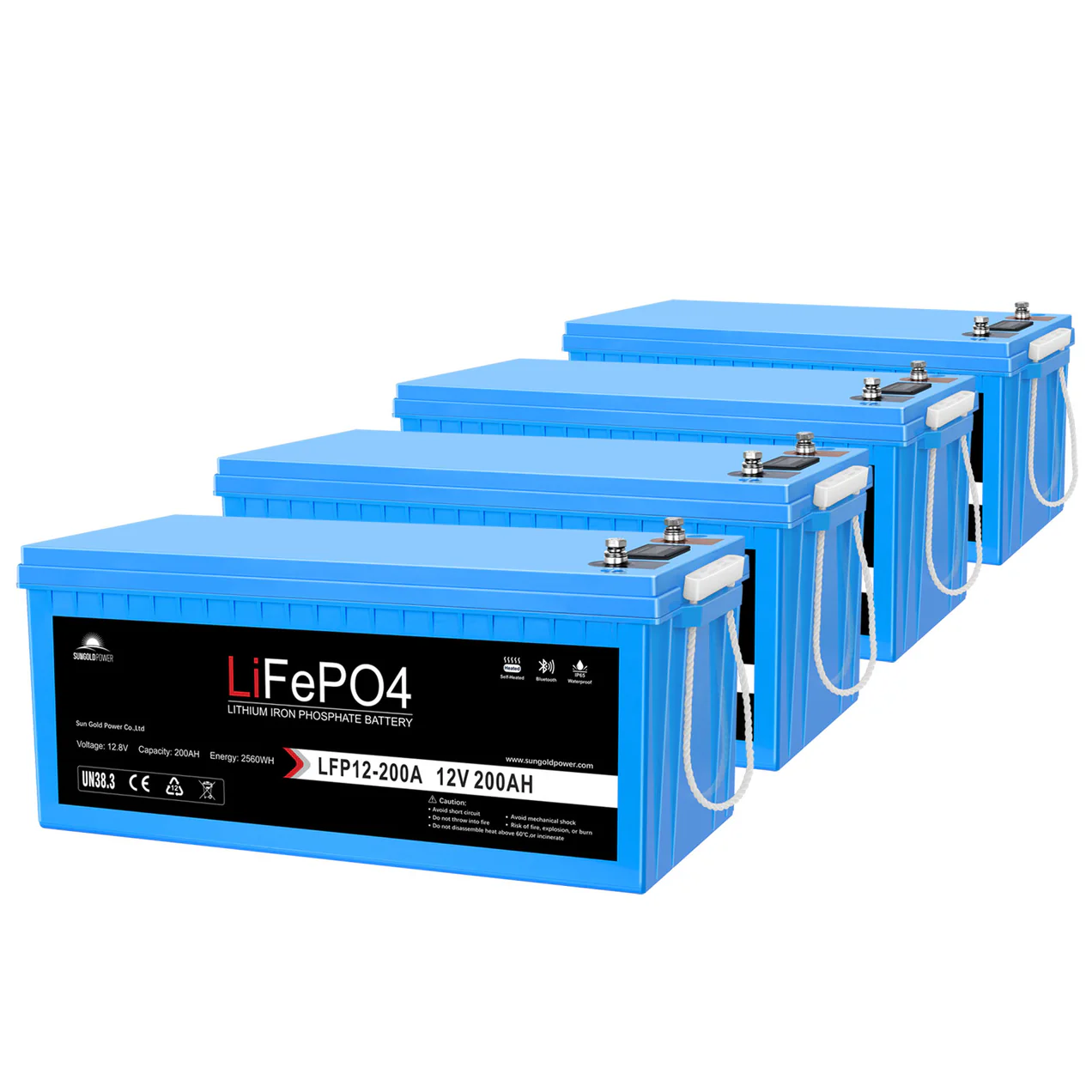
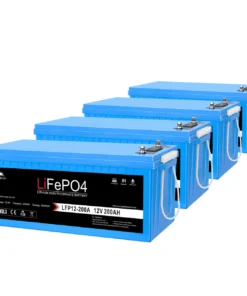
LiFePO4 Battery Solar Bank — 4 × 12V 200Ah, 800Ah Total, Self-Heating, Bluetooth BMS, IP65
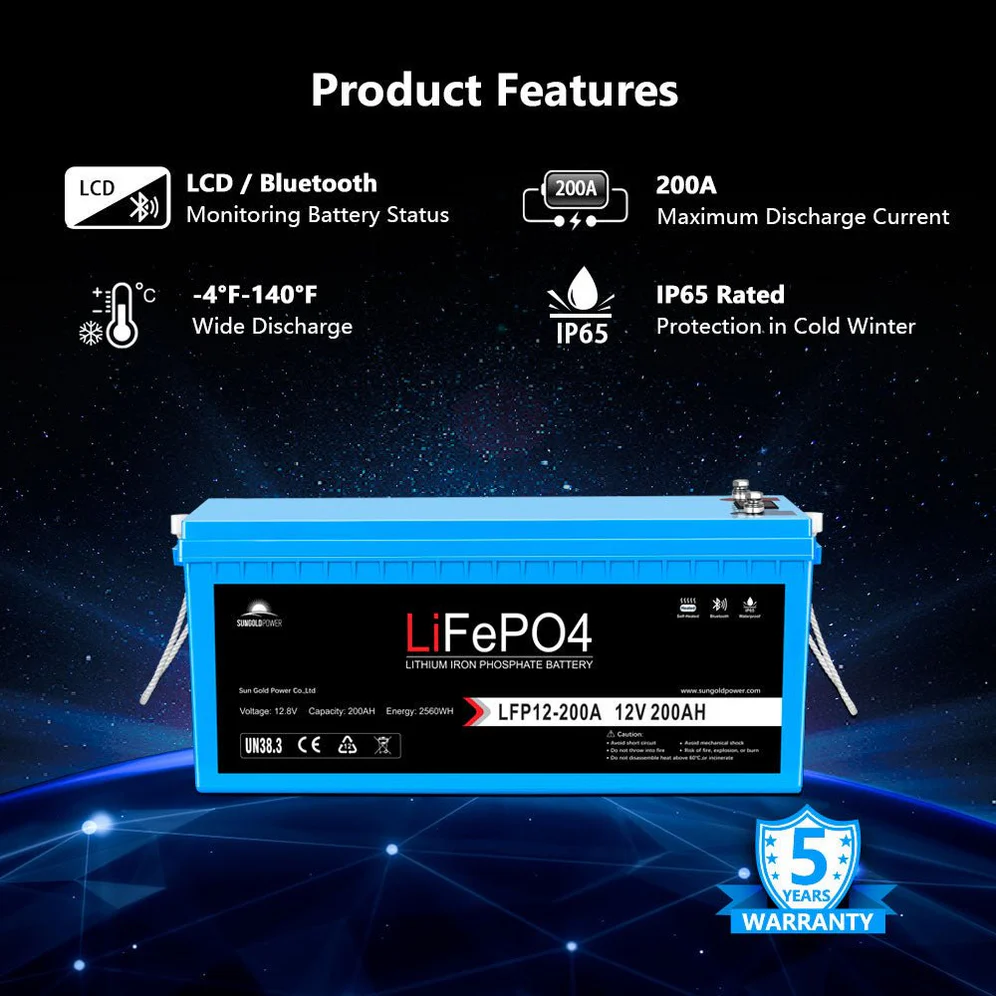
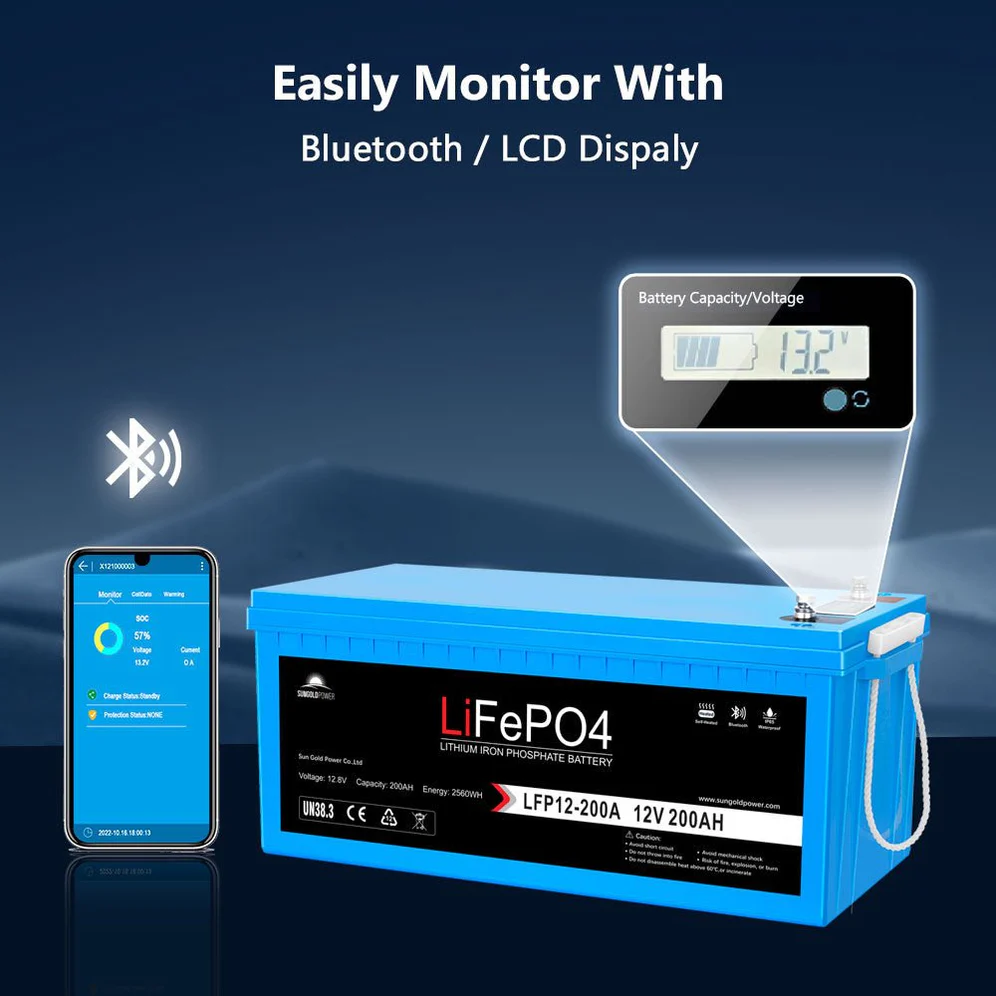
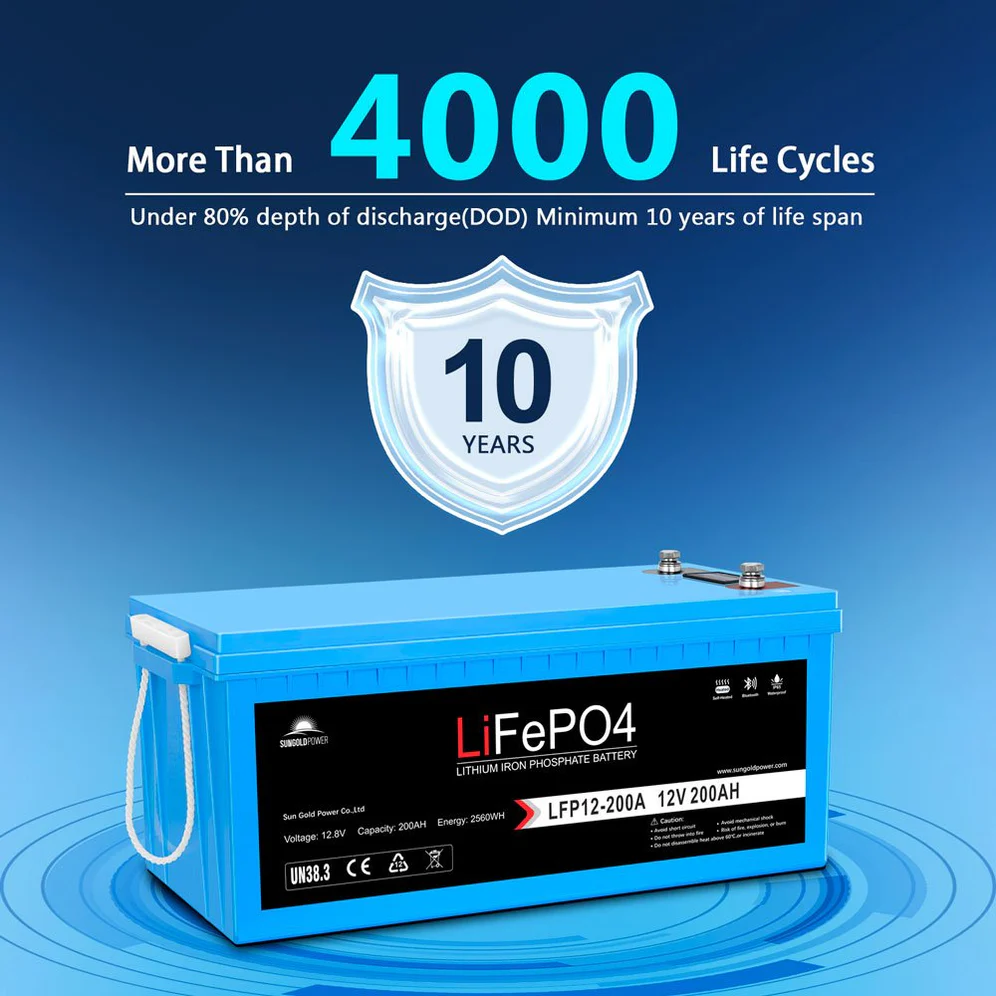
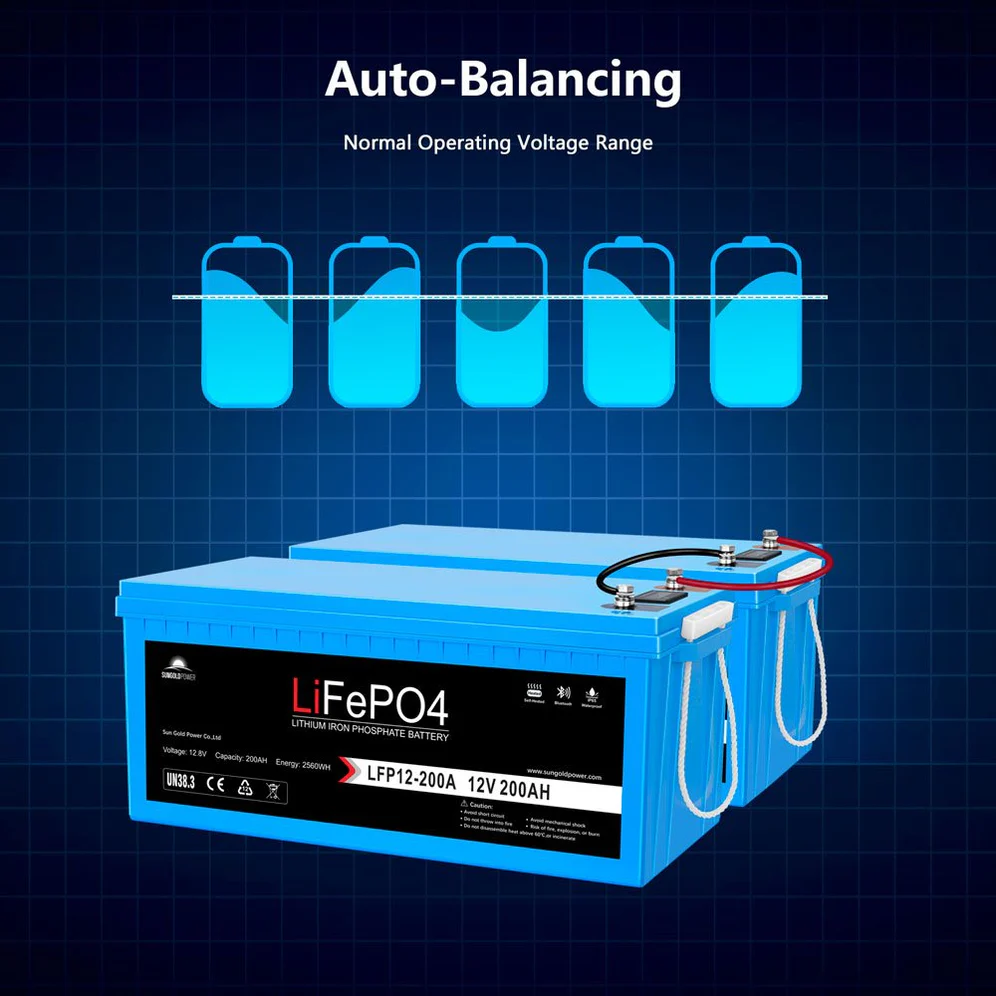
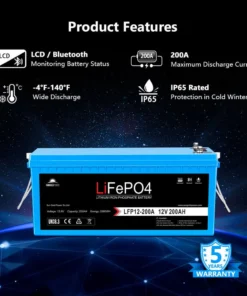
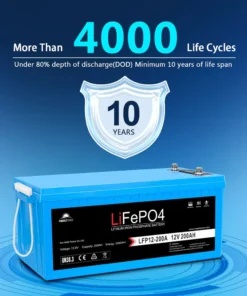
Four SunGoldPower 12V 200Ah LiFePO4 battery solar units connected in parallel deliver 800Ah of capacity at 12V — 10,240Wh of stored energy — forming the battery bank for a serious off-grid solar system, a full-time liveaboard vessel, or a large RV installation that cannot afford to compromise on available overnight capacity. Each unit is rated for more than 4,000 cycles at 80% depth of discharge, includes a self-heating function for cold-climate charging, carries an IP65 ingress protection rating, and communicates cell-level data to a smartphone via Bluetooth BMS.
Table of Contents
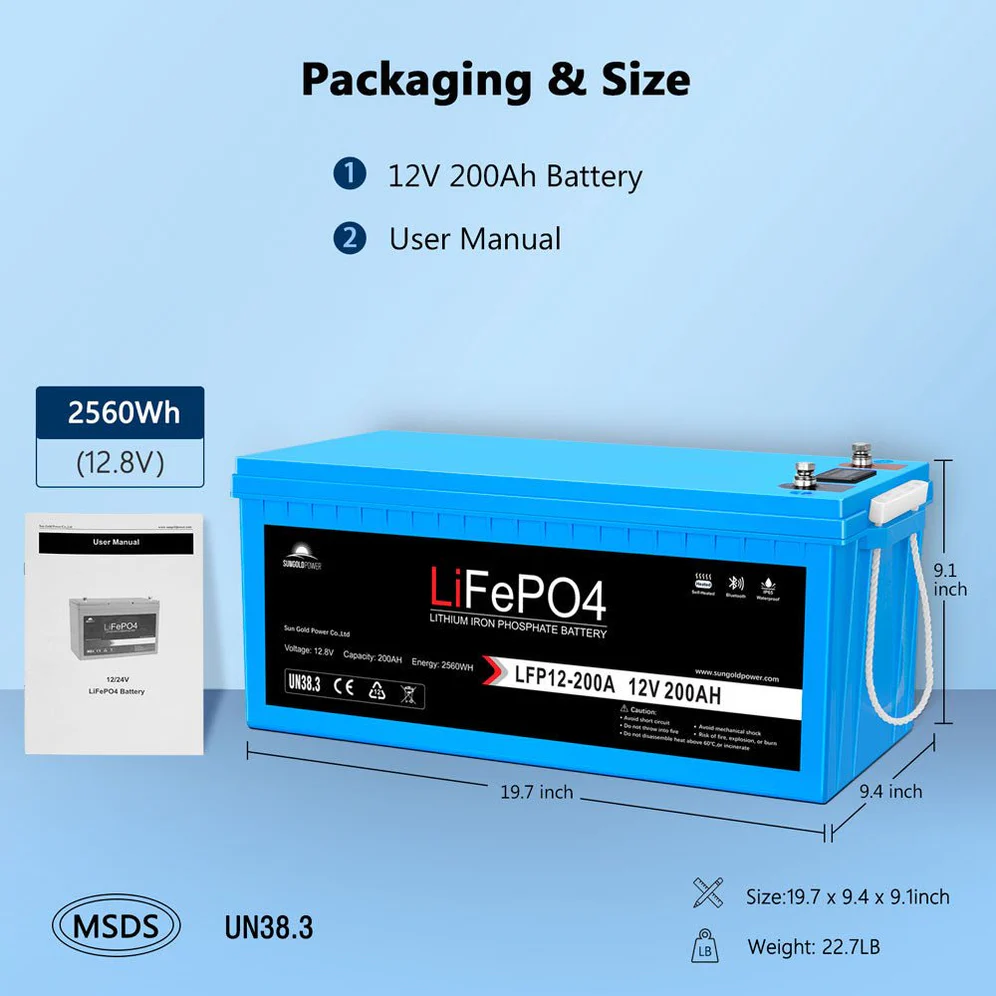
- Specifications
- What an 800Ah LiFePO4 Bank Delivers
- Parallel Installation — Critical Requirements at This Scale
- Charging an 800Ah Bank From Solar
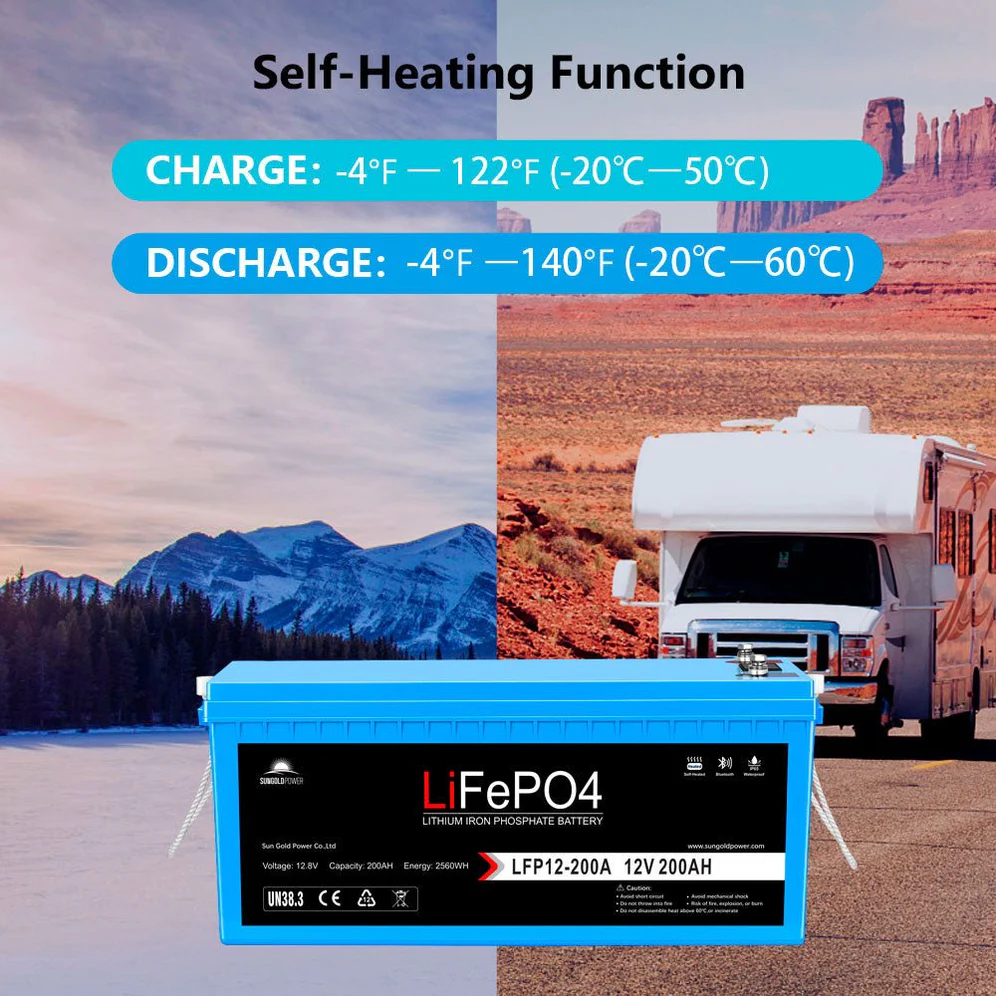
- Self-Heating at Scale — Why It Matters More in a Large Bank
- Frequently Asked Questions
Specifications
| Specification | Per Unit | 4-Unit Parallel Bank |
|---|---|---|
| Nominal Voltage | 12.8V | 12.8V |
| Nominal Capacity | 200Ah | 800Ah |
| Energy | 2,560Wh | 10,240Wh |
| Efficiency | >99.5% | >99.5% |
| Voltage Window | 10.8–14.6V | 10.8–14.6V |
| Max Continuous Charge Current | 150A | 600A |
| Peak Discharge Current | 245A (15s + 2s) | 980A |
| Recommended Charge Current | 100A | 400A |
| Recommended Discharge Current | 100A | 400A |
| Cycle Life (0.2C, 77°F, 80% DOD) | ≥4,000 | ≥4,000 |
| Charge Temperature | -4°F to 113°F | -4°F to 113°F |
| Discharge Temperature | -4°F to 131°F | -4°F to 131°F |
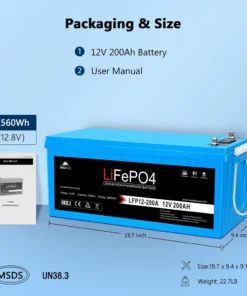
| Dimensions (L×W×H) | 19.7 × 9.4 × 9.1 in | — |
| Weight per unit | 48.5 lb | 194 lb total |
| Terminal Type | M8 | M8 |
| IP Grade | IP65 | IP65 |
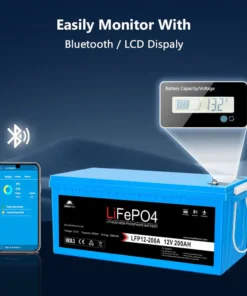
| Monitoring | LCD + Bluetooth per unit | 4 independent BMS |
What an 800Ah LiFePO4 Bank Delivers
800Ah at 12.8V is 10,240Wh of stored energy. At 80% depth of discharge — the recommended operating limit for maximising cycle life — 8,192Wh is available for regular use. In practical terms for an off-grid solar system:
- A 2,000W inverter load running for four hours consumes approximately 664Ah at 12V — well within the 640Ah available at 80% DOD.
- A full off-grid cabin overnight — refrigerator, lighting, fans, and small appliances drawing a combined 150W continuously for twelve hours — consumes 180Ah, leaving over 460Ah in reserve.
- A solar-only day with limited sun — the 800Ah bank provides two to three days of typical cabin-level autonomy before reaching the recommended discharge limit, depending on actual load profile.
This is the capacity level where a lifepo4 solar battery bank stops being a daily buffer and starts functioning as genuine multi-day storage — a meaningful difference in off-grid resilience.
Parallel Installation — Critical Requirements at This Scale
Four units in parallel is the maximum configuration for this battery model. At this scale, installation discipline becomes more important than at two units:
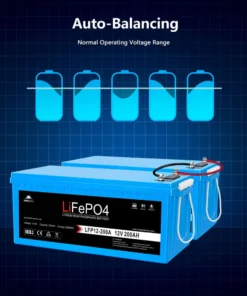
- All four units must be at equal state of charge before connection. The recommended approach is to fully charge all four independently before joining them. Connecting units at different charge levels at this bank size causes large equalisation currents that will trip BMS protection on one or more units.
- All cable runs from units to busbar must be identical in length and gauge. At 800Ah, even a small resistance difference between cable paths causes significant current imbalance over time.
- Use a proper busbar, not daisy-chained terminals. Each of the four batteries connects directly to the busbar — not battery to battery in a chain — to ensure equal current sharing across all units.
- Monitor all four BMS via Bluetooth after installation. Within the first full charge and discharge cycle, verify that all four units show similar current readings. Persistent imbalance indicates a wiring or connection issue that needs correction before regular use.
This is the maximum-scale configuration for a 12v lithium ion battery in this product series — plan the installation carefully and build the wiring infrastructure to match the bank’s capability.
Charging an 800Ah Bank From Solar
An 800Ah LiFePO4 bank requires a meaningful solar array and charge controller to charge fully within a single day. At 100A of recommended charge current per unit, the bank accepts up to 400A combined — equivalent to approximately 5,120W at 12.8V charging voltage.
For a battery for 12v solar application at this scale, a 12V MPPT charge controller rated at 100A or above is a minimum. Multiple controllers connected to the same busbar — each feeding the bank in parallel — is a common approach for large 12V banks where a single controller’s output is insufficient to charge the full capacity within available daylight hours.
A 3,000W solar array under good conditions produces approximately 234A at 12.8V — charging a fully depleted 640Ah usable capacity bank in roughly two to three hours of peak production, plus absorption time.
Self-Heating at Scale — Why It Matters More in a Large Bank
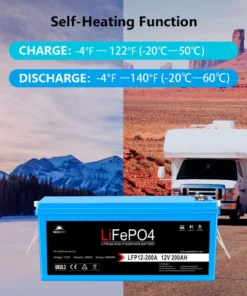
A large bank represents a larger investment that is harder to replace if damaged by cold-temperature charging. The self-heating function on each unit operates independently — each battery warms its own cells before accepting charge. In a four-unit bank, all four heaters may activate simultaneously on a cold morning, drawing heating current from the bank’s own reserve before the solar charge begins.
The net result is that every unit reaches safe operating temperature and begins accepting the morning solar charge at full efficiency — regardless of overnight low temperature, down to -4°F. This protection is automatic and requires no user intervention.
Browse our full 12V LiFePO4 Batteries, Solar Battery Banks, and Off-Grid Solar Systems collections for compatible charge controllers, inverters, and busbars.
Frequently Asked Questions
Q: Is 4 × 200Ah the maximum bank size for this battery? Yes. Each unit supports a maximum of four units in parallel. Four units at 200Ah each is 800Ah — the largest bank this model can form without mixing into a series-parallel configuration.
Q: What happens if one BMS trips in a four-unit parallel bank? If one unit’s BMS disconnects due to an over-current, over-temperature, or cell imbalance event, that unit drops out of the bank and the remaining three continue to supply the load. The Bluetooth BMS on each unit will show the fault condition on the affected battery. The bank continues to operate at 600Ah rather than 800Ah until the faulted unit is investigated and reset.
Q: Can this bank be used as a batterie 12v li ion for a grid-tied backup system? Yes. This is a suitable batterie 12v li ion configuration for a grid-tied backup inverter system at 12V. Confirm that the backup inverter is rated for lithium battery input and that its low-voltage disconnect is set no lower than 10.8V to remain within the battery’s safe operating window.
Q: Does the self-heating function consume significant energy overnight? The heating element power draw is low relative to the bank’s total capacity — exact figures are not published in the specification sheet, but at the 800Ah bank scale, the heating current required to warm all four units from -4°F to safe charging temperature represents a small percentage of total stored energy. The bank will not be meaningfully depleted overnight by heating alone.
Q: How long does this battery bank last before replacement? At the rated 4,000-cycle life at 80% DOD and one full cycle per day, the bank reaches end-of-warranty life after approximately eleven years of daily use. In solar systems where the depth of discharge averages less than 80%, actual cycle life extends beyond the rated figure.
Be the first to review “4 × 12V 200Ah LiFePO4 Deep Cycle Lithium Battery”
Related products
Lithium Solar Batteries
Lithium Solar Batteries
Lithium Solar Batteries
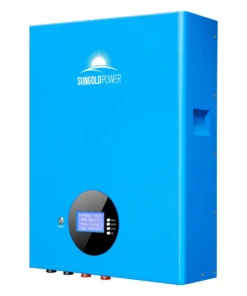
5.12KWH Wall-Mounted LiFePO4 Lithium Battery – Reliable Solar Battery Near Me
Lithium Solar Batteries
48V 100Ah Server Rack LiFePO4 Lithium Battery SG48100P — UL1973 / UL9540A
Lithium Solar Batteries
Lithium Solar Batteries
4× 24V 100Ah LiFePO4 Deep Cycle Lithium Battery — Bluetooth / Self-Heating / IP65
Reviews
There are no reviews yet.