
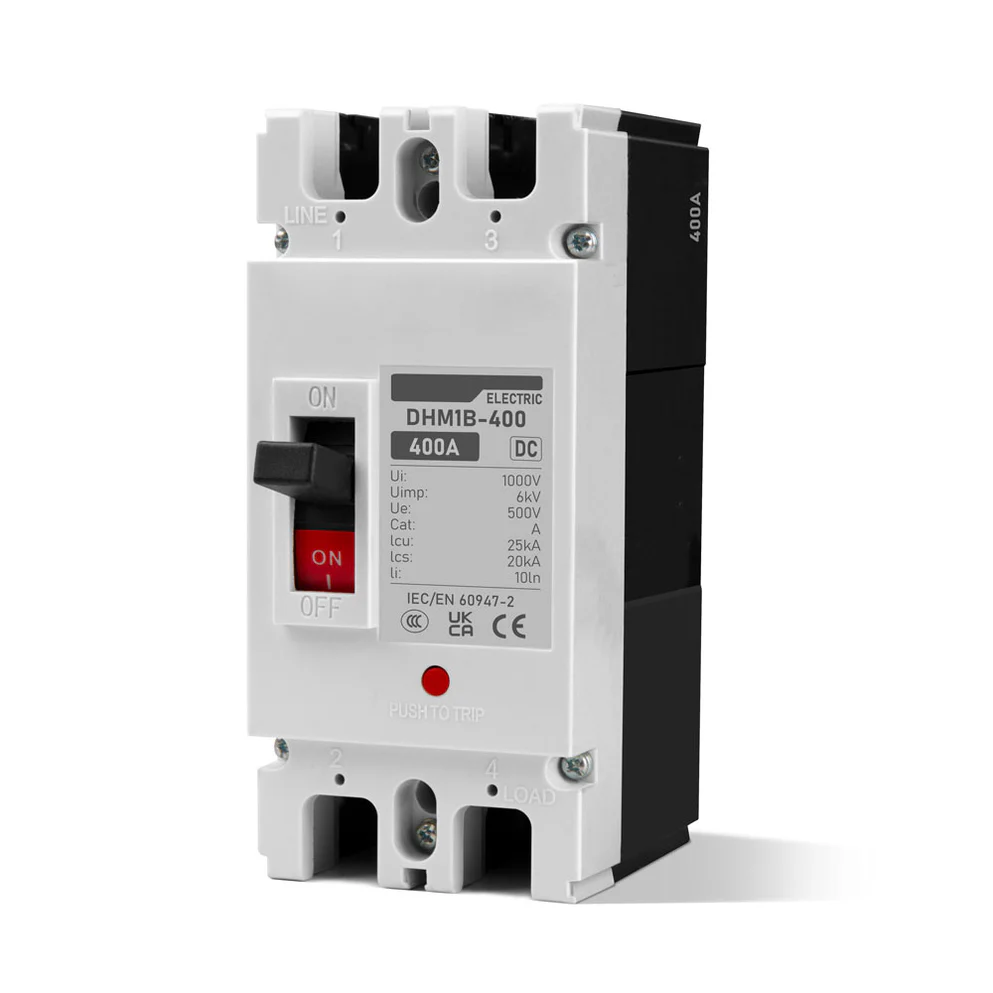
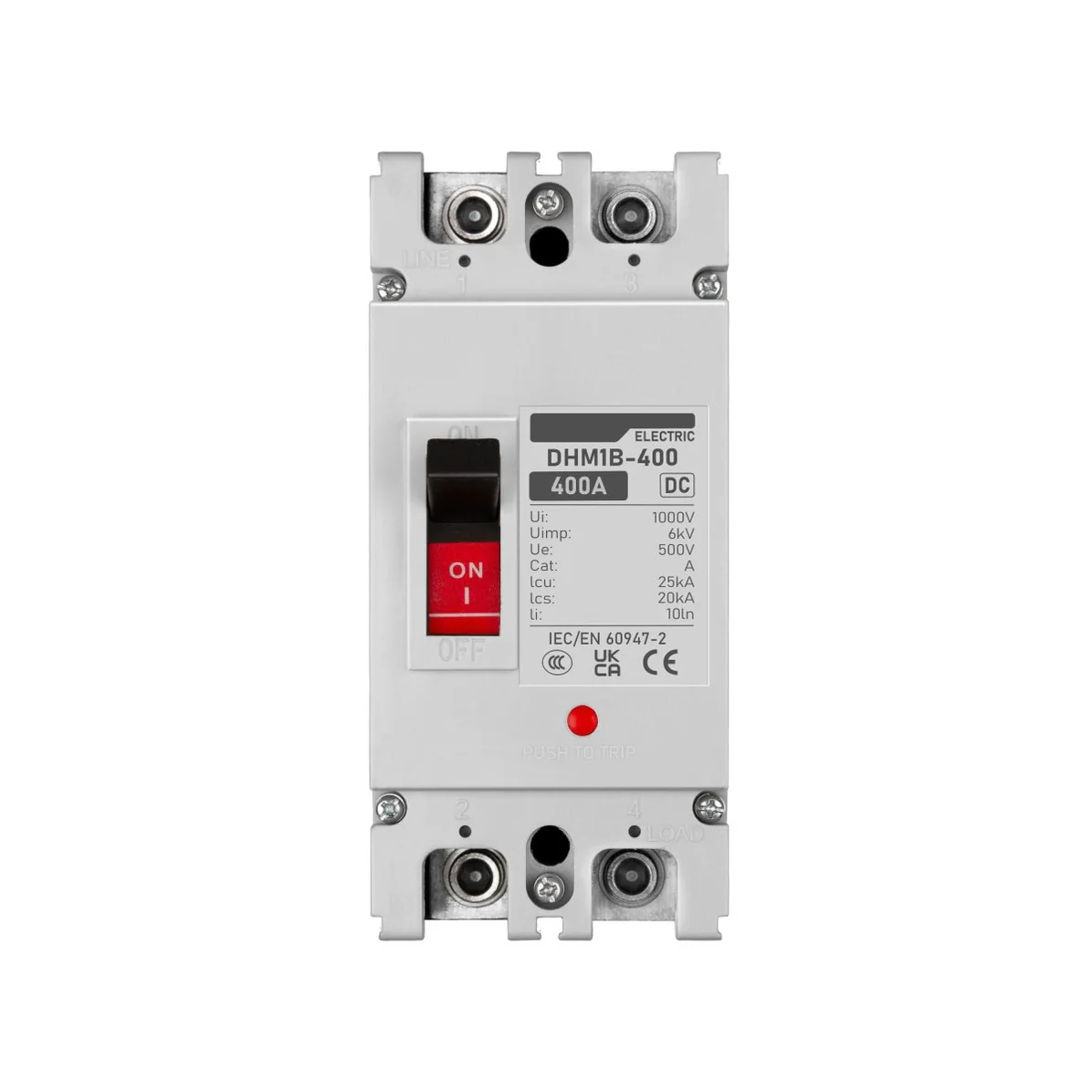
DC Circuit Breaker — 400A Thermal-Magnetic Trip, Solar PV, Battery, Marine, and UPS Protection
This 400A DC circuit breaker provides thermal-magnetic overload protection, isolation circuit capability, and short-circuit protection for high-current DC applications including photovoltaic solar systems, battery banks, UPS systems, marine trolling motor installations, and data centre DC infrastructure. The thermal-magnetic trip mechanism combines two independent fault detection methods — a thermal bimetal element for sustained overload protection and a magnetic element for instantaneous short-circuit response — in a single front-panel accessible unit designed for compartment installation where the breaker face must be reachable from the front without accessing the rear wiring compartment.
Table of Contents
- Thermal-Magnetic Trip — Two Protection Mechanisms in One Device
- DC Circuit Breakers Are Not the Same as AC Breakers — Why This Matters
- Applications: Solar PV, Battery Banks, Marine, and UPS
- Front-Panel Access Design and Compartment Installation
- Frequently Asked Questions
Thermal-Magnetic Trip — Two Protection Mechanisms in One Device
The thermal-magnetic trip mechanism addresses the two fundamentally different electrical fault conditions that circuit protection must handle: sustained overload and instantaneous short circuit.
The thermal element — a bimetal strip — responds to sustained overcurrent by heating and bending until it trips the breaker mechanism. Because it requires time to heat, it tolerates brief current spikes without tripping — motor startup currents, capacitor inrush, and momentary surges that exceed the rated current for a fraction of a second do not cause nuisance trips. The thermal element’s trip time is inversely proportional to the overcurrent magnitude — a 110% overload trips slowly, a 200% overload trips faster, providing graduated protection that matches fault severity to response speed.
The magnetic element responds to instantaneous short-circuit currents — fault currents that can reach ten to twenty times the rated current in milliseconds. The magnetic field generated by this extreme current trips the breaker mechanism electromagnetically, faster than the thermal element could respond. Without this magnetic element, a short-circuit fault would persist long enough to damage wiring insulation, melt conductors, and potentially start a fire before the thermal element responded.
Together, the two mechanisms in this dc circuit breaker protect against the full spectrum of overcurrent conditions: the gradual overload that develops when too many loads are connected, and the sudden fault that occurs when conductors contact or a device fails internally.
DC Circuit Breakers Are Not the Same as AC Breakers — Why This Matters
An AC circuit breaker rated at 400A 240VAC cannot be substituted for a dc circuit breaker in a DC application — this is a safety-critical distinction that is sometimes overlooked.
DC current creates sustained arcs that AC current does not. When an AC circuit breaker interrupts a fault current, the natural zero-crossing of the AC sine wave — which occurs 120 times per second at 60Hz — extinguishes the arc within a half-cycle. DC current has no zero-crossing. When a DC circuit is interrupted under fault conditions, the arc sustains indefinitely until the breaker’s arc extinguishing mechanism quenches it. DC-rated circuit breakers use specific arc chute designs, magnetic arc blow-out systems, and contact gap dimensions that are calibrated for DC arc extinguishing — AC breakers lack these features and will fail catastrophically in a DC short-circuit event.
For solar PV source circuits, this means the DC voltage rating of the breaker must equal or exceed the maximum open-circuit voltage of the string — which at standard test conditions can reach 600V or higher in modern residential installations. Always confirm the specific DC voltage rating of this breaker against the circuit voltage before installation.
Applications: Solar PV, Battery Banks, Marine, and UPS
The 400A rating at DC voltage covers a specific set of high-current DC applications where standard residential AC breakers are both improperly rated and mechanically unsuitable:
- Solar PV disconnect: In an off-grid system, the 400A breaker serves as the main DC disconnect between the battery bank and the inverter — the point where the system can be safely de-energised for maintenance or emergency shutdown without disconnecting at the battery terminals themselves.
- Battery bank protection: Between parallel battery banks and the main busbar, the breaker protects the wiring against short-circuit faults that could otherwise cause catastrophic arc events in a high-energy battery bank.
- Marine trolling motor: High-current DC trolling motor circuits require DC-rated circuit protection — the marine application listed in the product specifications is a common use case for 400A-class dc breakers in large electric boat motor installations.
- UPS and data centre DC: Uninterruptible power supply systems and DC-powered data centre infrastructure both operate at high DC voltages with high fault current potential — the breaker provides isolation and fault protection in both applications.
Front-Panel Access Design and Compartment Installation
The front-panel accessible installation design allows the breaker to be mounted inside an equipment compartment — a battery enclosure, a marine electrical panel, or an off-grid system cabinet — with only the breaker face accessible from the front. Wiring connections on the rear of the breaker are made during installation and remain inside the compartment, protected from accidental contact and mechanical damage.
This is the correct installation approach for high-current DC circuit breakers in any enclosed system — the breaker’s trip button and reset function are accessible for normal use, while the live terminals remain inside the enclosure where they cannot be accidentally contacted during normal operation.
Browse our full DC Circuit Breakers, Solar Accessories, and Off-Grid Power Systems for compatible battery banks, busbars, and complete system protection components.
Frequently Asked Questions
Q: What DC voltage is this breaker rated for? The DC voltage rating is not specified in the available product data. This is the most critical specification for any DC circuit breaker — a breaker must be rated at or above the maximum DC voltage of the circuit it protects, including the open-circuit voltage of solar PV strings under standard test conditions. Confirm the DC voltage rating with SunGoldPower before purchasing for any specific application.
Q: Can DC circuit breakers be used for AC circuits? No. A DC-rated circuit breaker is not certified for AC applications and should not be used as an AC circuit breaker. The trip calibration, arc extinguishing mechanism, and contact gap design are specific to DC fault current characteristics. For AC circuit protection, use an AC-rated breaker with the appropriate AC voltage and amperage ratings.
Q: What is the difference between a circuit breaker for DC voltage and a fuse? Both protect against overcurrent, but a fuse is a one-time protection device that must be replaced after it operates. A circuit breaker is resettable — after a fault is cleared and the cause identified, the breaker is reset manually and returns to service. For a solar or battery system where occasional overload trips may occur during system commissioning or load changes, a resettable breaker is the practical choice over a fuse that requires a replacement carried in spare stock.
Q: What is the interrupt capacity of this breaker? The interrupt capacity — rated in kiloamperes interrupting capacity (kAIC) — specifies the maximum fault current the breaker can safely interrupt without failure. This figure is not provided in the available product data. For battery bank applications where short-circuit fault current can be extremely high — a 48V LiFePO4 bank of 400Ah can deliver thousands of amperes into a short circuit — the interrupt capacity must exceed the prospective fault current of the system. Confirm with SunGoldPower.
Q: Is this DC circuit breakers suitable for a marine installation? DC circuit breakers are the appropriate protection device for marine DC electrical systems, and the product is listed as suitable for boat and trolling motor marine applications. For a marine installation, confirm that the specific breaker carries ABYC (American Boat and Yacht Council) certification or equivalent marine electrical standard compliance before specifying for a surveyed vessel or insured marine installation.
Be the first to review “DC Circuit Breaker 400A Authentic Solar [Thermal Trip]”
Related products
Reviews
There are no reviews yet.